Kevin O'Leary
In the launch episode of Build or Break, Daniel Lubetzky sits down with his Shark Tank co-star Kevin O'Leary — the friend he had to fire at Softkey, the confession he almost didn't make, and the father's grave in Malahide, Ireland he and his brother are returning to restore.
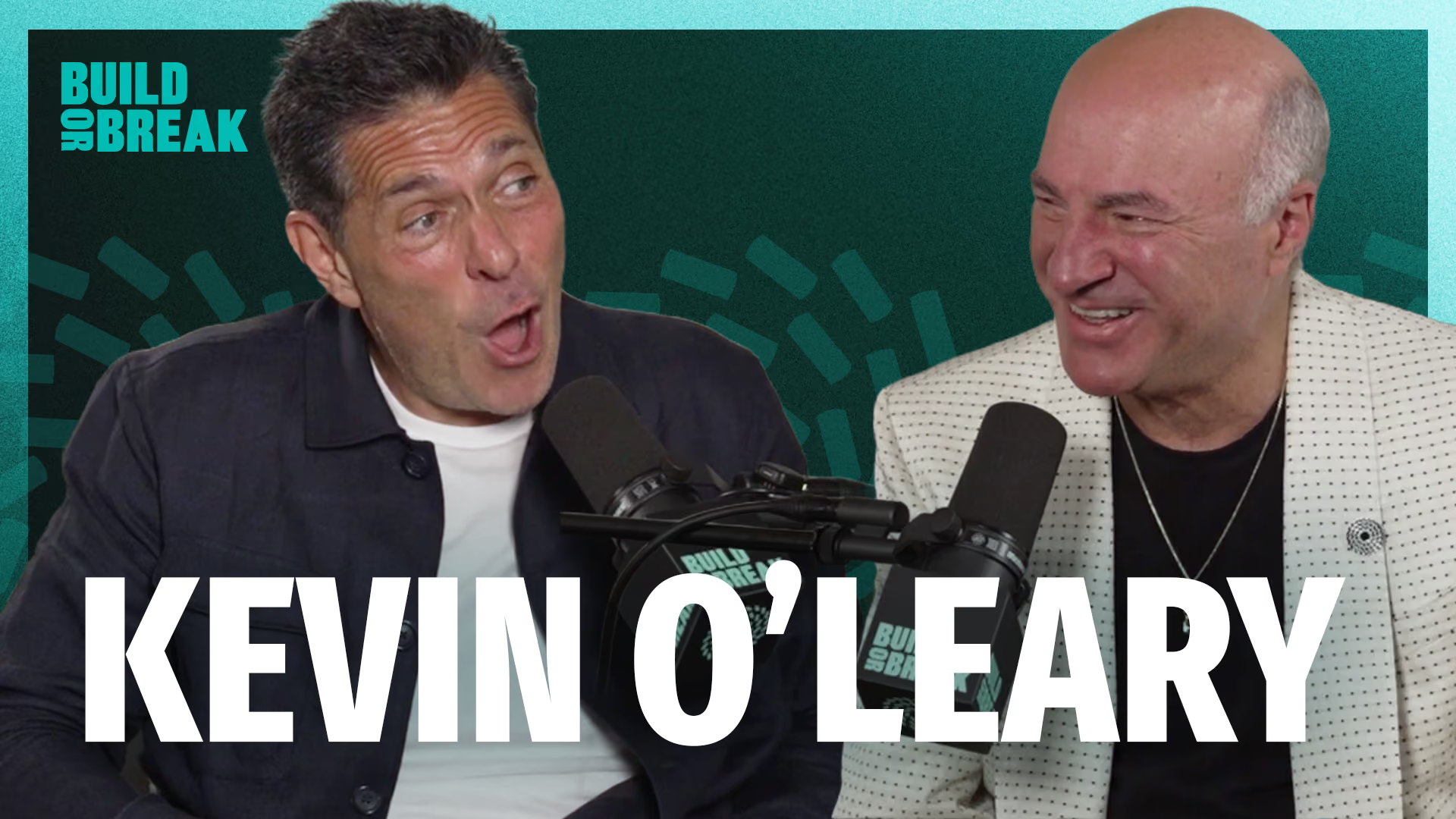
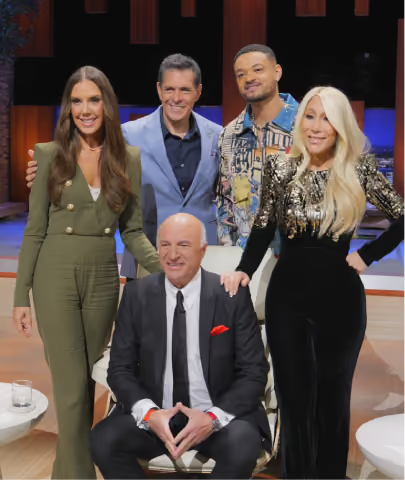
Daniel Lubetzky launches Build or Break with the shark he's shared a carousel with for eight seasons: Kevin O'Leary, Mr. Wonderful — investor in over 80 companies and a fixture of 18 seasons of Shark Tank. The conversation opens light, with the origin of Kevin's twice-a-day shave in a sweltering Canadian barn shooting the original Dragon's Den, and the story of how television found him: dispatched by T.H. Lee's Scott Sperling to buy every digital cable license at a Canadian auction, he got into an on-air fight with reporter Janice Mackie Frayer — "the phones exploded," the producer asked him back the next night, and a TV career was born.
Then Daniel pushes into the worst moments. O'Leary walks through the "valley of death" every founder descends into, and the hardest one of his own: sitting on the steps of the rented house where Softkey Software Products — the company that became The Learning Company and sold for $4.2 billion — was writing code 24 hours a day, realizing the friend he'd started with couldn't cut it. "You can't offset a lack of executional skills with friendship," he says; he fired him, and the relationship is "forever changed." He admits he cried in those early days, and shares the confession he made while dating the woman he was serious about — cheating on a business trip, then calling her the next morning to tell the truth — arguing that brutal honesty, in firings as in love, "is actually the beginning of the healing." He also passes on the signal-vs-noise discipline Steve Jobs gave him around 1992: get three things done a day, keep the ratio 80% signal.
The emotional core is the story teased in the cold open. Kevin's Irish father Terry — a difficult, mentally abusive man — divorced his Lebanese mother and pursued custody of the boys under Quebec's Napoleonic Law. His mother put her sons on planes, moving hotel to hotel through Stockholm, Geneva, Zurich and Paris every two weeks so Terry couldn't find them. They were on their way to court the morning he died, at 37. Decades later, Kevin went back to his father's grave in Malahide, Ireland with his brother, found it in disrepair on historic castle grounds, and is now working with the Irish ambassador in Washington to restore it. He credits his stepfather — an ILO productivity expert who moved the family to Cambodia, Tunisia, Ethiopia and Cyprus every 24 months — as his unsung hero: the man who told teenage Kevin "you're not good enough, you'll never make it" as a photographer and pushed him toward an MBA and a lifetime of option value. And he reveals his mother's secret: 20% of every paycheck into dividend stocks and 7% telco bonds, never touching the principal — a portfolio that stunned him when he became her executor 50-plus years later.
The back half tours the O'Leary empire and its excesses: the $1.5 million hand-stitched Dolce & Gabbana Oscars jacket he insisted on owning, the $12.93 million Jordan-Kobe dual logoman card (a Japanese buyer has already offered $21 million) hung from a 110-carat, 2.2-pound Tiffany chain; O'Leary Digital's data centers, Bid Zero's June 9 IPO built on cheap Norwegian and Finnish power, and the lean 14-person O'Leary Productions mothership. Rapid-fire rounds cover John Mayer's 2 a.m. guitar lesson at Capitol Records ("slow it down by 70%"), paddling Timothée Chalamet on the set of the nine-time-Oscar-nominated Marty Supreme, and why he's against any AI regulation. His closing thesis: "Entrepreneurship is about buying freedom" — he tried retirement, it was boring, and he's having more fun than ever.
Key takeaways
- Every startup descends into a "valley of death" — something horrific happens to every founder, and the job is to emerge from it.
- Friendship can't substitute for execution: O'Leary fired most of the people he started Softkey with, including a close friend, because "the business itself doesn't have any tolerance for friendship versus executional skills."
- Steve Jobs taught him the signal-to-noise rule around 1992: get three important things done each day and keep your attention 80% signal, 20% noise.
- Brutal honesty — whether confessing a betrayal to a partner or telling someone exactly why they're being let go — "is actually the beginning of the healing."
- His mother's secret formula compounded for 50+ years: invest 20% of every paycheck in dividend stocks and bonds, spend only the interest, never touch the principal.
- Optionality beats burn-the-boats: his stepfather's "you'll never make it" pushed him from photography into an MBA, and he now drills option value into his own kids.
- Stop micromanaging — agree on a 12-month goal, give the leader real equity and skin in the game, then get out of the way.
Chapters
00:00 — Cold open: the valley of death and a grave in Ireland
02:02 — The twice-a-day shave, born in a Dragon's Den barn
05:44 — The $1.5M Oscars jacket and the $12.93M Jordan-Kobe card
10:01 — The on-air fight that put Kevin on television
16:25 — Every startup's valley of death and Steve Jobs' signal-vs-noise rule
20:12 — Softkey's worst moments: firing the friend he started with
23:03 — "It did happen to me": the confession he chose to make
27:35 — Paying stars, cutting mediocrity, and steady eddies
35:51 — Inside the empire: O'Leary Digital, Bid Zero, and a 14-person mothership
42:52 — An expat childhood: Cambodia, Tunisia, Ethiopia, Cyprus
45:01 — His mother's secret portfolio and the 20% rule
47:46 — On the run across Europe and the grave in Malahide
52:30 — "You'll never make it": the stepfather who redirected his life
59:55 — The Mexican Inquisition and Build or Break rapid fire
Common questions
What savings rule did Kevin O'Leary learn from his mother?
His mother put 20% of her salary into dividend-paying S&P 500 stocks and telco bonds, spent only the interest and dividends, and never touched the principal. O'Leary's own takeaway: put a little aside in your 20s, leave it in the stock market, and you can't believe what you end up with.
What did Kevin O'Leary say about acting in Marty Supreme?
He had never acted before, so he forgot about the cameras and let the 1952 tablecloths, menus, and clothes put him in the moment. He plans to do one film project a year and wants to keep playing the antagonist, which he calls the richer role.
What is Kevin O'Leary's data center company?
O'Leary Digital is his new data center development company. It has its own CEO, who owns a large stake so he has skin in the game. O'Leary also has a data center company in Norway and Finland that he says just went public on June 9. It was built on a bet on the region's cheap hydro and nuclear power.
What advice does Kevin O'Leary give his kids?
Get option value: have a plan B in case the first attempt doesn't work. He rejects the burn-the-boats approach and says you have to be ready to pivot, a lesson he learned from his stepfather.
About Kevin O'Leary
Kevin O'Leary — "Mr. Wonderful" — is an investor and television personality who co-founded Softkey Software Products, the company that became The Learning Company and sold for $4.2 billion. A shark across 18 seasons of Shark Tank after starting on Canada's Dragon's Den, he has invested in more than 80 companies and now runs ventures including O'Leary Digital, data-center company Bid Zero, and O'Leary Productions. He recently made his acting debut in the nine-time-Oscar-nominated film Marty Supreme.
Kevin: You're going to go down into the valley of death and have to emerge out of it. I've gone back to his grave in Ireland. It was tough. Malahi, my brother. What I've learned is it is impossible to make everybody happy and it's not worth trying. Sometimes you're led astray, particularly early years of the marriage. He said, no, you're not good enough. You'll never make it.
Daniel: In my kind methodology, there's no room for mediocrity.
Kevin: There's risk. You may burn all that time and not make it. Why don't you diversify risk through option? I tell my own kids that. And Timothy came out and said, I don't want another ass. I want my ass because it's going to be mortalized. And they're sitting there holding a card for an hour. You got to think there's a person inside that costume who's going to take a piss.
Daniel: Today's guest and builder break is known for telling the cold hard truth. He's been called brutal, blunt, brilliant, bold, bastard bully, and yet he is beloved by millions. He has invested in over 80 companies, appeared on one of the most watched business shows in television history for 18 seasons and built a financial empire out of a philosophy his mom taught him when he was seven years old. I call him El Senor Maravilloso. Others call him Mr. Wonderful. Welcome to the wonderful Kevin O'Leary.
Kevin: Great to be here. Thank you. Thank you
Daniel: For being here.
Kevin: Yeah.
Daniel: I want to cover a lot of ground, some funny stuff, some serious stuff, but I want to start with the most consequential of questions that I could think about. I've been now recording with you eight years on Shark Tank, and I've noticed you shave twice a day. My skin can't even handle once a day, and you do it for many, many days. Is that basically the essence of who you are, a rugged man that can handle it and I'm a wimp that can't really -
Kevin: I'm a man of routine. And when I started shooting this format, Shark Tank's owned by Sony, it was called Dragon's Den way back. I saw the British version. In Canada. Yeah. So the British version was first and then the Canadian was second in Australia, New Zealand, other countries and now over 50 countries. But we started, Robert and I, together on Dragon's Den in Canada. And it was a really, really bootstrap production. We were in a barn, no air conditioning, and it got really hot at noon. Our makeup would be sweating and caked on your face. So I went into the washroom because it was a toilet back then that was it in a barn and washed it off and I noticed, wow, I've got an afternoon shadow. So I had an electric razor and I shaved it off and then I put the makeup back on. And ever since then, which has to be, it's got to be 25 years ago, I've been doing the same thing when we shoot Shark Tank. And I also am able to sleep for about 20 minutes during the break, which recharges me for the afternoon. I'm very fortunate to be able to nap in airplanes and limos and I'm a big sleep phenomenon.
Daniel: You always joke that you're a vampire and never believed it. But yesterday or a day before yesterday when we were doing makeup, I came in to say hello and you're asleep while sitting. I'm like, maybe this guy does have something.
Kevin: Well, I'm very into longevity these days. I wear an oar ring and I track all of my hours of sleep, how much REM, how much deep. I care about what I eat and all the exercise and everything else. But sleep is the key to longevity actually. People ignore it and they think, "Oh, I'm an entrepreneur. I got to work 20 hours a day." I don't invest in people to do that. They fail ultimately.
Daniel: Yeah. My team teases me because I talked too long about this topic, so we won't go there, but
Kevin: I
Daniel: Had chronic insomnia for 44 years. It's
Kevin: Very tough.
Daniel: I only conquered getting good sleep a year and a half ago and it's completely transformed my life.
Kevin: Well, sleep is a billion dollar plus, multi-billion dollar industry now for people, whether it's bedding or new technology or we've seen so many deals on Shark Tank that have to do with sleep too.
Daniel: Yeah. I believe in it too. Just one more thing before we actually go deeper on Shark Tank. You look so dapper. You're just always looking this good. This is an honest question. When you travel, you travel that elegantly?
Kevin: Yeah. Over the last, I don't know, 10 years, I've started to watch others that are very, very successful. And so much of what I do today is present ideas to people, whether it's in business or whether it's on television or shooting a show or recently acting. And it's an old adage, you only get one shot at doing the first impression. And so particularly now when I'm involved in so many political issues, people have a certain expectation of what I'm going to look like when I arrive somewhere. And most of the time it's the Shark Tank outfit, which has been seen hundreds of millions of times. It's the same black suit, black tie, white shirt, skull cuff links and the red thing. So I want to shake it up. I want to show up looking a little different. And so I've been working with Dolce Cabana, the design team. We have an arrangement. I'll give you -
Daniel: I'm not at that level. I have to pay them to wear their clothes.
Kevin: Yeah. No, the days of free clothing for anybody, unless you're on a movie set where you don't own it, is over. Too
Daniel: Bad.
Kevin: Yeah. But let me give you an example. When it came time to walk the red carpet for the Oscars, we had nine Oscar nominations on Marty Supreme. Every single fashion house reached out to me and said, "Look, what are you wearing for the red carpet?" And the same thing with jewelry. But
Daniel: They did gift it to you or they bring it to
Kevin: You? No, no, no, no. What I said to them, I said, look, let's deter. I chose a jacket, one of a kind jacket that they were trying to sell for $1.5 million.
Daniel: What?
Kevin: Yeah. It took six months to make it. It was hand stitch sequin. It was beautiful. But
Daniel: You kept it or used it
Kevin: Before? I kept it. I refuse ever to wear anything rented, including watches or jewelry. I will not wear something I don't own. But let's
Daniel: Talk about fashion for one second because for me, a $1 million, anything above a thousand dollars seems ridiculous. And I have to tell you, I do not understand fashion. And when I'm on Shark Tank, I look pretty good there. I say so myself, but it's because of Artemis. She dresses me and then I have this cheat where I learned what she did and then I repeat it for the whole year. It's basically my routine. And I find it crazy. I don't understand how one time it's pointy shoes and then I start wearing pointy shoes like, no, no, now it's flat shoes. I almost feel like they're doing it on purpose to keep me confused and keep people buying stuff. You
Kevin: Come into the life of social media. You're on Shark Tank. How you dress, how you look, what you do on major events like the Oscars red carpet stays digital up. It's digital in perpetuity. And so that jacket, there was another piece of jewelry that I negotiated with Tiffany on. I'm very much into collecting cards now, baseball and basketball, sports collecting. It's really remarkable because as an asset class, I got into it last August for the first time. I went in with a syndicate to buy a $12.93 million Jordan Kobe dual Automan logo. And so I though this is crazy. My wife thought it was crazy. We paid 12.93 million. We got offered out of a buyer in Japan $21 million for it. I don't have an asset class that outperformed that. And
Daniel: Also because of the demographic, a lot of men who grew up with that big enough market that it should do better. But
Kevin: Also the Asian market, the Chinese market. Basketball has become a global sport. And so baseball is famous too. But anyways, the idea was to wear that card on the Oscars, how to do that. And I sat down with Nicole Weiss at Tiffany. She's the head of high jewelry for LVMH. And I said, "Let's dream big." The logo for the movie was dream big. I said, "What can we do that would be a big splash on the carpet? Could you design a solid gold chain with diamonds and rubies to hang the card in and I'll wear it with the Dolce?" So the design teams worked together in LA and New York, Milan, Rome, designing this thing, one of a kind piece. A two point weighed, it was 110 carats, 2.2 pounds. Please tell me
Daniel: You borrowed that one.
Kevin: No. So I said, "I'm not borrowing that because they said, look, we'll lend it to you. We'll put it in the museum in New York." I said, "No, I'm not doing that. I don't mind putting it in the museum. I have to own it." We went through a long negotiation because I knew they'd get so much press from this thing. I've been wearing it all over the world now. It's only one in the world. Then I went to Rolex and said, "Can you match this? Is there such a thing as a ruby white gold diamond Rolex? It's mystical. Maybe it exists, maybe it doesn't. It's off catalog." Anyways, they flew it to LA the night before the Oscars and I bought it. But anyways, I wore it. There's a long story, but the presentation was explosive. It went viral. Do
Daniel: You ever feel that, I know this is an asset class that you are actually creating value on, but do you ever feel that taking so much time with all those looks takes away from building businesses?
Kevin: I used to think that. I used to believe that. I'm going to tell you a story that I learned 25 years ago. The VC firm that invested in learning company, the one I sold for 4.2 billion, it was T.H. Lee was one of the main capital T.H. Lee, very famous in Boston. And the guy I loved there was Scott Sperling. He's still running it. And Scott said to me after we exited, he said, "Kevin, why don't you come over here and we'll set you up. We'll give you a fund and you do it all over again.This time you're an investor." I said, "Well, that's interesting, Scott. Okay, let's try that." And I started looking at deals, not from the perspective of running them, like you do now. You were an operator. I was an operator. You were very successful. I was very fortunate as well, but now we're not operators, we're investors. We have made the mistakes. That's what I like to say. And now I can see them coming. But here's what he said. He said, look, I got a phone call because I have a Canadian passport and Canada that year was selling all the digital licenses for the first cable, the movie channels, the dog food channel when that was happening, but you had to be a Canadian to buy the license. So Scott said to me, look, get up there, bid on everything, buy it all. Just buy everything. We don't know which one's going to work. Get up there and buy everything. So I got up there and I started buying everything. I don't know what the price was. I just bought it, whatever they kept bidding it to. With their
Daniel: Backing. Yeah,
Kevin: Of course. And one of the reporters there noticed me and said, listen, can you come on tonight and talk about the auction because you're being an absolutely greedy pig. Nobody's getting a chance to buy anything. You're buying everything. Her name was Janice Mackey Freire. She's very famous now for NBC. She reports from all around the world. We got into a huge fight on television and she started crying. She was upset. She was upset. I wasn't going to take any shit from her. And I'd never done any television before. So I was just having a conversation with somebody tagging me for buying licenses with money. The phones exploded and the producer came and said, Can you come back tomorrow? That's when you discovered
Daniel: Television.
Kevin: Yeah, that's when I discovered television. For real, that was your
Daniel: Original -
Kevin: That was the first time. And we're still in touch. Janice Mackey Ferrer, she's very famous. She's terrific. But
Daniel: That's the moment
Kevin: We learned so
Daniel: Much about -
Kevin: Because I forgot I was on TV. I didn't give a damn.
Daniel: That's when the Cavern Mr. Wonderful was born in some way. Obviously not
Kevin: The name. Yeah, it happened around then, but I started doing TV and more and more TV. And then Scott said to me, "Kevin, in venture capital and private equity, we keep a low demeanor. We stay out of the spotlight. We move in the shadows making investments. We're all uncomfortable with you running around on television everywhere." By now, I was on CNN and everything else. And I said, "Scott, I'm talking our book every day. I'm getting more and more calls from people because they're seeing me on TV. What are you talking about?" He said, "No, no, no, no. We're uncomfortable. We're uncomfortable." Today, he wants to get on TV to talk about T.H. Lee. They all do. Everybody, you look at all the business cable channels. The change, my whole point about this is no, it doesn't disrupt business. It enhances business. Selling your own personal brand, talking about your vision, getting the opportunity to reach millions of people this way all around the world, and you're obviously seeing it happen on Shark Tank for you. Your brand is expanded, but your brand is also your vision for business. And so I don't see, they've completely merged. And I think it's a spectacular way to invest your time. And I probably spend 20 to 30% of my day on television every day.
Daniel: People that watch you on Shark Tank, some people hate you. You play that up for the drama to be the protagonist, that's an antagonist. But I've gotten to know you over eight years. I love you. You're an amazing guy, but there is an essence of that cold, hard truth, you like it like it is. But one of your formative influences was seeing that confrontation with that news person and seeing that it actually worked on television and seeing, oh wow, let me lean into this. Let me be that. And there was an essence of you that had that strong personality that was comfortable saying what needed to be said. My personality, maybe because of me being the son of a Holocaust survivor, I hate confrontation. I can deal with it as you've seen on the tank or behind. If somebody fucks with me, I will fuck with them twice over, but I don't like it. I like to say what needs to be said in a nurturing way, but above all, I like to build bridges. And in some ways it's a weakness because sometimes in the tank, somebody needs to hear something and you sometimes are the only one that has the courage to say it and the rest of us don't have that strength. And you have a brand because you actually just tell it like it is. And so there's nowhere else to go but with that frankness.
Kevin: Yeah. I don't think it's possible to, over a long period of time, not be authentic because the falsehood bleaks out. That's the problem and people sense it right away. What I've learned is it is impossible to make everybody happy and it's not worth trying. So if you have a direction, you have a vision, you have a strategy, you have a mandate, whatever you want to call it, and you want to do something, if you think it's the right thing to do, whatever it is, then just go do it and don't spend any energy worrying about everybody that's trying to stop you.
Daniel: Was there something in your life that taught you to be that way? Just like I think that my primary thing is building bridges to prevent what happened to my dad from happening and to others. What made you have the resilience and the thick skin to say, do what I believe I need to be doing and not worry about what others may say? Well,
Kevin: I'd argue that everybody that's an entrepreneur goes through that because no matter what you think when you start that first business, I remember my first business, you're going to be hit by a hammer. Something's going to happen to you that's brutal.You're going to go down into the valley of death and have to emerge out of it. That's every business being startup. Something horrific happens. And that happened to me multiple times in starting my first software company. Wow, was that hard? And I realized in every day, and I live this way myself, during the period you're awake of every day, and it's the same today that it was 30 years ago. Something euphoric is going to happen, something catastrophic is going to happen. You're going to pick up the phone and it's going to be a disaster. And then 10 minutes later it's, "Oh, somebody called to buy or you're the control shareholder in this business and they want to buy it for 200 million cash." That happened to me yesterday while we're shooting Shark Tank. It just happens. And I've learned now the answer is the concept of signal versus noise. And I've talked about this a lot. All day long, there's the important things coming at you and you have to be able to determine, does that matter? Is that signal or is that noise? Adversaries firing at you is noise because it distracts you from what you need to get done. You're always going to have somebody pissed off about something no matter what you're doing. They don't agree with you. They want to stop you. They're trying to throw whatever it is at you. But if you engage in that, that's noise. It has nothing to do with your goal. I learned this from Steve Jobs. I've talked about this so much because it was a gift he gave me, 92 or something. I don't remember when. During the day, you only need to get three things done. They're important each day. Not the big vision, just three things done. And you have to do those first. Anything that stops you from getting the three things done is noise. So your signal to noise ratio, according to jobs, has to be 80% signal, 20% noise. Noise is when somebody wants to have small talk with you or talk about a show they saw yesterday or a phone call from an aunt or something. I mean, you got to take them. He was 80%. And because he was 80%, he was extremely difficult to work with. He was tough and he was brutal and he was not a nice guy. I mean, but look at what he achieved. And I've only seen one other guy that has a higher ratio, Elon Musk. I've been with him at Mark Burnett's home when he did Shark Tank Christmas parties. The minute he thinks he's in a conversation with three people, four people that he's getting no value about it, he just walks away. He just doesn't want to waste his time and look at what he's achieved. So this idea of signal to noise is going to make you a difficult person. And it has, it has. That's why I have so many critics. He doesn't care about this, he doesn't care about that. I don't care because it's noise. It just doesn't matter to me. And so if it doesn't matter to me, why should I put any energy into it at all?
Daniel: Earlier you talked about how you had major setbacks with your software company. Can you talk to us a little bit about, give us a story of one of the worst setbacks and how you handled it because you talk to entrepreneurs in Shark Tank all the time about taking the tough decisions. Did you ever have so much pain that you wonder whether it made sense for you to be doing what you were doing and how did you handle it? Yeah,
Kevin: I did. And I think every entrepreneur has. I think the first thing - You've cried?
Daniel: Oh
Kevin: Yeah. I mean, I remember the early days of Softkey Software Products was my first company and that emerged in the learning company and that's what eventually was acquired years later. But you go through the startup phase usually with a friend that you start a business with and you make the assumption that they have executional skills. You make the assumption that you start with 10,000 in sales and a million in sales and five million in sales. The problem is you can't, the business itself doesn't have any tolerance for friendship versus executional skills. You can't offset a lack of executional skills with friendship and you have to make the tough decisions. Most of the people I started with, I fired because they couldn't cut it. What was the
Daniel: First time when you had to do it and how did you feel and how did
Kevin: It? It was brutal. Well, I remember sitting on the steps of a home we'd rented to use as an office. We were writing software code in there 24 hours a day and I realized this is the wrong guy. He can't do it. And I have a decision to make. All the other employees are looking at me and saying, "I'm willing to follow you into the valley of death because I think you know what you're doing, so you have responsibility." Then I though about the thousands and thousands of customers we had now in schools and teachers teaching kids reading and math skills, Read a Rabbit, Carmen San Diego, Oregon Trail. These are the titles we were developing. And I though to myself, "Who is my master? Who am I reporting to trying to keep inefficiency in the business even though everybody around me knows this guy has to go?" And that's when I realized, "Wow, I have to do the right thing and I had to whack him." And we have a relationship today, but it is forever changed. There's nothing. I draw the analogy to marriage because everybody goes through this. When you fall in love, you're dating and you fall in love, it's euphoric. It's fantastic. You can't beat it. There's nothing like it. And a lot of people never stay in a relationship because they want that euphoria over and over again. They're serial daters or marriage or whatever it is. But when you get married and reality sets in about how hard it is to maintain a marriage, it's not easy, sometimes you're led astray, particularly early years of the marriage.
Daniel: Astray as in? You
Kevin: Cheat. You're out on a business meeting somewhere, you sleep with somebody else. That
Daniel: Happened to you?
Kevin: Yes, it did happen to me. And you have to make a decision. Do you get up that morning and tell the truth or do you hide it saying they'll never find out about it? Now here's your dilemma. If you call and say, look, I did something horrible last night, and at this point I wasn't married yet. I've been dating somebody seriously and we were on our way to. And I though to myself, I felt guilty and I had a hangover and all that stuff. If I immediately call her, tell her what I did, is that the right thing to do? Is it the right thing to do because I told the truth and that because you think you can hide it, but one day you'll get caught. I made the decision to call her and it was brutal. It was tough and I was out of town, so it was tough. I said, look, this is what happened. I'm sorry. I'm going to try like hell for that never to happen again because I value our relationship so much. The other way to do it is tuck it away, forget about it. But in the long run, you're going to get caught. Something's going to come up. I don't
Daniel: Understand the analogy of that situation to your first degree. Well,
Kevin: I'm going to tell you what it is. Telling the truth, the brutal honesty of why you're letting somebody go is actually the beginning of the healing. First
Daniel: Of all, I'm 100% in agreement with you that transparency and truth sets you free. And by the way, when you don't do that, you make it worse. We've had situations where we didn't want to be mean to person X and we told them, "It's not you, it's me." And guess what? Then they hate you. Mom was like, "Well, why are you letting me go?" So sometimes being fair, look, this is not working. This is not working. This is not working. It cannot work for kind because of these issues. We want to wish you the best, but you're not meant to be here for this, this and these reasons. I think all of us as humans want fairness. And if you're providing the right rationale and the fairness, the person can actually handle it better than if you bullshit your way through. No, it's not you. It's just us. We're restructured. All these bullshit answers that lawyers teach you is like, "Oh, we're restructuring. It's not about you. It's about..." At the end of the day, the person resents you more when you're not being truthful. That said, I also find that in the corporate environment, this thing like fire people like Trump in the apprentices, you're fired. For me, it's so suboptimal relative to as long as a person's not stealing, cheating, something horrible. If they are, then kick them out, report them to the police. But if they're well-meaning people that have a good faith instinct, you provide the truth, you give them a chance to fix it. And if they don't, you find a way to part ways in a way that sets them up and you up for success. For example, with my team members, we have this crazy agreement that if they want to leave, they need to give me two years notice. And if I want to make a change, I need to give them one year's notice. And there's a reason for the two years and the one years because they have to be responsible for their transition. But people almost never -
Kevin: I've never heard of that before, two years. It's a
Daniel: Gentleman's agreement, but
Kevin: It's
Daniel: For the highest level relationships, for people that I trust almost like a marriage relationship. It's a true partnership. But even at KIND, even for early team members, junior team members, we have a 60-day notice. And if you wouldn't give your 60 days, you'd lose your stock options, which were worth millions - That's
Kevin: Written in the contract. That's
Daniel: Written in the contract. But by the inverse, we were not unfair. If you gave those 60 days, we treated you like the team member through the very, very last day and we positioned you for success. We helped. We were references to you. We helped you with. Because if somebody wants to leave to go study or they want to go for another job, why hide it? Why not be transparent and be partners? Then those 60 days, you have the opportunity to look for a person, for this person who was a good team member to replace themselves and train them to pass the baton better and vice versa. As long as there's good faith on both sides, and obviously it's a very high functioning culture where you trust each other, you have good communications. What do you think about that?
Kevin: In any organization as it grows, and I've learned this lesson long time ago, let's say you start with 10 people in your organization and after two years, it's evident that out of those 10, three have extraordinary executional skills. It's about the right ratio. And seven are okay, but just okay. So you have a dilemma and you've undoubtedly faced this. Do you start compensating the ones that are extraordinary performers significantly more than the mediocrity? In
Daniel: My kind methodology, there is no room for mediocrity. The danger is that if you tolerate mediocrity, you're going to move down to that average because the excellent people are going to leave. The mediocre people are never going to leave. They're going to always stay. Nobody wants to hire them. They don't want to leave. And eventually you're in the land of mediocrity and then you do not achieve the potential of your company around. So you have to look for the number six performing people. Nine or 10s you have to invest in to keep them there always and always empower them and strengthen them. It's very, very hard to do. Seven and eights, you need to try to cultivate to become nines and tens. Sixes are the trickiest because people are performing at six. They're not causing any harm. Can a six get to a nine
Kevin: Is the question. No,
Daniel: A six, in my framework, a six cannot. If it's a seven, you have to help drive them to an eigt, take care of them. But if it's a six, it's like mediocre is in them. By the way, this is different from what John Leahy, who was my amazing president that kind, without him, I would have not achieved what I achieved that kind. But John Leahy taught me about steady eddies. Do you know about steady eddies? These
Kevin: Are
Daniel: People that's very different from being a six. These are people that are never going to be hungry to become the CEO, but they're doing their job well. But a steady eddy is essential in an organization because you cannot have a hundred Mr. Wonderfuls in an organization. You kill each other. You have to have people that are striving for excellence and they're hungry and whatever, and you have to have people that are happy with their lot, but they're doing what they do very well.
Kevin: Yeah. I think an army of steady eddies with good leadership is a great business and I get that, but Sometimes it takes a period of time to determine what is the strengths and what are the weaknesses of these people. And some of them have flaws. They're just, for whatever reason, it's not worth the energy to try and fix them because they're broken. But within an organization, an entrepreneurial organization, I look at sort of the one to five million is the startup. Very hard. Very hard. Getting the first million in sales is almost impossible. Then from one to five, really hard. And then when you hit five, all of a sudden you're forced to team build. You have to start hiring people and you're going to find out about yourself. Do you have executional skills to manage people? And that's going to take you from five to 10 million. And I argue to the students I teach, the journey from 10 to 50 is much easier than the journey from one to five or one to 10, because by then you've proven to yourself you know how to hire, fire, manage, build teams, everything else. The journey from 50 to 500, I found very easy.
Daniel: I want to do a little bit of a pivot to just ask for advice from you.
Kevin: Sure.
Daniel: Give us some tips on a couple different things where you're best at. What are some of the areas where. Let's start with Shark Tank. For any entrepreneur that wants to go, for me as a shark, criticize me. Tell me what you've observed. Daniel, honestly, you suck at this. You need to do this better. I don't even understand how you do what you do. Sometimes you're so weedy and so fast. There was that one example that you make me laugh out loud. Do you ever think about these lines or they really, really authentically just come to you so quickly?
Kevin: I think the way of what I learned even way back having been on television for all these years is you have to get to a place where you don't see the cameras, where you are not. This is what I learned in doing Marty Supreme. I've never acted before, but I figured to myself, if you just put me in a room where it's 1952 and the tablecloth is 1952, the menus are, the clothes I'm wearing, everybody's dressed like 1952, then I must be in 1952. And forget about the cameras. Why not just read the room and be in the moment? And I think that's what television is all about, is about being in the moment, that moment, not calculating anything, just saying, "Here we are having this discussion about this topic. I don't see any cameras. I don't see any lights. There's a bunch of guys sitting here talking about someone's business, which we do all day long in Shark Tank." If you get to a place like that, you'll be in harmony with the room. You'll be in a mode of great creativity, I think. But if you're calculating or you're reading your notes or you're trying to remember what you thought you would want to say in a moment like this, that doesn't work. It's not authentic. And the audience can smell that bullshit.
Daniel: I remember the one where you made me laugh out loud. There was one character that was in our costume. Somebody gave some offer and you said, "These characters being in their pants, but the way you said it, I laughed out loud." Did that just come to you?
Kevin: Every time they bring somebody and dress them as a mascot, and the pitches can be an hour long and they're sitting there holding a card for an hour. You got to think there's a person inside that costume who's going to take a piss. I remember once where they had these guys that came out and they stood solid and they locked their knees and one of them passed out. I tried to run from my seat, jump over the table to catch his head because I watched it. It was like slow motion. There's a phenomenon for drummers in football games where if they stand and they lock their knees for more than 11 minutes, the blood doesn't get to their head and they pass out. That's how the body protects itself. It makes it crumble so the blood can start moving again. And so I didn't know this till the medical on Shark Tank, his head hit the cement. Nobody could get there on time. I watched him fall like a tree. And of course we took a break. The medical guys came in. We didn't tape that episode. They never. No, they decided was their liability. You can imagine. Did
Daniel: You think that there's a lot of content in those troves that should be one day. I mean, I find it fascinating how inefficient the.
Kevin: You're right. There's
Daniel: Tens of thousands of companies that apply. Only about 160 get selected, of which maybe only, let's say depending on the season, 100 film, but only maybe 60 or 80 actually air. And then out of the ones that air, 75 or 80% of the content is never seen. There should be a bloopers channel or
Kevin: Something. Well, it gets better because there's AI tools now that can actually analyze the video. This is just in the last nine months where you could take all of the content ever shot on Shark Tank and in a matter of hours, it would pull together incredible moments of TV that have never been seen and it would just give you an index of it.
Daniel: What are some of your organizational tools for. You have so many companies. How do you organize yourself and your team? When
Kevin: We create a new business as we're doing now with data center development, that is O'Leary Digital. Brand new company, new CEO, Paul Paulangen. He's hired a whole bunch of people. He's raised money for it. And so he's operating that business and he and I check in maybe once a day. And we do a lot of stuff in sync about meeting with politicians and going to Washington and all that stuff. And I have a lobbyist for that firm, but it's run by a CEO. It's an end. You
Daniel: Hire a champion
Kevin: For
Daniel: Whatever it is and
Kevin: It's
Daniel: To be somebody that wakes up in the morning, goes to sleep at night, who's best in the world at running it and then you empower them. Do you have a whole -
Kevin: But I not only empower them, that business is 30%. When we created that company, I said, "Okay, you're going to be the guy. What's our deal? What's our deal? Because I want you to have skin in the game. I want you to be at risk." They're a
Daniel: Partner.
Kevin: Yeah, you're a partner, you're not an employee. So I'm the largest shareholder, but he owns a huge piece. And every time he brings in someone, we equally take the dilution. So he feels the pain.
Daniel: Oh, he's part of the -
Kevin: Yeah. So we started at 70 / 30. I bet you he's down to 24 and I'm probably down - So
Daniel: He has to consciously decide, is it worth it to bring this
Kevin: Person? Kevin
Daniel: Will be diluted more, but I'll be diluted.
Kevin: And that's the only way to do it because if you don't do that, you're not taking risk in bringing people in. The
Daniel: Other format that exists is that you hire the CEO, they get their stock option, everybody else gets their stock options, and there's a stock option pool that CEO does not have to "suffer from" or be diluted from.
Kevin: Yeah, I don't believe in that
Daniel: Model. I like your model. But is there O'Leary Enterprises that. Is there somebody only you there or are each of these entities completely separate from the other or is there
Kevin: Somebody? There are many entities, but the mothership is O'Leary Productions and it exists in multiple countries. I'm 100% shareholder of that. But
Daniel: That's lean and mean, right?
Kevin: It's very lean and mean.
Daniel: How many people do you have there?
Kevin: 14.
Daniel: 14. And what's legal? What do you -
Kevin: Legal, accounting. It's more corporate because it also owns rights to IP of stuff that we own and brands that we own. But what I've been doing lately, because I think maybe it's a lot to do with technology, let's say for example, accounting, which is important and compliance. These are important because I operate in many. I have positions in many public companies. I've started them as startups. They're now listed. And one of them, Bid Zero, just went public on June 9th. That's my data center company in Norway and Finland. That started, like you and I right now, that started six years ago, two guys talking saying, "The cheapest power in the world. Is in Norway and Finland. Why don't we just bet on power? Why don't we just go buy land with-"
Daniel: Because of hydro or because of the oil or both?
Kevin: No, because they have hydro and they have nuclear power. So the cheapest on earth is one cent a kilowatt hour in Saudi Arabia, but there's stability issues in that region for data centers. So my thinking was with my partners, there was four of us. And this woman approached me said, "Look, I worked for one of the top accounting firms and I'm splitting away and I'm going to create a service providing platform. Why don't you let me do all of your bookkeeping and accounting and pay me to be the HR for all accounting? I hire, I fire, I deliver your reports when you want. I design anything you want and I build a team just for you and your company." I though, damn, that's interesting because I have to manage the HR of all the accounting people that are doing it. And let's say for example, WonderCare, my watch insurance company, there comes a point where I'm not the control shareholder. I hire a CEO, we raise money, other partners, and all of a sudden I'm under 50%, yet it's sitting inside of my holding company. I want it to be like a child graduating from college. It's got to go on its own. So now I'm using all these outside entities as service providers for these breakaways. It's a new model. It lets me be much leaner, pay much more to the few people that are left.
Daniel: What do you do, for example, with technology? Do you have someone that's insane trying to help all the portfolio companies or each of the portfolio companies needs to figure out their way?
Kevin: Yeah, I tried both ways. I've tried both ways. I've heard that a lot too. Centralized IT, it doesn't work. You have to let each company find their person or service provider and operate because let me give you an example. AI platforms, do you use ChatGPT? Do you use Claude, whatever? So I finally said, we were using so many tokens. It was our number one growing expense on the income statement for my hold co, all the AI costs. And so I said to the team, "Okay, everybody, I'm going to be democratic. I'm taking my vote out. You guys decide choose one platform and we're going to buy an enterprise license. We're going to negotiate for an enterprise license," because we were spending hundreds of thousands of dollars a month. So they chose Claude. I'd never used it. I had to relearn it and now I'm a Claude user, but we have an enterprise license. We cut our costs 30%. And so other companies are coming to me saying, "What are you using?" I'm saying, "Why don't we do a buying cooperative for these technologies?" So in cases like that in the new world, I think cooperatives are going to start television advertising. Maybe I spent five million a month in the different companies. I'm now buying remnant cable collectively. So there's ways to have the idea of a Japanese philosophy of cooperation with competitors to save costs. And I learned this from Switzerland too. The Swiss do a lot of interesting things across pharmaceuticals where they compete with each other, but they also aggregate for buying services or hiring people as apprentices. So cooperation is a new word in my lexicon of things I do.
Daniel: Something that I don't think enough people understand about you is you truly are very knowledgeable and you are a man of the world. You're talking about Japan, the Emirates, Saudi Arabia, Norway, Finland, United States, Canada. I seem to recall that you told me that you lived in a lot of countries as a kid. Can you remind us, how did you develop this knowledge base? So
Kevin: What happened when I was very young, my dad died when he was 37. My biological Irish father married to my Lebanese mother and my mother remarried. How
Daniel: Old were you?
Kevin: I think I was nine years old. We moved to Champaign Urbana, Illinois where the University of Illinois is because my stepfather was graduating out of engineering and I think management science at the time. It wasn't called an MBA. He went to work for the ILO, the International Labor Organization as an expert in productivity. His mandate was to move every 24 months to different countries. So we started in Cambodia, Tunisia, Ethiopia, Cyprus. I thought this was how everybody lived. I was living in new countries. I met Hailey Selassie. I met Paul Pott, I met Sinook. I met them all. I met all these people because I was an expat in a country, you'd be working with the government or whatever. I remember it being a cocktail party with Paul Pott, the guy that went crazy and killed everybody. So
Daniel: You're born in Montreal, born
Kevin: In
Daniel: Montreal?
Kevin: Yeah.
Daniel: At nine, start traveling like crazy. I
Kevin: Just moved every two years.
Daniel: Did that teach you to build bridges, to connect with people?
Kevin: Yeah. I'm also learning the culture, the philosophy of the French because they colonize Cambodia. Japan is completely different in the Zen way they live. All of these in Germany's different. France is different. England's different, but I'm very comfortable going anywhere in the world now. As a
Daniel: Kid, you said your mom was Lebanese, but
Kevin: I
Daniel: Feel like the Lebanese entrepreneurial spirit is insane. Unbelievable. In Mexico, the richest person in Mexico and among the richest in the world is a Lebanese Mexican. And the Lebanese community in Mexico that I grew up with, they're incredible business people. And then also in New York, I mean, there's something in the Lebanese DNA. They're very, very good merchants.
Kevin: They're big in real estate. Any city they go populate.
Daniel: Do you think that in some way, the
Kevin: DNA,
Daniel: Your mom. What was the thing that you said that your mom taught you about?
Kevin: She basically said, because she was very worried after being divorced from Terry, my father, about financial independence. She never, after that experience, ever let anybody tell her what to do with her money. She kept it sequestered for herself and she would take 20% of it. Back then they paid them in cash each week. She worked for her father at a company called Kitty's Togs that made winter clothing for children. When she got paid, she took 20% of her salary, invested in stocks that paid dividends in the S&P 500 and telco bonds, which were paying 7% back then for as long as five to seven years. And her philosophy was, "I'm only going to spend the interest or the dividend. I'm never going to touch the principal." And during the 50 plus years of that portfolio that she kept it secret, when she passed away, I became the executor. I'm the older brother. I couldn't believe what she'd amassed. I mean, if you just put a little bit aside when you're in your 20s and stick it in the stock market and forget about it, you can't believe what you end up with. It compounds at eight to 9% a year, sometimes 12%. You just don't know. The years go up and down through the market, but you should not bet against the North American economy. Do you
Daniel: Miss your mom? Oh,
Kevin: Of course. I mean, who doesn't? So
Daniel: You said around the ages nine, earlier you said you were dyslexic. Yeah.
Kevin: And
Daniel: Your dad passed away and your stepfather took in, but she had already divorced your father.
Kevin: Yeah, but she stuck with her second husband for the rest of her life and he still - But were you
Daniel: Close to your biological father or no?
Kevin: I was. He was a difficult man. I probably have some of his traits. He was probably an alcoholic. I don't know. He was abusive to my mother. There's no question, but that's why they got divorced. He was also very - Was he abusive to
Daniel: You?
Kevin: No, he never. I don't mean abusive physically. I mean, he was mentally abusive. I'm just telling the truth here. And he was very kind to my brother and I, but being in a. A divorce is extremely tough on kids. You don't know how it affects them long term, but he didn't last long. He got divorced and then he died. And back then they called it thrombosis. We don't know what happened. How do you think
Daniel: That impacted you? I
Kevin: Don't know, but what happened was he was pursuing to get control of my brother and I away from my mother. In Quebec, in Montreal, it's Napoleonic Law, so it favors the man. And so he basically wanted us to live with him. Were you
Daniel: Scared of that? Well,
Kevin: I didn't know what was happening, so my mother decided to get on an airplane with the two of us and start going to cities like Stockholm, Geneva, Zurich, Paris, every two weeks moving from hotel to hotel so Terry couldn't find us. And didn't
Daniel: Quite understand what I
Kevin: Did. I was probably six. My brother was four or five. I can't remember how old he was, but we would wake up in hotels in different cities there every week. But were
Daniel: You having fun or were you traumatized?
Kevin: No, no. For me, I was having fun. I was just wondering why we're moving around so much. But
Daniel: There was something going on in her that -
Kevin: Yeah. She was scared out of her mind that the judge was going to. They were actually on the way to court when he died. He didn't make it one morning. He was dead in his apartment. That's when that whole thing ended. It was tough because it was so traumatic and so difficult for her. She just sat us down one day said, "Look, your father's passed away." And we didn't even know what that meant. So I've gone back to his grave in Ireland. It was tough in Malahi with my brother. Thank you. Very tough. The thing was in disrepair, and so my brother and I are going to restore it. We're going to the city and I've talked to the Irish ambassador in Washington to help me do this because it's very hard to go to a historic land site and make modifications because it's in a castle. So we're going to restore his grave.
Daniel: Well, what's interesting from what you're saying is your stepfather stepped in, you lived an incredible life. Those early years were filled with complex feelings, which sounds like he loved you and treated you guys well, but he was difficult with your mom and you guys were. And that you're going back every few years to
Kevin: Ireland. I don't think I'd be the person I am today with Terry. I don't think that would've been the outcome, but my original father. But then
Daniel: Why do you go back to Ireland?
Kevin: Well, I think.
Daniel: It's still at the end you -
Kevin: Yes, I still remember him. This topic is difficult because I have such allegiance to my stepfather who's 96. And this year I'm getting the whole family together. I'm sending planes around to pick everybody up. He will not get on a commercial aircraft. 96 years old, he's not going through customs. Where does he
Daniel: Live? He
Kevin: Lives in Geneva. He's Swiss. He's now a Swiss citizen. Now my mother lived there for. Listen, he has a home overlooking Lake Geneva that's beautiful. French Swiss?
Daniel: Yeah,
Kevin: It's beautiful. And so she lived there too. Georgette lived there, and over time, they really loved being Swiss. She became a Swiss citizen too. I think my brother and I are the oldest man in history to be adopted in Switzerland. Do you
Daniel: Realize you and I have a very strong connection with Switzerland?
Kevin: Yeah.
Daniel: My grandfather survived the Holocaust, went to Mexico, built a business with my dad, duty for business in the watch business. I don't know if you
Kevin: Remember
Daniel: That.
Kevin: Yeah, the Rolex dealership. And
Daniel: Then my grandfather moved to Switzerland and he's buried in Switzerland. That's
Kevin: Very rare. Yeah.
Daniel: I
Kevin: Mean, the Swiss are very protective of every inch of their soil. And
Daniel: I have a very romantic connection to Switzerland because I used to accompany my dad to the watch fairs because he eventually got the concessions for duty free from -
Kevin: That was in the city of Burn you first went to. Yeah. That's now moved to Geneva. It's called Watches in Wonder. I go every year. And
Daniel: Do you think part of why you're so in love with watches is because of your stepfather?
Kevin: Undoubtedly, because I bought my first watch in the '70s, the moon watch, the one that was designed to go into space, or wasn't designed to go to space, it went to space. That's my first watch. I still have it. I have many, many watches now, but they're very emotional because you remember your time of your life when you get them. I think for men, it's one of the pieces of jewelry that they can get, and I wear too. And these are very rare pieces. Yeah, I wear it too. I have extraordinary watches now. Does your
Daniel: Stepdad know how much impacted you? Does he appreciate the
Kevin: Difference? We still talk about it. In fact, I took him to the F.P. Jorn factory to meet F.P. Jorn and the team in Geneva, and he's met Simon Britt, who's making. Simon Britt is one of the hottest watchmakers in the world right now.
Daniel: What were some of the things that he imparted on you that you said you would not be where you're at today without him and if your dad had been your dad and raised you would've been very different outcome for you. What did your stepfather do?
Kevin: I'll tell you, that's a great question because I remember in high school, in Ottawa, I was in high school in Ottawa at this point. I said, "Look, I want to be a photographer.That's my career. I want to be a photographer," because I was developing my own film. I was shooting and I still have those images actually. He said, "No, you're not good enough. You'll never make it." And so what you need to do is to get option value for your career. And I suggest what you do is finish high school and try and get into college because your marks are such shit because they weren't that great. And so I got into environmental studies. When I graduated, I said, "I want to go back to pre-photography." He said, "No, you're going to fail because environmental studies in those days meant nothing and now they matter a lot." But he said, "Why don't you go get an MBA? Why don't you go and see if they'll let you in and get a business degree? That way you have all the optionality in the world." And he was right. So he pushed me into postgraduate work. I came out of that MBA with perfect marks because I convinced the dean to let me make a film over the two years. And I said, "Judge the film as a recruitment film. If it's a tool that works, mark me on my ability to capture this two-year journey on film. I'll edit it. I'll cut it and let me off two courses. Give me enough time to do it." And he did, and I created the first recruitment film that really worked for them. Kerry,
Daniel: You know what I love about what you just said? It puts together everything about you, meaning you love business and you love filmmaking and movies and entertainment. That's Shark Tank, that's Dragon's Den, that's Marty Supreme, that's your life. It goes back to that period when you
Kevin: Would
Daniel: Create a film about the business. Right.
Kevin: I mean, I still to this day, I think that's good for anybody to have a blend of yin and yang and the chaos of arts versus the discipline of business, which is binary. Either you make money or lose money versus arts, which is you have an idea and you want to be creative about it and see where it goes. I still cut each week one social media post with Premier Pro to keep my chops up. I sit down. I have a huge editing facility. The funny thing is I couldn't afford any cameras when I wanted to be a photographer. And just despite my dad, I bought every camera when I got out and started making money. I have a massive camera collection of Hasselblads and Leicas and vintage stuff, and I do all the digital stuff and I shoot everything. To me, it's very relaxing. Last night when we finished Shark Tank, I was so fried. You know how it drains you, right? That's tough to sit there and do all those deals, keep yourself sharp. I went into the bar downstairs in this hotel. I ordered a bottle of Montrechet, a very good one, and some great fish. I pulled out my laptop and I edited all of the photos I'd been taking for the last few days. Very relaxing to do that. I sent them out. Artemis got one and Mindy got some and they're very appreciative. Your
Daniel: Stepdad, when he told you you're not going to make it as a photographer, that was an important moment for you, both because he then pivoted you, but was it also that he was speaking truth to you and that's who you became to be comfortable with just saying what needs to be said? Do you think that that was an essential moment or am I reading too much into it? No,
Kevin: You may be right. Maybe what he was trying to do is to challenge me to go get motivated to prove him wrong, which is what's happened in data centers, for example. Anytime anybody says you can't do it, I go do it and I do it over and over again. I don't always - You
Daniel: Were born with that.
Kevin: But he was trying to say, look, there's risk. You may not make it. You may burn all that time and not make it. Why don't you diversify risk through option? And I tell my own kids that. Option value is a big thing in my family. I say, Trevor, what's the option? Get some option value in this strategy just in case it doesn't work. What's the option? What's the B plan? What are you going to do? And some guys say, well, they're burn the boats. There's no B plan. Bullshit. You have to have a strategy in case it doesn't work on the first attempt. Pivot. You got to pivot. I pivot all the time.
Daniel: Your strategy in life is very connected to creating that optionality. He taught you that
Kevin: Very
Daniel: Valuable thing. By the way, the best business people are not like me where I risked everything, but when you create more upside and no downside, that works out better. So if you
Kevin: Can create optionality - Everybody likes. You somehow built this huge business with a brand that stayed intact with this message of kind, and it's also the name of the company obviously, but that's very powerful in terms of incremental choice in the snacking category where you have so many choices. I always reach for the kind because I understand the brand versus all the other shit out there. And there's a lot of it and that category remains brutally competitive. So I don't think you had a strategy. I think you figured out I'm going to try this. And when you saw it working, you stuck with it. That's what I think. No,
Daniel: We kind of had it, but it evolved and changed. But I want to just end with where you were a minute ago about Shark Tank. I am in Marvel of you because I'll shoot two, three days in one season and I am fried. And to your point, days go by and I'm processing because it's very intense. You do the entire season. I don't even understand. Do you have a tool for how to not get tired, demotivated, confused? For me, it's hard to keep up with all these companies.
Kevin: No, I learned years and years and years ago. I think what's important is when you finish the pitch, in the morning pitches, flush them out of your brain. Forget about them. Oh,
Daniel: You actually do the
Kevin: Opposite of what I thought. I don't remember what we shot in the morning and I've intentionally done that to myself so that I can absorb - So you can have a
Daniel: Clean slate. I have
Kevin: A clean slate. I don't let the decision from the morning take - Why didn't
Daniel: You tell me this eight years ago? I would've been a better
Kevin: Shot. Because the thing is you'll learn it on your own. I don't remember. I have to go to Matt, my analyst, who comes here for all the pitches say, "Okay, what do we do this season?" And we nickname them all, whether it's this or that. And the thing I've learned, which I think is so great about Shark Tank, and obviously you've been around long enough to know this, you go through a season, you do, I don't know, 10, 12 deals, whatever it is, and you think you're so sure about the three winners. You think you know - And then you get
Daniel: Surprised. You
Kevin: Get completely surprised. Ebay
Daniel: Windows then.
Kevin: 36 months later, four months later, four or five years later, you have no idea what's going to happen because it could be the market, it could be the individual, it could be just sheer luck. I've been amazed at the journey. I've been amazed at the outcomes. I can't believe Base Paws and Fallicious and all this stuff. They were not my winners. Okay.
Daniel: We're going to pivot to something called the Mexican inquisition. So I'm going to ask you questions you need to try to think about hard and fast.
Kevin: Okay.
Daniel: Ready? Name an unsung hero who helped you get here.
Kevin: My stepfather, for sure. I mean, he's unsung, but without him I wouldn't be here. Yeah.
Daniel: What is a question I should have asked you that you've never been asked or that I should have asked you today and I missed out on?
Kevin: How good a guitarist are you?
Daniel: I've seen you perform on the tank. You're doing real.
Kevin: Well, I'm learning that. Remember John Mayer came, maybe you don't remember this, he came to the set.
Daniel: Who did?
Kevin: John Mayer came to Shark Tank. He's a Shark Tank fan. He wanted to take a picture in the chairs. And he said, "Look, I'm recording. Why don't you come down to my studio tonight? I'm going to record at two in the morning." And I went down there at two in the morning in LA to Capitol Records with Linda, my wife, and watched him record his new album. And he said, "Why don't you play for me?" And I played Jimi Hendrix's original guitar that he had there. And he said to me, "Kevin, you're trying to be too fast. Everything you're doing is too fast. Why don't you slow it down by 70%? Hold the note longer, do it slower, have more feeling. And that's much harder to do." And that's why I realized, wow, there's something to look up for.um
Daniel: That advice about life.
Kevin: Yeah, maybe.
Daniel: We move so fast
Kevin: And
Daniel: Everything that I find that if you slow it down, you're actually better at
Kevin: It. Yeah, I think that's great. It's a great lesson is arts towards life. That's a good question.
Daniel: Who's a historical figure that you wish you could have lunch with?
Kevin: Bismarck, best negotiator in history. He had the innate ability to read a person within moments and knew right away their strengths and their weaknesses. That is a great asset to be able to do that. It doesn't matter what generation, what era you're in, even 200 years ago, it doesn't matter.
Daniel: What's something you've changed your mind on over the last year?
Kevin: I don't micromanage anymore at all. I find a leader, put them in place, tell them, "Let's agree on a goal over the next 12 months. If you don't make it, I whack you. But I'm not going to tell you what to do because I'm funding you."
Daniel: When did you figure that out? Because I used to be a micromanager, but I figured it out early on too. You cannot micromanage. You either empower people to get it done. If it's not working out, you let them
Kevin: Know. But I'm talking completely safaire. I don't mind giving advice if I've asked for it, but I don't tell them what to do. It's working. There comes a point where you got to let go and it's just happening for me now.
Daniel: What drives you?
Kevin: I just like to be in the game like you do. I mean, I'm very interested in just being in the game. I don't know what else I would do. I tried retirement. It was very boring. I'm having more fun than I've ever had in my life. I'm working harder than I ever have. I do four, sometimes five cities in one day. I'm involved in crazy stuff. I mean, just crazy stuff. And something you've obviously figured out is Shark Tank has opened doors for me around the world. All
Daniel: Right. Now we're going to do one last section. This one really is rapid
Kevin: Fire.
Daniel: Ready? Build or Break. If you like it, you go like this. If it's break,
Kevin: You say
Daniel: Build or Break.
Kevin: Okay.
Daniel: Build or Break the butt of a young celebrity.
Kevin: Build.
Daniel: We're talking about that.
Kevin: Marty Supreme. Do you know the story there? There was a stunt double at three in the morning and they used to bring in the stunt because we're not going to whack Chalamet's ass, too risky. And then Timothy came out and said, "I don't want another ass. I want my ass because it's going to be immortalized." I said, "You don't want me to hit you like this." He said, "Go ahead." And I tried to slow down the paddle. And the director said, "You're holding back and it's showing up and it's not good. It's not good."
Daniel: I love that story. I love that story. Build or Break, seven guest sharks on last season.
Kevin: Break.
Daniel: Yeah, it was too many.
Kevin: Too many. Too many.
Daniel: I think guest sharks are really, really valuable to me.
Kevin: No, they are, but you can't do that many.
Daniel: Build or Break filming a whole season in one period.
Kevin: I'm for that. Build. I like to get it over with, get it done.
Daniel: But it's not overwhelming to you because you have
Kevin: The - No. In the old days I used to do 22 episodes all in a row, no breaks. No
Daniel: Breaks. What?
Kevin: No breaks.
Daniel: I don't understand that. You're a real man. And you shave twice in a day. Build or Break, poutine.
Kevin: Break because I don't eat carbs like that anymore.
Daniel: Putin is a Canadian.
Kevin: It's potato dish. It's french fries with sauce on it.
Daniel: I tried it.
Kevin: Very rich. I couldn't get into it. It's thousand calories.
Daniel: Build or Break AI regulation.
Kevin: Break. I don't want any regulation on AI. None whatsoever. No. I want innovation, no regulation, but that's not what's going to happen. The Chinese don't regulate AI. We're competing with them. That's what's going on.
Daniel: Build or Break craft services for scripted movies.
Kevin: Build.
Daniel: I just found that funny in one of your interviews. There's different types of hierarchies. The unscripted, we get treated like the poppers compared to
Kevin: Marty - When I was shooting Marty Supreme, it's a different level of support because you're working 18 to 20 hours all night. You need nourishment. It's different. Shooting a film is just different and it's interesting and different. And I'm going to do it again. I'm going to do one project a year. I've looked at three scripts. They're all shit so far.
Daniel: But honestly, Marty Supreme, what a movie. You invited us to a premiere. We enjoyed it. We were all stunned at how great a job you did, but on the other side, it was you and the director -
Kevin: Josh Safti.
Daniel: Joe Safti talked about how he was looking for the essence of the character. And I talked to him afterwards and he looks for people that inhabit that character. Do you plan to do stuff that's not?
Kevin: No, I want to stay the antagonist. It's a richer role. I'm looking for bad guy roles. I think there's much more interesting elements to explore when you're the bad guy. I mean, it's better for me, for what I do. And everybody thinks I'm the bad guy anyway, so it's an easy role to get into. But I think if you read scripts and you have an antagonist, it's always a richer role. And that's what I want to do.
Daniel: But you don't see any tension between you continuing to build a multi-billion dollar business empire, you being in the news as a commentator and you being a movie actor. For you, they all can -
Kevin: I don't spend any time worrying about it. I think everybody should have. Entrepreneurship is about buying freedom. It's not about the pursuit of greed. I can do anything I want and why don't I?People say, "Well, aren't you worried about what people think about that?" I don't even spend a second worrying about that. I don't care. How can you possibly spend any of your energy worrying about what someone else thinks? You answer to yourself. It's what you think that matters. And I think that's something every young person should think a lot about. Don't try and please everybody because you can't. You should worry about your close friends, your family, your children, your wife, your parents. They matter. You should listen to them. But if you're going to be involved in the media, there's millions of people and you can't make them all happy. You just can't, and you shouldn't try.
Daniel: And on that note, we're in. Thank
Kevin: You.
Daniel: That amazing. We want you to become a builder with us. So subscribe to Build or Break now and leave us a comment or our review. We're trying to build a movement and you can be part of it by hitting the notification bell and telling us what you think about this episode and by telling all your friends to watch too. Thank you.
Watch Build or Break on YouTube
Listen on Spotify, Apple Podcasts, or Amazon Music
Follow Daniel Lubetzky on Instagram and TikTok
Become a Builder: buildersmovement.org
https://www.instagram.com/kevinolearytv/
https://www.youtube.com/@kevinoleary
https://www.tiktok.com/@kevinolearytv
https://x.com/kevinolearytv
https://www.linkedin.com/in/kevinolearytv/
Personal site: https://kevinoleary.com
O'Leary Ventures: https://olearyventures.com
Shark Tank profile: https://sharktankgroup.com/kevin-oleary.html
Kevin O'Leary
Mr. Wonderful
Shark Tank
Dragon's Den
Softkey Software Products
The Learning Company
T.H. Lee
Scott Sperling
O'Leary Digital
Bid Zero
WonderCare
O'Leary Productions
Music: Amos Cochran https://www.editscoremusic.com/
Production: Straybird Studios https://www.straybird.studio/
Post Production: Jennell Lewis & Scott Convery
Social Media Production: https://www.edits-etc.com/
Build or Break Team:
- Executive Producer & Host: Daniel Lubetzky
- Executive Producer: Kristin Schneider
- Head of Programming & Production: Joel Rubin
- Marketing & Communications: Sarah Black
- Associate Producer & Social Media: Taylor Larned
- Booking & Scheduling: Kayla Rose
- Network Relations: Julianna Cohen

Become a Builder
Sign up for episodes, ideas and advice from Daniel