Chris Paul
On Build or Break, fresh off retiring after 21 NBA seasons, Chris Paul tells Daniel Lubetzky about the Clippers exit he calls "one of the most disrespectful things I've endured," the night his crushed hand sent him into shock, and the 61-point game he played five days after his grandfather was murdered.
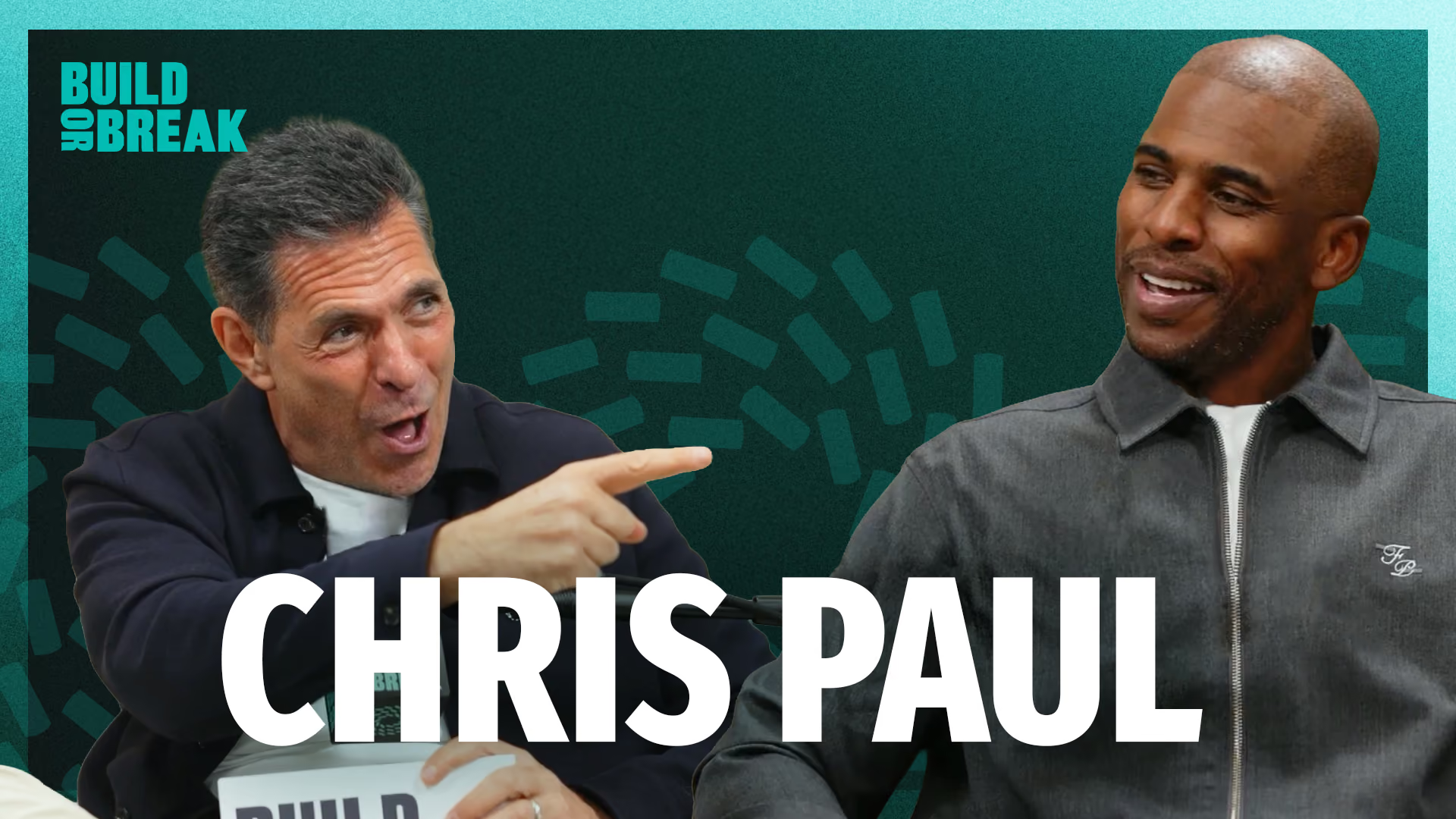
Daniel Lubetzky launches Build or Break with Chris Paul — "the Point God" — newly retired after 21 NBA seasons, second all-time in both assists and steals, and suddenly one of the most-watched teachers in basketball. The two dig into the viral basketball-IQ videos CP3 has been posting to his 11 million Instagram followers: the Derrick Rose steal, where Paul shadowed a ball-handler's left hand to bait the crossover he was actually hunting, and a jump-ball trick — sliding his hand just over a taller opponent's at the line — that he says he can finally reveal "now being retired from basketball." NBA players in his comments confirm he taught them these moves at his elite camps for the top 40 high school and top 20 college guards in the country.
The episode's emotional center is Paul's grandfather, Mr. Jones, who owned a full-service gas station in North Carolina where Chris and his brother pumped gas and rotated tires as kids. On November 14 of his senior year, Paul signed his letter of intent to Wake Forest with his grandfather beside him; on November 15, five teenagers tied the 61-year-old up and beat him to death after he came outside to check the mail. The funeral was November 19. On November 20, in the first game of his senior season, Paul scored exactly 61 points — one for every year of his grandfather's life — then deliberately threw his free throw out of bounds and walked off to hug his dad, with Michael Jordan's state record of 67 still within reach. He calls it the greatest moment he's ever had in sports.
Paul also relives the trailer's promised moment: his fifth hand surgery, after his hand was "crushed and folded over" during a 2023 game with Golden State. "When it happened, I went into shock. During the game, went into shock," he says — and the pain only lifted when he got home and saw his daughter. That fed directly into the rawest stretch of the conversation: the way the Clippers, where he was an All-Star across six seasons of Lob City, wound down his final chapter. "It's probably one of the most disrespectful things that I've endured," he tells Daniel, adding the lesson that stung most: "No matter what you do or what you've done, nobody cares. Seriously, nobody cares." Family — the wife who commented "girl, bye" on Instagram, the brother who serves as his business manager — is what held.
The back half turns to business. Paul founded Good Eat'n for the same reason Lubetzky founded KIND: snacks that taste good without the junk, aimed at the high blood pressure, diabetes, and food deserts hitting the African American community hardest. He taste-tested every product for crunch and seasoning, visits the plants where they're made, and has landed the brand in Walmart, H-E-B, and Kroger — "It's not KIND bar, but we're on the way." Along the way: mentoring Victor Wembanyama in San Antonio, the Steve Nash rookie-year test, his "keep stacking days" philosophy, why a tied game with the shot clock off allows only one shot, and a rapid-fire Mexican Inquisition where referee Scott Foster gets an emphatic "break."
Key takeaways
- "Keep stacking days": you're terrible on day one, better on day two, and by day 89 the impossible move is a habit — mastery is just unseen repetitions.
- When something doesn't go right, you have two options: do something about it, or complain and blame somebody else.
- In a tied game with the shot clock off there is only one shot to take — hold until three seconds so a make wins it and a miss still means overtime.
- Confidence isn't a trait, it's earned preparation: "The only way that you get confident is you got to put in the work."
- The Clippers exit taught him that no organization's loyalty is guaranteed — "nobody cares" — so build your foundation on family, not on a team.
- Locker rooms and companies lose the same way: people who whisper in hallways instead of having hard conversations directly — "if they'll do that about them, they're going to do it about you too."
- Empty time is a creative asset: staring at North Carolina trees from the back seat of his parents' car is where the dreaming — and the basketball IQ — began.
Chapters
01:19 — Welcome to the Point God: Daniel introduces Chris Paul
02:15 — The Derrick Rose steal: how CP3 baited creatures of habit
06:30 — A retirement reveal: winning jump balls at six feet
08:38 — First job: pumping gas at his grandfather's service station
09:26 — The murder of Mr. Jones, the day after signing with Wake Forest
13:32 — "You have one or two options": what failure taught him
18:16 — Time and score: the game-winner most teams shoot too early
21:24 — From Lob City to mentoring Wemby in San Antonio
30:33 — Scoring 61 points for his 61-year-old grandfather
33:13 — "Keep stacking days": the philosophy behind 21 seasons
39:07 — Five hand surgeries and the night he went into shock
40:42 — Building Good Eat'n into Walmart, H-E-B, and Kroger
45:58 — The Clippers exit: "one of the most disrespectful things I've endured"
50:21 — The Mexican Inquisition: build or break rapid fire
Common questions
What is Chris Paul's grandfather story?
Chris Paul's grandfather owned a gas station in North Carolina where Chris and his brother worked as kids, and he became Chris's best friend. He was 61 when he died. Days later, in the first game of his senior year, Chris scored exactly 61 points, then threw his free throw out of bounds and walked off the court to hug his dad.
Did Chris Paul retire?
Yes. Chris Paul says that now he's retired from basketball, it's fun to give everyone insights on how he was able to do it for 21 years. On the show he breaks down the Derrick Rose steal and reveals a jump-ball trick he used against taller players.
What is Chris Paul's business?
Chris Paul started the snack brand Good Eat'n for the same reason Daniel started KIND: snacks that taste good without all the artificial flavors and junk. Chris says they taste-tested every last thing to get the crunch, the taste, and the seasoning right, and he goes to the plants where the snacks are made.
What is Chris Paul's advice for getting better?
His advice is "keep stacking days." He says you'll probably be pretty terrible at a new move on day one and a little better on day two, and then you keep going to day 32, day 65, and day 89. Making shots in a game comes from those unseen hours of stacking days.
About Chris Paul
Chris Paul — "CP3," the Point God — is a 12-time NBA All-Star who retired after 21 seasons ranking second all-time in both assists and steals, with back-to-back Olympic gold medals for Team USA. A Wake Forest product from North Carolina, he closed his career mentoring Victor Wembanyama in San Antonio before a final, contentious chapter with the LA Clippers. Off the court he is the founder of Good Eat'n, a better-for-you snack brand now on shelves at Walmart, H-E-B, and Kroger.
Chris: When something doesn't go right, you have one or two options.
Daniel: That last chapter, the way they handled it, at least to me, did not feel right.
Chris: It's probably one of the most disrespectful things that Ivender. You got Wemby on your team who is unlike any other player or teammate I've had. You have to be open to collaboration. It's the same thing in business. When he was murdered my senior year in high school, it was devastating.
Daniel: Your grandfather was murdered?
Chris: My grandfather. I went to the free throw line. I threw the ball out of bounds and walked off the court and argued my dad. The only way that you get confident is you got to put in the work. Whenever kids ask me what they can get better, I say, keep stacking days. When it happened, I went in the shot. During the game, went in the shot. If the game is tied up and the shot clock is off, you should only have one option.
Daniel: At God, six feet from Wake Forest, he doesn't eat meat, but he'll still cook you on the court. The founder of Lob City with back-to-back Olympic goals going from CP3 to CPG with good eating. The point got himself number three, Chris Paul. Man,
Chris: I'm going to start taking you everywhere with me when I go.
Daniel: Would you? I could hang out with you anytime, anyway. Chris, I'm so ridiculously excited to have you here. And I've been a fan of yours. We met a few months ago or a year ago or two years ago. I like what you're doing on the court. I like what you're doing off the court with your business, but I was fascinated by this video that just came across my Instagram thing.
Chris: Oh, the basketball IQ.
Daniel: It was insane. And interestingly, my son was just telling me that you're the greatest with the second most tills ever, second best assistant. I'm like, look, I know Chris Paul's cool, but I think you're excited. No, that you don't understand. The guy was the smartest player out there. And then you have this video where you explain how you would get people to. Can you explain what you do?
Chris: Yeah.
Daniel: For me, it's so fascinating to see how it's not just physicality, but creativity and strategy.
Chris: It was the video where I was talking about Derek Rose dribbling the ball up the court, and we're all creatures of habit. So even when you playing basketball at the highest level, you only got two hands that you can dribble the basketball with. So he's dribbling the ball up the court with his left hand and I'm just running behind him and I act like I'm trying to steal the ball on his left hand because unless a guy has the knowledge - Eyes in the back? Yeah, eyes in the back of his head, like they always say, in his mind, it's going to make him think that someone's on his left side. So because you're going so fast and you're probably thinking about what's in front of you, your natural instinct is to get the ball out of this hand and switch it to the other hand. And I just found a way year after year, as soon as they switched to the other hand, that's when I'm right there to steal it.
Daniel: The creativity, did you invent this or you learned it from somebody else?
Chris: No, I definitely. I don't know. Someone else. No one taught me.
Daniel: I've always thought about sports that you win them through physicality, but you need to have that physicality because you're keeping up with them, but you don't want to get ahead of them, you explain. And then you tap him on the opposite thing so he throws the ball. But the creativity that it takes to come up with that.
Chris: It's interesting because for years and years I've done basketball camps. When I first came into the NBA, I did kids camps. I would do them in my NBA city. I would do them in my home city. I would do week long camps. And then maybe my second or third year in NBA, I started doing elite camps. And I still do it every year. I do it the top 40 high school guards in the country and the top 20 college guards in the country. I would just give them the knowledge of this is how I throw pocket passes, this is how I steal the ball, all these things. And what's crazy, and if you see in those comments of that video that you looked at is guys who have went on to play in the NBA, they're like, "Man, you used to teach us that at camp, you used to teach us that." And so now being retired from basketball, it's kind of fun and cool for me to give everyone insights on how I was able to do it for 21 years.
Daniel: When I commented on that video, because I was blown away, you commented back and I told my kids it's not him, it's AI. I
Chris: Know. And they're
Daniel: Like, dad, don't be an idiot. He commented for real. He only commented to four or five, but how the hell do you do it? You have like 11 million followers just on Instagram. It's incredible that you stay engaged.
Chris: You have to evolve. You know that better than anyone. For years and years, you post and you don't necessarily interact with people in the comments or whatnot. But when I see cool things, especially now, it's cool to learn, just be a lifelong learner.
Daniel: The stuff that you did on the court, which is not just teaching you discipline, but also that strategic gamemanship, that creativity, think outside the box, how much does it help you when you're building your business?
Chris: Oh, it helps everything. I always say sport and especially basketball taught me everything I need to know about life. It teaches you about competitiveness, teaches you about hard work, teaches you about failure, teaches you about showing up on time, all these different things. And so when I was younger, when it came to basketball, everyone told me what I couldn't do. "You're too small. You're too short. You won't be able to go to this college. You definitely won't make it to the NBA. "So when I try to attack business, CPG with our brand, it's always," Okay, you can't do that. Okay, let's find a way. "And then I think the other thing too is understanding that you can't do it by yourself. So the same thing with the business. There may be things that I have insight to, but I need help. I need the knowledge. We need a team. And so being on a team my whole life, it was just a natural transition.
Daniel: One of the things that I noticed is that you started sharing what to me seemed like a real developed secret sauce now that you've retired. Do you have other secrets that now that you're retired, you're willing to share? I'll
Chris: Tell you this, this is crazy. So if you think about the jump ball, you think about in grassroots basketball, like high school, college, all that, if there's a jump ball, there's a possession arrow. So the ball goes right or the ball goes left. In the NBA, you actually do a jump ball. So if two guys hold onto the ball, you go and they throw the ball up to see who's going to win the tip to get possession. So with the jump ball, there'd be times where, like I always say, I'm six feet, maybe six one on a good day. I may have to do a jump ball against a guy who's six seven. So when we line up and we're about to jump for the jump ball, guys usually put their hand like this. So if his hand is here, I just try to make sure my hand is just a little bit over his, just a little higher. So now when the ref throws the ball up, if I just get my hand over top of his and we jump, I'm going to win the tip. And when you think about it, most referees, officials, they're not going to call that a foul. They're just not going to call it a foul because it happens so quick and it's so fast.
Daniel: You're not the tallest for me, you're very tall, but you're playing against six and seven foot and you're not faced. Is that why you were known as the smartest person on the court because you were forced to use creativity and strategy to -
Chris: I was absolutely forced to use creativity. A lot of kids always talk about my mid-range shot or my patent fade away. And the reason why I had to sort of. I don't even remember when I developed that fade away shot. It just sort of naturally happened. I didn't fade away when I was in high school or middle school or any of that stuff, but I think it naturally happened being that when I got to the NBA, six feet and six, seven guard me as a seven foot two guy in the lane and it just became repetition habit. So now you can't block my shot.
Daniel: As a kid, before you were on the court, do you remember if you were always thinking outside the box? Anything that made you who you became before you got to the court? What was your first job?
Chris: Oh yeah. So my first job, I mean that depends on if that includes cutting the grass at home. I don't know if that's a job, but that was chores. We had to cut the grass, we had to fold clothes, we had to do all these things. But my late grandfather owned a service station, a gas station in North Carolina. It was a full service and self-service. And me and my brother worked there every summer and even days, because it was a family business, there'd be days on the weekend, mom and dad would drop us off and we're working. So I'm pumping gas. I can check your oil. I can rotate the tires. I can do all these things. Is your
Daniel: Grandfather from your mom's side or from
Chris: Your dad side? Yeah, my mom's dad.
Daniel: And was he one of the closest figures you were to?
Chris: Man, he was-
Daniel: Was he a role model?
Chris: Absolutely. As my grandfather, his wife, my grandmother, my grandma Rachel, she passed away when I was seven years old from lung cancer. So my grandfather became my best friend. So anywhere he went, I just got in the car with him. Anytime I got in trouble with my parents, I called my granddad. I'd be like, "Papa, they over here tripping." Anytime we went to church or went to go eat after church, I was with my granddad. And so when he was murdered my senior year in high school, it was devastating.
Daniel: Your grandfather was murdered?
Chris: My grandfather. My grandfather, my senior year in high school, I signed my letter of intent to go to Wake Forest on a full scholarship. My grandfather was there with me, with my whole family.
Daniel: I'm very proud of you.
Chris: Oh man. He closed down the shop. He never usually closed down the shop, but he closed that down for my ceremony. That night, me and him went to go see Wake Forest play. The very next day, November 15th, I'm at our high school football game and I get a call from my brother that he's coming back in town and he said my granddad was sick. I run out to my car and I see one of my cousins and he told me that my granddad had been killed. How? Five teenagers had tied him up and beat him to death. Everyone in my hometown knew my granddad. So at that stage of my life, I was Mr. Jones' grandson. Everybody knew us as Mr. Jones' grandson.
Daniel: Were they robbing the gas station or no?
Chris: No. So what's interesting is he had got home. He had got home from work, walked in the house, put down his groceries when he came outside to check the mail. Yep. He was on the phone with my mom and my aunt, I think, and he said, "I'll call y'all back after I check the mail." And they never got a call back.
Daniel: What was their motive?
Chris: My granddad always walked around with a big knot of money in his front pocket, in his front pocket. I laugh about it because as a kid, you want things. Me and my brother, we wanted shoes. We wanted this, that, and we would see our granddad pull out this wallet of money and we'd be like, "Papa, these new Jordans came out. Can we have some money?" And my granddad would make us work for it. Even though he had it on him, he would always say, "Come work at the service station for a week and then I'll pay you."
Daniel: Do you do that with your kids?
Chris: Yes.
Daniel: How do you deal with the fact that you have so much success? And by the way, your son plays basketball, which I find fascinating. How does he not feel intimidated to try out and enjoying and pursuing? My kids showed me some videos that said he's a good hooper, but how does he feel comfortable and how do you make sure that he feels comfortable trying those things out and how do you create guardrails for your kids?
Chris: It is so hard. My kids live a totally different life than me and my wife ever lived at their age, and we try as best as we know how to make sure that they understand work ethic and how you have to work for this and that. And then as far as the pressure of playing basketball or whatever you do, I just try to make sure that they enjoy it and I want them to know what the work looks like. Whatever you do, I don't care what you do, but you're going to do something and I want you to be passionate about it. You know that you can't wake up every day and just sort of float or maybe you can, but I've found that having a passion about something teaches you things along the way.
Daniel: The common thread that I find between all incredibly interesting people that have achieved so much in their careers is they try something out, right? They pursue the passion and they take risks and they try things out. Going back to the question that I asked you a few minutes ago, is there something in those formative years working, obviously help build discipline and character, but where did the fucking creativity come from? Where did that think outside the box? Because I think for our society with our AI and all that stuff, thinking outside the box is going to be what differentiates us. And you are an out of the box thinker. Where did that come from? How can you train that?
Chris: You learn things here and there from when you win, but I think from some of my biggest failures, I've really learned. Some of the rejection or some of the no thank yous have driven me to be. I tell my kids this all the time. I say, "When something doesn't go right, you have one or two options, right? You can do something about it or you complain and blame somebody else." I wholeheartedly believe that. When something's not going well for you, if you're not as good as you'd like to be in something or you got two choices, you can work harder at it and get better at it. Or what a lot of people do is they'll complain about it. "Oh, this person wouldn't let me do this or they wouldn't let me do that." There's obviously always going to be situations and circumstances that can hinder you, but you got to believe. And sometimes when nobody else believes, you got to believe even more. And I've always had that conviction in my heart. Did
Daniel: Your parents or grandparents still think that were you born with it? Because I do agree with you, attitude is destiny, right? If you make the best of things and be a protagonist, and then that's how you change the course of history
Chris: And of
Daniel: Your own life. Where did that come from in you?
Chris: Well, I think first and foremost, it comes from. You got to dream. Whatever it is, you got to dream. You got to sort of envision it. And I say this about kids now in general at times always on iPad or a phone. I vividly remember riding in the back of my parents' car. And this is so funny because you got kids too. And so kids now, you could be riding in a car and they could have headphones on. They won't even listen to the same music that you listen to. And I remember growing up, you just didn't have that choice. You listened to what your parents was going to listen to. And then when you're riding in a car and you're sitting there and you're looking out the window and the trees just keep going by, that's me being from North Carolina, it's trees, trees, you just find your brain drift off and that's when you start imagining or dreaming like, "Oh, I want to be in the NBA. I want to be in..." And so what happened for me is a bunch of my brother's friends used to tell me what I wasn't going to do. I was a diehard University of North Carolina Chapel Hill fan when I was a kid. And so I used to be like, "Man, I'm going to go to Carolina one day." I used to be like, "Man, no, you're not. No, you're not." And so maybe it was the little brother in me, but I've always been a, "You tell me I can't do it. I can show you better than I can tell you."
Daniel: I have that in common with you what you were talking about how when I was a kid, I remember very distinctly that I would have nothing to do but talk with myself. I very much believe that helped me be a creative thinker. And you're saying that, right? Having time to do nothing is not nothing. You are doing something, you're filling your brain with creativity, with dreams, and that's good. If you're always filling up every second with your devices, you're not allowing your brain to come up with -
Chris: It happens with me now. It happens with me now. I'm sure you, we can get so busy at times with things and scrolling on our phones. Just think about the flights that you take, right? Every now and then when you fly, just about everywhere we go, we have wifi until that one time you get on a plane or something like that and they say, "Sorry, the wifi's not working on this plane." And you're like, "What the hell? What am I going to do?" And then you find yourself thinking creatively. But I'll tell you this too, because I grew up in a middle class family. If I didn't look and see stuff on TV and I wanted things, right? I used to go with some of my friends or whatnot, housing. I'd be like, "Dang, I got a big house." So I wanted things. Everybody always say, "I wanted to buy a house for my mama. I wanted this for my dad. I wanted to take care of my family financially because my grandfather had done that." So when he died, I said, "I got this. I got to find a way."
Daniel: The goal of the show is to inspire people to learn from the grades on how to apply some of that in their own lives. The way I explain Chris Paul to myself, tell me if I'm getting it right, everything is about getting reps and you're getting reps on the court trying, but you're also getting reps in creativity. And once you become creative from those days in the walking and watching the trees to think your brain cannot stop being creative. And a lot of your game is about being creative and you just
Chris: Can't turn it on. Yeah, it is. And at times people could say it's the gift and the curse, because sometimes you may overthink a situation or whatnot, but that is what it is. But the game is the game, right? There's rules involved in the game, right? When you shoot a free throw, you can't be standing on the line, right? There's all these different things. There's out of bounds. There's all these things. So the way that you get better at understanding time and score, if it's 23 seconds left in the game, that means the shot clock, which is a 24 second shot clock, the shot clock is off. Then one of the things that I'm constantly. It's funny, last weekend, this past weekend, teaching the kids that play in our AAU program is that the people listening to this who love basketball, I'll tell you this, this is another gym and people do not understand this concept. If the game is tied up and the shot clock is off, you should only have one option. So a lot of guys will go and shoot a game winner and they'll shoot the shot when it's eight seconds left on the shot clock. That is not a good shot to take because if you make it, the other team is going to get the ball back. If you miss it, they definitely going to get the ball back. So I've always tried to teach, and it seems small, but a lot of games are won and lost in the last few seconds. But if the score is tied up and you have the ball to last possession, you should wait and shoot the ball with like three seconds, three seconds, two seconds left, whatever it is. And now that way, what happens, Daniel?
Daniel: If you make it, you win and they don't have the ball back.
Chris: Exactly. If you miss it, you just go into overtime. Your mind would be blown if I pulled up on YouTube or something and showed you how many teams lose games because they decided to shoot the ball too early.
Daniel: The other thing though in how you think is yes, there's rules about don't do this, don't do that, but there's a lot of conventional wisdom that's actually wrong and you keep challenging that, that the way you bring or you're like this, in Spanish we call it travieso or. You're like a mischievous thinker. Watching your play evolve for me, what I find stunning is you got the second most deals ever, the second most assist ever in NBA history. That's insane. And also you've evolved to fit to what the need is, right? You've been one of the highest scorers. When it's needed, you are the biggest playmaker. When you're needed, you become the defensive player. When you need it, you become a mentor. I was just listening today to a thing where you were great at stealing, you were great at doing it, but Wenby said, "Don't worry about it. I'm going to block it." And you then evolve and you adjust. Talk to me a little bit about how you're more of like an octopus to try to fit the circumstance.
Chris: It's crazy that you say that because for so long, I'm in it. So I know how to navigate whatever situation it is. I've been in so many different locker rooms with so many different teams and spanned over the course of 20 years. So I remember when I was the fastest one on the team who could get from this end to that end, but my game changed. It evolved and teammates changed and personalities changed and your needs for this team changed. When I played in Phoenix, I could orchestrate. I could get the ball to Devin Booker. I could get it to Mikhail Bridges, Deandre Ayton, but in the fourth quarters is where I would score a lot more. Same thing in San Antonio where it's a very young locker room and you got Wemby on your team who is unlike any other player or teammate I've had, you have to be open to collaboration and it's the same thing in business.
Daniel: When you're a CEO of a company or a founder as you are with Good In and me with Kind, part of leadership is being able to see how do you create an ensemble play, what role do you need to play? And part of leadership is being adjust. I talk about how it's like gear. Sometimes you need to go in first, second, third, fourth, you need to adjust to what the needs are. When you came to the Spurs ahead of your arriving, Dave and Pop saw your role as the mentor or it just something that you figured out along the way? Who saw that? Because it was very smart to anticipate that you could provide that coach and mentorship with them. They've all given you credit for it. How did that come about?
Chris: My natural being is to help and to. I'm not a hoarder of information, right? You're not either or you wouldn't be doing build or break. I'm not a holder of information. I've always tried to give back and make sure that guys have a opportunity to live this fairytale lifestyle I've had a chance to do.
Daniel: For me, I noticed the common thread with you is this competitive edge. You are a fighter, right? There's this edge when you were so feisty and you were fighting. One of my favorite clips that I saw, and I don't think I've ever seen something like this, is Clippers versus Memphis. And there's a sequence where you steal the ball and then pass it and it doesn't make. You steal the ball again, then something happens. You fucking take the ball from the guy the third time in one single play. In the corner. You steal the ball three times. I've never seen that. You stole the ball three times in a single play. The balls that he must take to go and to go to the county floor and grab the ball from him, where does that come from? Where does that competitive fire come from for you to think that you deserve to be there and you deserve to take the ball from him for a third time?
Chris: It's crazy to say that because I need to go find that clip. It's
Daniel: Insane. I can
Chris: Send it to you. I was talking to my son about it, watching his games, and I'm a dad. I love on him as much as physically possible, but I also have to be able to coach him and tell him what he has to get better at. So I told him a lot of times there's a loose basketball, like a rebound or a guy will have the ball and he'll go over and sort of try to get it. But it's exactly what you just said. I told him, I said, "There are too many plays that you should have stole it or you should have gotten it or you could have gotten it instead of just taking it." You have to believe it. Yes.
Daniel: Don't go through the motions. Own that ball,
Chris: Go on that court. Get the ball. Get the ball. And that's part of, I don't know, how I grew up, how I. And just a will to. One of the things I did over my career, and I need to go find somebody like a statistician to find all these things because I've had players tell me that they watched me and they remember this, like a turnover. So if you got the ball and you pass it to the other team, turnover. Anytime I would turn the ball over -
Daniel: You'd overcome it.
Chris: I'd go get the ball back.
Daniel: You'd have so much
Chris: Fire. I got to get it. I got to get it. And I know that there's a crazy stat somewhere about that, but that was a real thing. If I would turn the ball over, I would be playing and be like, "All right, let me figure out how I'm going to get that ball back because I need to cancel out
Daniel: That turnover." But is it self-confidence or insecurity that drives you to go for great as meaning. And it obviously goes beyond basketball. How do you get somebody to believe in themselves enough to have what we say chutzpah, the goal, the self-confidence to believe in yourself and try something that others think is impossible? Because you're six foot and you're going after these seven foot guys and you're still above three times in one single play. Where does that come from? Is it because you have something to prove? Is it because you're super self-confident? How do you coach your kids on the balance between not being too full of yourself, but believing in yourself, but having enough something to prove?
Chris: It's a little bit of all of that. It's a little bit of everything. I think there's something in me I think that is confident. I'd be lying if I said that I wasn't confident because you have to be confident. And the only way that you get confident is you got to put in the work. You really have to put in the work. I knew when I showed up to a game, and I correlate a lot of things with my kids to schoolwork. I say, "When you show up for that Spanish test or that math test and you look at the test and you're like, Oh, I'm good. It's because you prepared. One of the things I always talk about is preparation. So when I went out to a game, I knew I put the work in. I knew I ate right. I knew I did all the lifting. I knew I got my shots up. And so now it was just my opportunity to showcase it to the world. It's all the unseen hours, all the unseen late nights and early mornings. So now was my time to show everyone. And then I feel like I never got comfortable. I never got comfortable. I'll tell you this quick story, which I've told a number of times was my rookie year I played against Steve Nash and Steve Nash was the staple for point guards, and I couldn't sleep the night before the game because he was how you measured yourself. And the third quarter, I think I had 19 points in the third quarter. I was just going by, shooting, doing all these things. Fast forward to my third, fourth year in the NBA, I felt like I had become sort of the staple as far as point guards and what guys wanted to achieve to be. The way my brain works is I started thinking about, even when I got to year six, year eight, 10, I was like, "Okay, now if I'm where Steve Nash was, who's the young kid who's coming in trying to go at me the same way?" But I was like, "No, there's no way he's going to be more hungry than I am." And that's why I just always try to keep that edge.
Daniel: I love that. So it's putting the work so you develop that comfort and then stay hungry to always keep that edge. Connected to that point, when I watch my kids sometimes see either them or their friends do this bravado things and whatever. And I'm like, "Kids, be more gentlemen. Don't be so rough." And they're like, "Dad, you don't understand. For basketball, you have to have that edge and you have to celebrate the brabado." I looked at a lot of your clips and you are feisty, you are hungry. You have that hunger and you have to have that fight in you. And so are my kids right that it goes with the territory and you have to just be comfortable with that stuff?
Chris: You can be both. It depends on who you are. I think everybody has their own different feel. When I step on the court, it's a whole different world. It is a whole different world. I almost click out until the game is over. It's just that competitiveness and probably the drive. It may be because I played football also. I grew up, I played football, like American football. I played varsity football as a freshman and sophomore in high school and played JV basketball. So I've always loved that. And then I've been in situations where guys elbow you do all these different type things and you got to know when to just let your game show up and it's balanced.
Daniel: Is there also, sorry for being so dramatic, but you said your grandfather passed away when that period and then a year or two later you're playing football and you're playing basketball. Did that also make you have that fire?
Chris: Oh yeah. So like I was saying, my grandfather, I committed to go to Wake Forest November 14th. My grandfather was murdered November 15th. November 19th was his funeral. My very first game of my senior year was November 20th. So all my family was in town, had came to the funeral and I was contemplating whether or not I was going to play my basketball game the next day. My grandfather was 61 years old when he died. In my basketball game, the first game of my senior year, I had 59 points in the game. I drove to the lane, shot, made a floater, got fouled. That gave me 61 points. I went to the free throw line. The state record for the most points in the game at that time was 67, held by Michael Jordan. But I had 61, I went to the free throw line, I threw the ball out of bounds and walked off the court and hugged my dad. So still to this day, one of the greatest, if not the greatest moment I've ever had in sports was scoring 61 points from my late grandfather.
Daniel: Grandfather
Chris: That way.
Daniel: Yep. It's a powerful story.
Chris: To see the way that he took care of my family emotionally, financially and all these different things, that is what gave me the drive. That seriously is what gave me the drive because I looked up to him. I looked up to my granddad and saw the things that he was able to do. And my grandfather used to say, "Chris, I can't have some man telling me what time to be to work every day." He used to say that all the time. He said, "I can open my shop and close my shop whenever I want to. Can't nobody tell me what to do." And so that above all, I think - Gave me that. Yeah, gave me that fight and that entrepreneurship and playing basketball and being in the NBA and getting a chance to play a game every day and say that was my way of life. That's why I never got comfortable. When
Daniel: Did you realize that you were so competitive? Because I'm not 100% certain, but I don't think that I recognize that I'm a very competitive person till later. In my early years, I was a bright kid and I had a lot of hobbies, but I didn't do any sports. But once I started winning in business, it made me wanted more to fight more. So do you feel that when you keep fighting and you win one and you like that and then you get more competitive, where did it come for you?
Chris: You're right. Part of it is once you see the success, I have a saying, I always say keep stacking days. Whenever kids ask me what they can get better, I say, keep stacking days. When you think about trying to dribble between your legs, it is really hard if you've never done it. Day one, it's going to be extremely hard.
Daniel: Well, the other hard one that you did at last clip, you kind of do it the opposite way. Do you know what I'm talking about? You're running. I looked at the clip 20 times. I can't even understand it looking at it, let alone doing it. You're running and you kind of slow down and go back. You suspend the loss of physics and the
Chris: Ball goes on
Daniel: The other side.
Chris: I don't know what you're talking about, but what I can tell you is that this is for fact the way most things work. I'm not going to say everything, but most things work. The play that you're talking about, if you got up with a basketball right now and tried to do it, you'd probably be bad. You'd probably be pretty terrible at it, right? But if you tried it the second day, you're going to be a little bit better, right? You're going to be a little bit better than the first day. Now imagine you get to day 32 and then you get to day 65 and then you get to day 89. It's
Daniel: Just masters, just
Chris: Trying to keep going. Keep stacking days, keep stacking days. And once you do that, now you get a chance to sniff a little bit. Oh, this is what that feels like. This is what it feels like to go into a game and make shots and hear people scream like, "Oh man, you made those threes." Yeah, because it's the unseen hours of the keep stacking days.
Daniel: I really like your authentic range of emotions. There's a clip where you let yourself go and you were emotional and sentimental. You have a lot of fun. You're giving CPR to one of the players. You're just having fun and you just have a lot of authentic range of emotions. Are you sure you're not also a Mexican Jew or
Chris: Something? I mean, my wife says to me this all the time. She always saying, grow up, grow up. And I tell her never, never. Kids have the most fun. I think sometimes people find themselves in situations where they're taking themselves too serious.
Daniel: And also it's a tool to make you win. Having a good sense of humor.
Chris: Got to be able to laugh. I think
Daniel: I see that in you.
Chris: You have to be hyper-focused. You definitely have to be able to lock in when it's time to lock in, but you got to be able to celebrate the wins. You got to learn from the losses. And there's times where you got to be able to laugh and enjoy each other because if you just work, work, work all the time and you can't ever laugh about anything and enjoy life, then that's no fun.
Daniel: What do you do to stay grounded and having achieved all that you've achieved? How do you try to just keep things in perspective?
Chris: Man, my family. My family. I mean, we play cards. One of the things that helps too is I have a group chat with my homies that I grew up with that are from my hometown. So just like anybody else, we putting funny memes in there. We laughing, we joking consistently. I would say my favorite thing to do above anything other than spending time with my family is I love to laugh. I feel like that helps just about any situation, any situation. When you're sad, when you're down and out about something, if you can find something to laugh about, it'll always keep you centered.
Daniel: In the last few conversations you and I had, I invited to a really, really impressive event with a lot of movers and shakers. You're like, Daniel, I need to be with my family. First time that I could spend Christmas with my family, first time that I can just enjoy investing my kids, you're coaching your kids. I was reading that you chose not to go to the third Olympics because you wanted to be with your family. I mean, it's a tricky thing to balance. You got to got three Olympic medals, but you said, all right, this one I need to be with my family. How do you find balance between those things?
Chris: There's absolutely no balance. I think I probably said in the past that you got to balance and the more I've learned and watched people and I listen to other people talk sometimes and I'd be like, that is absolutely right. Some days you're going to pour more into this bucket. Some days you're going to pour more into that bucket. You just try to manage it as best you can. Today is a day where I've been sort of here, there, all these different places, but that's okay. But what I do know, and this is from life experiences, even TV shows or whatnot, you can watch, you can learn from so many other people. And the one thing that will be there after everything else is said and gone, you hope, is your family. Your business could be doing amazing and it could absolutely go to shit one day. But what you hope is that you have your family or somebody, somebody or something that you can rely on that can be there. And that ultimately is what I've learned from some of the most successful people. When we talk, a lot of times we end up talking about our family, our kids, all that stuff. And you realize that is ultimately the most important thing.
Daniel: A hundred percent with me, when I was running kind at full speed, whatever the feat I had or challenge or setback, I'd just go home and my kids would love me just the same and hug me just the same. My wife would love me. And I think that is a very, very valuable
Chris: Way. I broke my hand. So I had five hand surgeries over my NBA career. So I got 16 screws in a metal plate here. I had this surgery after the 2012 Olympics. This happened 2021 NBA finals, wrist surgery, thumb surgery here, I think it was 2017. And this one right here happened 2022 when I was playing for the Warrior. No, or 2023. Yeah, this might have been like two or three years ago. This was 15 screws in a metal plate. So the night that I did this one, this was the most recent one, the fifth one. When it happened, I went into shock. During the game, went into shock. I went downstairs at the practice facility in San Francisco, Golden State. And before the doctors, I even let them look at my hand because I knew it was broken. It was crushed and folded over in my hand and I'm just holding it. I got home and I remember seeing my family and specifically when I walked in the house, I seen my daughter and I felt better. I honestly felt better. My hand or whatever, I knew it was broken, but once I seen her and seen them and everything is all better now.
Daniel: I was asking you at the beginning about how sports is tied to business because I see a lot of commonalities and you built a very cool brand called Good Eden. When did you start it? How did you found it?
Chris: So I'll tell you what's crazy and I would be interested to hear everything. If you will, hand me that pink bag. Hand me that pink bag. This
Daniel: Is good eating cinnamon pops. The one that I'm having is good eating tortilla, nacho chips. But what I read about it, and I think it's very true, is you don't feel like you're giving up anything. It's tough. This is full of flavor.
Chris: Yeah. And you want it to taste good. So your reasoning for starting kind, you said you wanted something that tastes good and didn't have a whole bunch of junk in it. It is so crazy. That was my reasoning for doing this because when you look, especially in the African American community and a lot of people suffering from high blood pressure, diabetes, all these different things.
Daniel: My wife is a kidney doctor and she talks to me about this all the time. The African American community really, really has a lot of issues with kidney disease and it's a very serious issue.
Chris: Yeah. And one of the things that we all do every day is we love to snack. So if people can't necessarily change their diet, because there are a lot of food deserts out there and a lot of people don't have access to clean foods and vegetables and all that on a regular, people enjoy snacking. So if you're going to snack, why not be able to have something that tastes good and doesn't have all the artificial flavors and all the junk in it? And so we started good eating and we have all these different flavors and the thinking behind it too was kids tend to, like parents, some of these parents will be like, I'll eat this and the kids will eat that. Why not have something that everybody can eat? During
Daniel: Walmart, during H-E-B, Kroger.
Chris: Yeah.
Daniel: That's pretty impressive.
Chris: I mean, it's not Kind bar, but we're on the way and that's why I say we get offline, we going to find out some things to do. But what's been really cool about it is building it. And some people throw their name on something and just be like, oh, this is. I can tell you about when we first taste tested every last thing to get the crunch right, to get the taste right, to get the seasoning right. I mean, I go to the plants where they're being made, all these different things. So I try to just help where I can and through my learning process seeing, oh, okay, if there's relationships, you always got to know what you know and you got to know what you don't know.
Daniel: I have two last questions before we move to our final segment.
Chris: Yep.
Daniel: Is there somebody in your life, this is a signature question for all of us because I think everybody that achieves something has something behind them that sometimes is their unsung hero. Is there somebody that helped you become who you became that you'd like to recognize?
Chris: I say my family, and that sounds so generic, but it's so real. And when I talk about them, my parents, obviously, my older brother, my older brother works with me aside from me as my business manager, business partner in any and everything that we do. We're just like any brother. We love each other to death, but because there's a business relationship too, we disagree on things. We argue at times, but it's my brother. I know that he only has my best interests and I only have his best interest. So that love and bond is unbreakable.
Daniel: This is one of the things my dad taught us that I think is one of the most important lessons, my mom too, to just be united as a family. By the way, that's our family motto, to be united as a family, to be noble towards all, and whatever be our quest, to do our very best. When my kids were young, I made them come up with that. But united as a family is such an important trait.
Chris: It's everything. And I would say for me playing 20, 21 years, 16, 13 year old kids, my wife has had to do so much. I think a lot of times people see playing on TV, playing basketball and all these things, but the peace of being able to go into those games, these high energy, crazy emotional games, and to be in locker room with teammates and stuff who go into games and after games come out and they check their phone and they not sure where their kids are, what their kids are doing, the peace of mind to know that I knew that my kids were fed, they were getting great grades at school, and just to know that they were taken care of is more valuable than I think people realize.
Daniel: I saw a clip with Stephen A. Smith taking Lawrence Frank to task in how they wound down the relationship with the Clippers. The Clippers is like, I think you were a 12 time All Star, including I think five of the Clippers. You made so many amazing memories there, but then that last chapter, the way they handled it, at least to me, did not feel right. And then I'm thinking about your wife and I'm thinking about your children and how they must have felt and how they must have. You haven't commented a lot about that.
Chris: My wife actually commented on Instagram, which was really funny. I think she put something like girl by, but what's interesting about that whole situation is it's probably one of the most disrespectful things that I've endured. I done been through a lot of wild stuff in my career and having older kids and a wife who's very tapped in and they know the daily goings on as far as that team and that organization, obviously I was upset, but my family, my people, everybody - Broke
Daniel: Their
Chris: Hearts. Yeah. Yeah. I think just because of the investment we made in the team for as long as we have and to see the way stuff was handled, what it lets you know is that no matter what you do or what you've done, nobody cares. Seriously, nobody cares. Nobody cares. And it teaches you. It's another learning lesson.
Daniel: I think it teaches you the thing we were talking a second ago, right? Family, at the end of the day, no matter what, family is the most important because your wife, your children, your brother, your parents.
Chris: They're everything. And especially in that situation.
Daniel: Do you like Stephen A. Smith?
Chris: Stephen A's cool. Yeah. I've known him. I've had my differences with him before and have had to. I'll tell you something else, which sort of goes with the Stephen A. Situation is what you learn in business life, most people can't handle hard conversations. Most people can't handle hard conversations. So good, bad, or indifferent, I'm a person who I want to talk about it.
Daniel: You want the feedback to grow.
Chris: Let's talk about it. But
Daniel: It's interesting because I've never thought about it from your vantage point because for me, these commentators, sometimes they're fun, but sometimes they're assholes, sometimes they're hurting people's feelings, sometimes they're whatever. And it's kind of like a critic of a movie or of a person commenting on the players. For me, Stephen Smith, I predominantly listen to him for his take on the world. This builders about transcending this us versus them and joining forces against extremism and to work together. I really kind of like that mindset, but my comment is yes, dad, but you need to remember that the guys every day in, every day out, criticizing everybody and having opinions, so
Chris: It's
Daniel: A little more
Chris: Complicated. And you have a job to do, but I think more so I was saying if a teammate, so especially when you're playing basketball, playing point guard, obviously you have the ball in your hands a lot more. I've always, whatever team I went to, I think there's a clip of me at one of those games telling, I don't know, it might've been Jonathan. I don't know. I was telling someone, I was like, "Yo, if you haven't gotten the ball in a few possessions and you want the basketball, tell me." Because what you learn in sport is that guys come to the bench and they just be like, "Man, he ain't passing me the ball." Well, if you would like, talk, communicate. And I'm sure you learn that in business. When you have people that go whisper talking about this person or talk, the first thing that come to my mind is if they'll do that about them, they're going to do it about you too.
Daniel: Yeah. I love that point about no hallway commenting, talk directly to me. I love that point, but I find it fascinating that when you need to win the game, you need to win the game. It's not about this guy or that guy wanting the ball. You need to be the play maker with how it fits.
Chris: Win the game. And we all need to figure out if there is a problem, let's figure it out internally. I done played in so many NBA games where I'm out on the court and there's guys on the other team talking so much shit about their teammates. I'd be like, "Oh, okay, really?" And I think to myself, "We got them. We got them. If you'll do that, then your team is obviously not built to win." I love that.
Daniel: We're going to jump to our last segment, which is called the Mexican Inquisition. I'm going to ask you build or break. Build or Break, if you like it or you don't like it.
Chris: All
Daniel: Right. Ready? The smell of gasoline.
Chris: Ooh, break.
Daniel: But you work for your grandfather's gas station as
Chris: A kid? Yes, yes. I done had enough of that.
Daniel: Build or Break, coaching your children.
Chris: Build. Build. My dad coached me too.
Daniel: What's the rule of thumb when you coach your kid?
Chris: There's a balance of being coach and being dad, and you got to be able to have those conversations.
Daniel: Build or Break, opting out of the Olympics.
Chris: Build. The reason why that was the Olympics that no one's family could come, because it was sort of the COVID times.
Daniel: Build or Break, trash talk.
Chris: Build. I tell you the truth. I wasn't a big trash talker in my career. I always say I would never say anything to you first, but if you say something to me, then I don't know when to stop.
Daniel: Yeah. Build or Break, Scott Foster.
Chris: Break. The hell on somewhere.
Daniel: He's like a ref that was a bit.
Chris: Why are we even talking about him?
Daniel: Yeah. They call him the extender. Build or Break. Bowlers are athletes.
Chris: Build. Absolutely athletes.
Daniel: Your dad played, you played, and you have a bowling team. Build or Break, mid-range shot.
Chris: Build. It's a lost arc, but the best players still shoot it.
Daniel: Build or Break draft lottery.
Chris: Build.
Daniel: I think it's a creative.
Chris: Yeah, you got to do something.
Daniel: Yeah. To try to discourage too much abuse over there.
Chris: Exactly.
Daniel: I love Adam Silver. I've gotten to know him a little bit. I just really like the guy.
Chris: Yeah, really good guy.
Daniel: Build or Break veganism.
Chris: Build. I think what's interesting about diets or whatever you try as far as a way of life of eating, it can teach you a lot. It can teach you a lot about your body. And once you learn things, you can decide from there how to adjust.
Daniel: Build or Break, back to back nights. Build.
Chris: Yeah, I think it builds character. It's part of the. This is why we are the best, the top athletes in the world, right?
Daniel: Wow.
Chris: See,
Daniel: That's interesting. I'm like, why are we asking this? Of course he's going to say break. That's so hard. But you look to.
Chris: Yeah, it's part of it.
Daniel: Build or Break, the NBA 2K curse. I
Chris: Don't believe in that.
Daniel: Chris, I really enjoyed preparing for this. I enjoyed the conversation. I look forward to get to know you
Chris: More. Thank you so much, Daniel. I really appreciate you.
Daniel: Thank
Chris: You. Thank you. Thank you.
Daniel: We want you to become a builder with us. So subscribe to Build or Break now and leave us a comment or our review. We're trying to build a movement and you can be part of it by hitting the notification bell and telling us what you think about this episode and by telling all your friends to watch you. Thank you.
Watch Build or Break on YouTube
Listen on Spotify, Apple Podcasts, or Amazon Music
Follow Daniel Lubetzky on Instagram and TikTok
Become a Builder: buildersmovement.org
Follow Chris:
https://www.instagram.com/cp3/
https://www.linkedin.com/in/chrispaul3/
Good Eat'n: https://goodeatn.com/
Chris Paul Family Foundation: https://www.instagram.com/chrispaulfamfdn/
CP3 Camps: https://en.wikipedia.org/wiki/Chris_Paul_Camps
Coverage of this episode:
Chris Paul
CP3
Good Eat'n
LA Clippers
San Antonio Spurs
Golden State Warriors
Phoenix Suns
Wake Forest University
Victor Wembanyama
Steve Nash
Derrick Rose
Devin Booker
Music: Amos Cochran https://www.editscoremusic.com/
Production: Straybird Studios https://www.straybird.studio/
Post Production: Jennell Lewis & Scott Convery
Social Media Production: https://www.edits-etc.com/
Build or Break Team:
Executive Producer & Host: Daniel Lubetzky
Executive Producer: Kristin Schneider
Head of Programming & Production: Joel Rubin
Marketing & Communications: Sarah Black
Associate Producer & Social Media: Taylor Larned
Booking & Scheduling: Kayla Rose
Network Relations: Julianna Cohen

Become a Builder
Sign up for episodes, ideas and advice from Daniel