Steven Bartlett
Steven Bartlett, host of The Diary of a CEO, on how the show went from 40 downloads to 120 million a month, the failure team behind it, and his best advice.
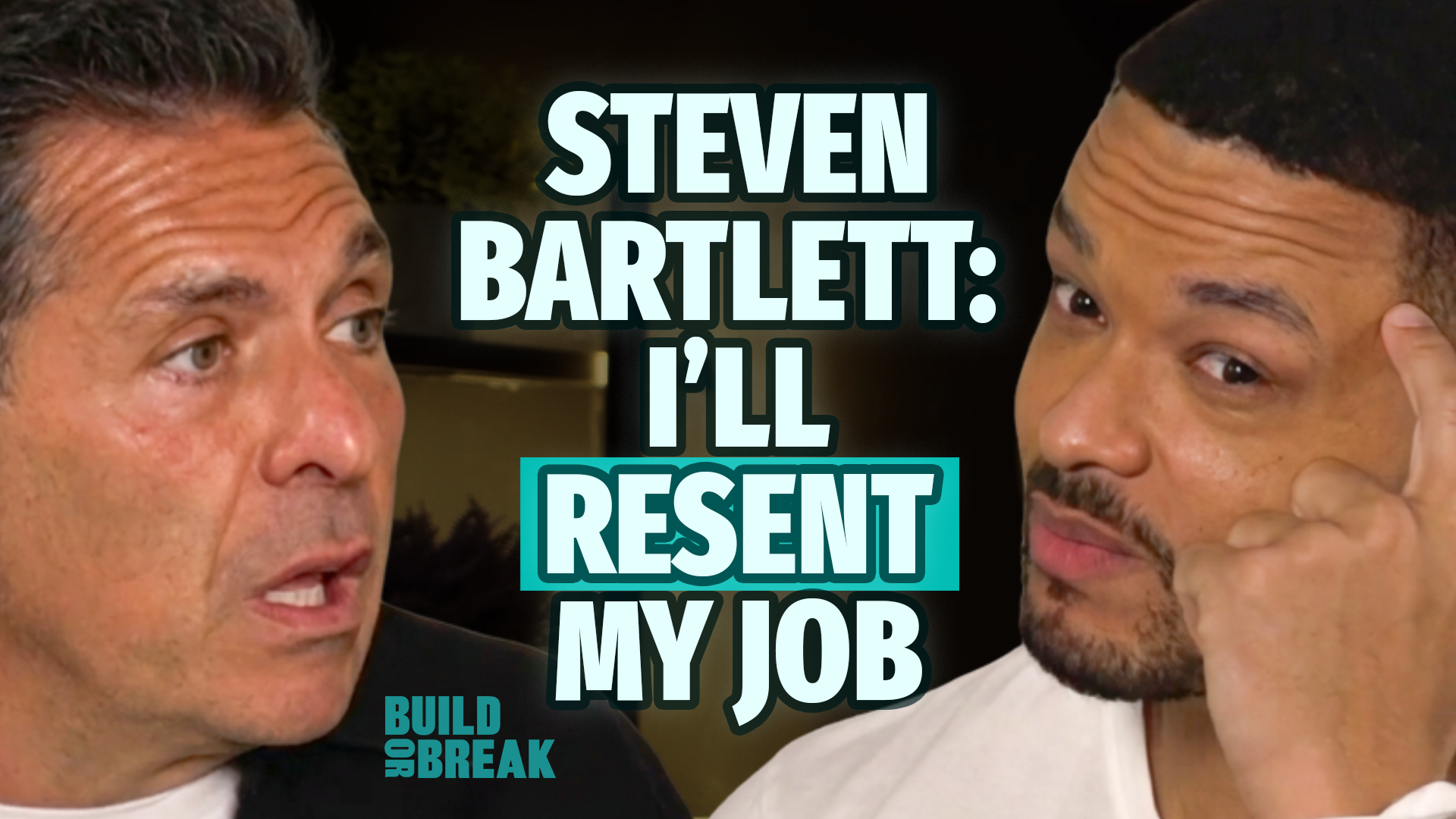
Steven Bartlett started The Diary of a CEO in 2017 by reading his own diary into a microphone. He says the first 10 episodes were exactly that, and they got 40 downloads. When he skipped a couple of weeks, one of his best friends, who is very honest with him, asked when the next one was coming. The friend had been listening on his morning drive and had gone back to Joe Rogan when the episodes stopped. Bartlett says that if the friend had not asked, he would not have carried on.
On the sixth episode of Build or Break, recorded the day after he and Daniel Lubetzky filmed Shark Tank together, Bartlett explains the thinking behind the show. In 2017, he says, media was racing toward short, algorithm-driven video that a platform could kill with one change of strategy. He went the other way: long-form audio, distributed by RSS to Apple, Spotify and other platforms at once. The name came from the same logic. Instagram was full of polished lives, so he bet on a person in a position of power showing the vulnerable, personal side. In 2020, after stepping down as co-CEO of his group, he went all in. A freelancer quoted him 5,000 pounds to film at his kitchen table. Bartlett sent him back for a bigger budget, which came back at about 40,000 for nine cameras, one of them a robot. The show had no sponsors, and he says he has always invested ahead of revenue.
The translation bet came later. Bartlett says he told his CFO that only about 10% of the world speaks fluent English, then set a team to translate every episode into 20 languages. It failed for 18 months. Spotify called to team up on translations and announced the effort, then, he thinks, paused it. His team kept going. Six months later his head of experimentation told him they had cracked it: people listening in Spanish were listening longer than people listening in English. He says the work now runs on AI agents with no human involvement, down to the guest's own voice in the new language, and that this month about 30 million of the roughly 120 million people who watch or download the show are doing so in another language.
Much of the conversation is about why guests open up to him. Bartlett asks for two hours minimum and turns down guests who will not give it. He sits facing the guest, and nobody else is in the room while nine cameras run. He traces the depth back to a 12-year-old who texted a girl at school to ask about the meaning of life, and to about six years of writing one tweet every evening at 7pm that forced him to boil a day down to a lesson. On listening, he borrows from former spies he has interviewed, including Mike Baker, whose point was that most people have never been listened to for 10 uninterrupted minutes. Bartlett describes pulling back from the mic so he has no intention to talk, a 20-second silence that ended with a psychologist in tears, and watching for the moment a guest's body language closes. People match the energy you bring, he says, so he goes into every interview curious rather than hostile.
Bartlett also compares Shark Tank with Dragons' Den. He says both shows reflect the countries they come from. In the Den, pitches can run up to two and a half hours, the dragons are told who starts, and they rarely interrupt each other. Shark Tank's producer described the show to him as a moving train. Bartlett says that within 60 seconds it felt like a train that was already full. He says he sat for two minutes saying "pardon me" before deciding he would have to start shouting to get a word in. On Shark Tank, he adds, you can keep talking after you are out and even come back in, which does not happen in the UK.
In the Mexican Inquisition, answering questions while holding a handheld shock game, Bartlett names his mother as his unsung hero. He recalls her sleeping on a bag of ice in the back room of her shop, and says his first job, at seven, was scraping paint off the step and walls of a corner shop his mother had bought, using a butter knife. His most personal answer is about his fiancée. In their second year they hit an intimacy problem neither could talk about, broke up for a year, and got back together after he flew to Bali to apologize. He calls conflict resolution the most important skill in any relationship. On investing, he says he bets on two poles at once: technology and AI, and the irreplaceably human, meaning community, live experiences and content only lived experience can produce. He closes with an idea he calls pushing on paper walls, which also gives its name to a Slack channel at his company, and in the rapid-fire says break to podcast distribution deals, break to three glasses of wine, and build to getting unexpelled from school, which he says happened at 16 because he was making the school money.
Key takeaways
- Length is a tool. Bartlett says the message should decide the medium. Because his show is built for depth, he will not accept an interview shorter than two hours, whoever the guest is.
- Judge early bets by honest feedback, not numbers. He calls downloads and money lagging indicators. He says what kept him going at 40 downloads was a couple of people he knew were being honest with him, telling him it had value.
- Run the 50-year test. Bartlett says asking what would have to be true to do this for 50 years changes the decisions. He would turn down a celebrity with 150 million followers he has no interest in, he says, because a calendar full of those guests would make him resent the job.
- Some bets cannot be proven on a P&L. The translation project failed for 18 months and outlasted Spotify's involvement before, he says, it finally worked. He puts the audience listening in other languages this month at about 30 million.
- Listening is a technique. Bartlett's version: step back from the mic, let the guest steer, follow the clues they drop in passing, do not fill the silence, and notice when their body language closes.
- Trust comes from what someone gives up. Bartlett says he believes a founder or a brand when they give up something in the near term that they would have made money from, and that entrepreneurs build trust by showing imperfection.
- Push on paper walls. Many limits are preference and tradition, not real walls, he argues, and he says there is always an industry protecting them. In his telling, asking "why" is how Zara founder Amancio Ortega got clothes on shelves within 14 days and how suitcases finally got wheels.
Chapters
00:00 — Cold open
00:55 — Guest intro
01:35 — Podcast philosophy and The Diary of a CEO origin story
03:56 — 2017: betting on depth while media went short
07:33 — 40 downloads and the friend who asked for more
08:40 — Translating the show into 20 languages: 18 months of failure
11:41 — Hooking viewers in the first two minutes
14:12 — The deep kid, and the 50-year test
16:22 — Inside The Diary of a CEO machine
17:09 — 2020: going all in with nine cameras and no sponsors
18:04 — Depth, vulnerability and the craft of listening
19:04 — One tweet a day at 7pm for about six years
24:42 — What spies taught him about listening
27:35 — Pushing, not pulling, and a 20-second silence
30:56 — Getting founders to open up, and why people match your energy
34:16 — Building trust by showing imperfection
35:22 — Shark Tank vs. Dragons' Den
39:47 — The Mexican Inquisition
42:08 — The five things that make any job worth doing
45:08 — The year apart that saved his relationship
48:34 — Investing in two poles: AI and the irreplaceably human
51:25 — Pushing on paper walls
55:19 — Build or Break rapid-fire
1:00:09 — Getting unexpelled from school
1:02:02 — ADHD as a spectrum
Common questions
Who is Steven Bartlett?
Steven Bartlett is the host of The Diary of a CEO (DOAC), one of the most popular podcasts in the world, with over 120 million downloads in a single month. He was expelled from school, founded a multimillion-dollar social media company, wrote a bestselling book, and is a regular on Dragons' Den, the British version of Shark Tank.
Who is the host of The Diary of a CEO?
Steven Bartlett. He has interviewed some of the most powerful and interesting people in the world, and on this episode of Build or Break he is the one being interviewed, by KIND founder Daniel Lubetzky.
How did The Diary of a CEO start?
Bartlett says the first 10 episodes were just him reading his own personal diary out loud, and they got 40 downloads. A close friend kept asking when the next one was coming, and Bartlett says that without that push he would not have carried on.
Does Steven Bartlett have a head of failure?
Yes. He says the company has an experimentation team and a failure team. When a project to translate the show into other languages failed, they kept going, and six months later his head of experimentation and head of failure told him they had cracked it: people listening in Spanish were listening longer than people listening in English.
About Steven Bartlett
Steven Bartlett is the host of The Diary of a CEO, the podcast he started in 2017, and a Dragon on the BBC's Dragons' Den. He co-founded the social media marketing company Social Chain and stepped down as co-CEO in 2020. He is the founder of Steven.com, the holding company for his creator businesses, including the media company Flight Story.
He is the author of The Diary of a CEO: The 33 Laws of Business and Life and Happy Sexy Millionaire. On the episode he describes being expelled from school at 16 and then unexpelled, says he is an investor in and ambassador for Whoop, and says he does not think he has done a single other podcast this year.
Steven: In order for me to do a podcast for 50 years, I'm going to have to be able to wake up and say, "Amazing that I get to do this interview today." Most people in their life haven't had a single person listen to them for 10 minutes uninterrupted in their entire life. So if you shut the fuck up, they're going to hand you their ideology.
Daniel: You're not only just a deep thinker, you are an amazing listener.
Steven: One of the things I noticed about myself was that I could almost put people off by the depth of the conversations that I wanted to have. I think the most innovative, interesting people are broad people. Yeah, I was a bit shell shocked for the first
Daniel: Two days. I didn't feel that. I'm like,
Steven: "Dude." I was sat there for two minutes like this. Pardon me.
Daniel: This is a game in Mexico that gives you shocks.
Steven: You have to wonder about our culture. So you have to have principles, and I literally do a first principle exercise every single time I have a new idea. How do you make sure that you stay grounded money or anything like this will just bring out actually who you are?
Daniel: Welcome to Build or Break. My guest today hosts one of the most popular podcasts in the world. Last month, they had over 120 million downloads. We just filmed together on Shark Tank, but he's a regular on dragons than the British version of the tank. Even though he was expelled from school, he founded a multimillion dollar social media company, wrote a bestselling book, and built an entire business empire rooted in asking questions. He's interviewed some of the most powerful and interesting people in the world, and today we get to interview him. Stephen Bartlett, thank you for being on Build or Break.
Steven: Thank you for having me. It's an honor.
Daniel: Your episodes are meaty.
Steven: Yeah, long. We usually say two hours minimum. And if someone won't give us two hours, then I won't accept the interview. And it really doesn't matter. For me, it doesn't matter who they are because I've tried it so many times to try and do shorter in the style that I do it. And it's specifically in the style that I do it, and it's never worked.
Daniel: When you started from the outset, it was deep and thorough and you had the guts to go for two hours, because one of the things that we're struggling with is we earn even the right to even be there, let alone to be there more than an hour. And I go deep also, so I always wanted to go two hours plus, but I found that I feel the pressure on myself to try to do it shorter.
Steven: So there's a couple of ways I think about this. So I think the medium is always the message. And so I should probably say, I think the medium and the message have a relationship. So if the message is, if it's depth, if it's intimacy, if you want to establish a deep emotional connection with the person, if you want to go a level deeper, then I think you have to think about the length as a tool to achieve that. If you think about what CNN do, they are trying to give you information quickly. And they're constrained by the ad model and stuff, so they do short. The message we want to deliver determines the medium, and it should really be that way around. So I would work backwards from what are we trying to make and then what are the first principles of what we're trying to make? And actually those first principles then dictate every single decision. They dictate everything. So I can speak to my set is one of the things that was important for me, for example, is that we face each other because the psychology says that if me and you are like this, it's a different level.You almost felt it instantaneously. It's a different level of connection. Okay, so that's one first principle. The other is when I record, there's actually no one in the room. There's no one in the room. You can't see a single other person. So there's nine cameras running and you can't see a single person. I don't let anybody in the room. And that's because it's a deep, intimate, emotional, personal conversation. It's the type of conversation you would have at 2:00 AM in the morning with your parent when you've got to confess something, when you're opening up to them. And so I do that by design.
Daniel: How did this come about? Because you sat down and said, "I'm going to do a podcast." What was your goal at that moment?
Steven: It was really principle based. Again, at the time it was 2017 and the world of social media and content and media was very focused on algorithm-based platforms like Facebook, and it was very focused on short form video. So the world is going for shallow, and I could argue unstable content. When I say unstable, the algorithms can change at any point. Meta have their quarterly earnings, they decide they want to go for something else, they can kill your business. So in a world that's speeding towards shallow and algorithmic, what is the very opposite of that? Where can I find depth and decentralized?
Daniel: When I try to do business, I always talk about it when people are zigging, you want to zag. So that principle made sense to me that you wanted to do it different, but it was also guiding you because you deeply wanted it. It was not just the opportunity. It sounds like that's who you are. So there was an intersection of I'm going to do it my way and it's also differentiated and has more chance or which one was more important?
Steven: Yeah. The thing about the passion and the love part is you don't know until you try. So you can think maybe I'll enjoy that, but you actually don't know until you've done a
Daniel: Podcast. So you were being very strategic about what you though the opportunity was.
Steven: Yes. I loved making content in written form, in short form form. I like the challenge of communicating a message in the most concise way that I can, but I just like storytelling generally. And at that particular moment in time, everybody was going that way. And I though, where is the depth? Where does depth remain? Because betting on depth in media has always been a good idea. And even now we find ourselves at this very interesting moment where you can churn out content with AI. And I'm asking myself the exact same question. I'm going back to first principles and saying, in a world where a kid in Mumbai or Manhattan has the same tools to churn out the same content, where is the moat? Where does value remain? It was almost an identical thinking exercise back then. And for me, it was clear that depth would eventually win out. There was only one medium where you could go deep and long and it was decentralized because of these RSS feeds, which mean when you upload this, it'll go on Apple, Spotify and a bunch of other players all at the same time with one click. And that was the bet. And then I sat down that day and the other thing was trying to deliver something to the world that was in high demand and low supply. That was the other principle. The reason it's called the Diary of a CEO was because at that time in the world, the thing that was in high supply was people making very polished, very manufactured photos of them living their best life.
Daniel: Yeah,
Steven: Very
Daniel: Performative.
Steven: Performative, polished.
Daniel: Still today.
Steven: Yeah. But my gosh, even more back then. The purpose of Instagram was to show how perfect your life was. Now it's the opposite. We've gone through an inversion where actually people want to show vulnerability and they want to show their struggles and sometimes they're crying. And in that particular moment, so the diary of a CEO in itself is a juxtaposition. You have someone who is in great position of power and then you get to see the most intimate, vulnerable, personal things about a person in a position of power. I thought that was in high demand and little supply. So the first episode is me opening my diary and talking about everything from masturbation to problems with my mom to mental health to I fired this person, I fucked up and I should have done it like this. It was me being as vulnerable as I could possibly be.
Daniel: Well, I haven't seen that. That was just you and yourself on your own.
Steven: Yeah. The first 10 episodes are just me just reading my own personal diary out. And I got 40 downloads and one of my best friends who's very honest with me was like, "That was good. When are you going to do another one?" And then I missed it for a couple of weeks and he came to me and said, he said, "When are you going to do another one?" And I was like, "Oh, he likes this?" And he goes, "Yeah, I was listening to it on my drive every morning and now you've stopped and now I'm listening to Joe Rogan again." So he goes, "When are you going to do another one?" And if he hadn't have said that to me, then I wouldn't have carried on. But we've all got that friend. And so I knew he would tell me that. And do you know the crazy thing is the metrics are like the big numbers, you just said 120 million downloads this month, they're all a lagging indicator. Money is a lagging indicator. So you can't use that as a metric of is this thing working? You have to use another yardstick. And for me, it was just a couple of people who I knew were being honest with me, telling me there's value in this.
Daniel: Yeah. I totally get what you're saying. At Kind, I always talk to my team about how obsessing about the numbers and we perform better than anybody, but I really taught my team to focus on the fundamentals because everything else is a lagging indicator.
Steven: Yes. This is a really important principle that I've just learned in business generally, because in my job, I have to take these principle-based bets where I can't prove it to my CFO. And I have to do that time and time and time again. I'll actually tell you one about podcasting because it might be applicable. Two years ago, I said to my CFO, I've got some principles here. I said, listen, only about 10% of the world speak fluent English. We're currently publishing in English. So there's this other 90% of the world which don't even know we exist and they can't access our content, but I'm sure they'd love to hear from Michelle Obama. I'm sure they've never heard from Michelle Obama in Spanish, in Hindi. So what if we just take one team of people and we just set them over in the corner and their job is to translate every single episode of the Drivesuit into 20 languages? And we did that for 18 months and it failed. It failed, it failed, it failed. That
Daniel: Failed.
Steven: It failed. Danie Leck at Spotify, the founder of Spotify called me and said. No, it was Alex, number two, who's now the CEO of Spotify, called me and said, "Hey Steve, we're working on this thing at Spotify. Translations. Let's team up and do it." We teamed up and did it together. They announced it to the world. It failed. We carried on going. We carried on going, we carried on going, we carried on going without Spotify. Spotify actually paused it, I think, but we carried on going as a team. Six months later, my head of experimentation and my head of failure, we have an experimentation and a failure team came to me and said, "We have liftoff. We finally cracked it." She said, "Now when people listen in Spanish, they listen for longer than when they listen in English. And if I showed you the graph on my phone, which I can show you, it's like this."
Daniel: What made that happen?
Steven: And I should also say it runs now with no human involvement at all. The team that do the translations, which is making sure the thumbnail is in the other language, the title is in the other language, and then translating a whole three hour conversation into that other language,
Daniel: 20 different
Steven: Languages. All of it's done by agents. It's all automated. It doesn't have any human involvement at this point. And it's not like it's a translated voice. It's Steven speaking Spanish. It's Stephen speaking Hindi. It's Michelle Obama speaking Spanish, Michelle Obama speaking Hindi. That's crazy. It was just we experimented for two years and it took off. And now this month of the 120 million odd people that will view or download the show in long form, I'd say about 30 million of them are listening in another language, but it's compounding quickly. So that's an example of a bet that I couldn't prove with a P&L that was principle based.
Daniel: Yesterday when we filmed Shark Tank together, I joked that I want to be an intern in the company that you were potentially going to invest. This for me is fascinating. I mean, your world is fascinating. I'm just stunned. I have a billion different questions. I actually wanted to start with Shark Tank, Dragons Den, your social media, digital, but let's just stay a minute longer in podcast. Right now in the last five minutes or two minutes that you spoke, I have like 3,327 things where I could take this conversation. I literally don't know how to go there. How do you do it as an interviewer to keep the train running?
Steven: Yeah. It took me a long time to figure this question out. When you interview someone, what's the story arc? And I'm going to say a couple of things. The first is it depends on who you're interviewing. Because if I'm interviewing a neuroscientist, the first thing I'm going to try and do is I know that 60% of people leave this interview in the first two minutes, so I need a hook. We obviously do trailers, but even put the trailer aside, I'll often ask my guest, I'll say to them, I've probably said this in 20 episodes, "For the person that's just clicked to watch this episode now, why should they stay and listen for the next two hours?" And I'll get the neuroscientist to say, "Listen, every single person listening now is walking around with one molecule missing from their body that could make them a superhuman. And if they knew what that molecule is, their headaches, their brain fog, their performance, their endurance, their relationships would be radically changed, even their libido. And I've spent the last 20 years figuring out exactly how to do that depending on who you are and where you live and what demographic you're in. And that's what we're going to talk about today.
Daniel: Okay, Steven. Oh gosh. What is it that the audience needs to stay with us for the next two hours for?
Steven: I can help you understand how to think about any problem you have in your life across business, people, entrepreneurship, problem solving, because it's very, very difficult to build something in life when you don't have the resources to compete with other people. So you need something else. I think that thing is you need to think differently. And this idea of reasoning from first principles and thinking from first principles is absolutely the basis of all of my success. I stole it from the great entrepreneurs that I've interviewed and that I've studied, and it means that you don't have to compete and it's hard competing. As we said at the start of this conversation where I started talking about that 1% thing, that was an effort to not compete. I said, everyone's going to do this, so I'm going that way. I said, everyone's going to focus on the big things, so I'm going to focus on the small things. These are all principles so that you don't have to compete in any game in life that you're interested in winning in, and it's about principles and thinking.
Daniel: So it's compete on your own terms, in your own turf, create your own rules, create your own turf, but ultimately you compete with other podcasts and you're kicking their butt, so you're doing something right. When you're coming up with these first principle rules, you're strategically thinking this is how I'm going to win, or there's something else also driving you because when you're talking about masturbation and about your failures and all that, you're being very vulnerable. There must be something driving you that's not just strategic.
Steven: Yeah, no. If you understand my only context, at 12 years old, at 10, 12, 14 years old, one of the things I noticed about myself was that I could almost put people off by the depth of the conversations that I wanted to have. I am an introvert, but I like having one-on-one deep conversations. Same here. Doing networking, meeting lots of people is my idea of hell on earth.
Daniel: I'm with
Steven: You. So at a very young age, I would take my mother's Nokia phone out of her bag because she had credit on her phone, and I would go and text the girl at school. I was 12 and I'd say to them things like, "What do you think the meaning of life is?" And they wouldn't text back and I was like, "Okay, I think I went in too deep there." And I knew this about myself that I'm very interested in the deep things. So when you add that to what I'm saying about the strategy component, you go, "It's no surprise that the same kid has this podcast where he sits there for three hours sometimes and asks people about their childhood and meaning and purpose and happiness and all these things. It's what I've always enjoyed. I've always had a bias towards that. And so there's always a dance, and this is why I said to you, you don't know till you try it." So I had a strategy and then I ran the experiment and the feedback was, "I enjoyed it and my best friend enjoyed it, so I'm going to do this more." And it's really critical to say that that enjoying it is the precursor for going long. And we both know that to win in any game, you have to be able to outlast. So when I think about podcasting, if you just start to ask yourself, "What would have to be true for me to take part in this game of podcasting for 50 years?" It completely changes your decisions. I'll give you one. I'm going to take the name out. Steven, there's this huge Hollywood celebrity that you don't know anything about and that you're not interested in. They have 150 million followers and they would like to come on your podcast. They're a big fan. They want to come on your podcast and do an interview. They have 150 million followers. It's going to make you massive in Latin America or wherever it might be. Will you interview them? Okay. In order for me to do a podcast for 50 years, one of the most important principles that's going to have to be true is I'm going to have to be able to wake up and look at my calendar and say, "Amazing that I get to do this interview today." And if I filled it with people like this who I really don't have any interest in, at some point I'm going to resent my job.
Daniel: In your ecosystem, can you isolate out of the 250 or 200, how many are working on Diary of a CEO, which is an incredible machine, or it's more people work across different things?
Steven: I could say I reckon we could run the Diary of a CEO with 30 people. And as a business, I think this year we'll probably do about 60 million in revenue.
Daniel: That's amazing.
Steven: And the net margins on that were probably about 50%. That's
Daniel: Crazy.
Steven: But I think we could run it with 30 people. We choose not to, because honestly, for me, this sounds like a crazy thing to say, I just want the show to be better.
Daniel: It's first principles. It will create more value. It was the way we run kind. We never were like, "Let's try to achieve this financial goal." It was run through first principles, the best product, the first quality, the first this, and you will create the highest value of that way.
Steven: Amen. And this is, again, going back to day one of the diary of a CEO. I'm sat in that apartment in London 2020 in the middle of the pandemic. I have no job now because I've stepped down as the co - CEO of the group. And I call a guy, a freelancer, and I say, "I'm going to start a podcast. I'm going to take it seriously." He comes in, he makes a budget for me. Say, "It's going to cost 5,000 pounds. We'll do it at your kitchen table, 5,000 pounds." I go, "I don't think you understand. I'm going to go all in. So come back to me with a proper list." He comes back the next day. It's almost $50,000. I think it was about 40,000. Nine cameras. One of them is a robot. We're going to black out everything. We're going to go for it. There was no sponsors on the show. I've always invested ahead of the revenue. So even now, what I was saying about translations, a million things I could tell you about where I'm investing ahead of revenue. I'm investing ahead of a P&L because the most important thing I care about is if I can find a way to give the audience more value, I'm sure they'll pay me back in the future.
Daniel: I want to pivot from podcast to Shark Tank, but with the same trait that I noticed about you that I found fascinating. I hope to become a friend of yours for life. I hope so too. Yeah. I really like you. You're a very deep kid. Do you think you were born that way or is there something that happened in your childhood that made you so contemplative? Because you, as a deep kid, think deep and when you think deep, you come up with ideas and create. It's such a fundamental strength and something that I assume people do is be self-reflective and come up with ideas. And when they're showering, what did you call it? Shower
Steven: Thoughts.
Daniel: Your shower though. I do shower thoughts. I'm always trying to solve problems, but not everybody does that. And I think that's one of the biggest strengths that you have, and honestly that I have, is that I'm always thinking, how can you do things better for society, for your business, whatever, but not everybody does that. Where did that come out in you? How did you become a deep kid? I'm
Steven: Going to say there's two things. So again, it's hard for one to ever really understand themselves because I don't know how much of my DNA is determining how I am or my trauma or what happened when I was a kid, but I'd say there's two exercises that have genuinely accelerated depth in me. The first is at 22 years old, roughly, I sometimes forget the age, I made a commitment to myself that every day at 7:00 PM, I was going to write a tweet about whatever happened that day and I was going to try and extract a lesson from it. And I did that for about six years. That's actually what grew my following. So I grew to about a million followers by basically writing a tweet. I then screenshot the tweet and put it on Instagram.
Daniel: You're the one person in humanity that actually used Twitter the way it was intended. Yeah, probably.
Steven: Yeah. And the interesting -
Daniel: And it worked.
Steven: It worked because back then tweets were 140 characters. Now there's a physicist called Richard Fryman that says, "If you want to understand anything in your life, you do what they call the Fryman technique. You go out and you learn something. You then condense it so that you could teach it to a 12-year-old. You then share it with the 12-year-old. And if the 12-year-old understands what you said, you understand it. You move on." Think about what I was doing from 21. I would go through my day, me and my girlfriend at the time would have an argument about something. At 7:0 PM, she would literally go, "Babe, go on then." And what she means is go write your tweet. So I would then go and I'd think about what happened that day. I remember one day I wrote, "If we're dating, I want to be your second priority. I want your first priority to be you, your life, and your future, because if we're happy alone, we'll be happier together." I tweeted it. It went viral. What I was doing then is I was going through my life with my eyes open, looking for truth. I love it. I was then being forced to condense it in a way that other people would be able to understand. I was then getting feedback from those other people.
Daniel: And adding value because those are nice.
Steven: You were paid in followers for the value, but it was the feedback. It was like realizing that when I put that out there, oh my God, people really like paradoxes. They like things that are unpopular, unconventional opinions. And if you look at what I wrote, I wrote, "If we're dating, I want to be your second priority." That is a highly provocative hook. So in my head I learned, okay, people like highly provocative hooks that challenge them. Why is that? I go down this rabbit hole, I'm like, "Oh, our brain has got this wallpaper filter. If we experience cliche or things we've heard before, our brain is an energy efficient machine. It doesn't give it attention. Our brain is orientated towards the new and the novel." Interesting. Okay. So when I speak on Shark Tank or when I speak to my team or when I speak to investors or on stage, I'm going to try and make sure those. And it kind of goes back to what I was saying about podcasting. I'm going to try and make sure the opener hooks you because your brain is fighting to give everything else attention. So I need it to -
Daniel: And you've just gotten enough repetition that you're good at that or you - It's repetitions.
Steven: My first. Oh my gosh, you should see it. It's my first post like everything happens for a reason. It's so cliche and jargony and it's repetition.
Daniel: I really love that. And I mean, my version of yours is just self-reflection because what you did, that exercise, it takes work. It's not like let me write 100. You have to work and you have to observe, condense, find a cookie way to share.
Steven: It would take sometimes two and a half hours for me to write 140 characters. And the constraint helps. Someone can simplify, they understand the essence, and it made me think in the essence of things. And then the other thing I said, so there was two, was honestly becoming a podcaster because creativity and innovation, and I guess what you're speaking to, which is having depth, is a function of having lots of reference points. I think the most innovative, interesting people are broad people. I think of creativity as all these little clouds in the sky, and the more clouds you have, the more reference points. Oh my God, you've seen Hamilton, you've seen Kind bars, you've seen Shark Tank, you've seen architecture, you've seen Shakespeare, you know about football, you know about management, culture, neuroscience. When you come to solve a problem, what creativity or innovation or depth is, is having lots of these things to go, okay, on Shark Tank behind the scenes yesterday they had an earpiece and that meant that they could drive the production. And it also meant that the pace of things increased. And when the pace increases, it's more entertaining and we're all much more sharp with our words. And now I'm making a trailer for this thing and da, da, da, and I've got a new idea.
Daniel: Yeah, it's such an enriching creative environment where you learn so much and you just get. I love that. I totally get what you're saying. Me doing the little break, honestly, I'm enjoying it so much because I'm growing so much. Every conversation I developed beautiful friendships with people that I knew and that I've gotten to discover more, and hopefully they'll enrich others. I also found a really, really cool bridge from this conversation to what I observed yesterday in Shark Tank from you. You're not only just a deep thinker, you're a fucking amazing listener. I mean, I saw a little bit of your Robert Greenan conversation and you let him talk and you're patient and you let the wines bouquet flow. And yesterday on Shark Tank, you were such a fascinating observer. It was incredible. Can you talk to us? How do you hone in your listening skills? So that's something I'm learning from. It's very hard for me and for all of us. Most of us are terrible. Listen.
Steven: It's such a crazy thing.You're right. I remember I interviewed Julian Treasure. He's done two Ted Talks. He did one on speaking. It did like 40 million views. It's the most popular Ted Talk on speaking ever. He did one on listening. It did like three or four million views. I think that tells you everything about society. We think that the way to get ahead is to be a great speaker, to impose our message on others. But I've also had the great pleasure of listening to interviewing some of the world's most well-known spies. I've interviewed about three or four of them, and their job is very simple. It's to go undercover, to go into a far away land, and to get someone to hand over their most precious pieces of information and secrets. And what do spies do? They don't speak. They fly into insert country and they'll realize that that taxi driver over there is driving the head of state. So what they'll do is they'll wait. They'll give it a couple of weeks and then they'll bump into him and they' say, "Oh, could you give me a lift to the airport?" They'll go to the airport and they'll just let him speak. And they said to me, they said, I was speaking to one called Mike Baker who was a spy, I think, for 20 years. He goes, "Most people in their life haven't had a single person listen to them for 10 minutes uninterrupted in their entire life. So if you shut the fuck up, they're going to hand you their ideology. That's the first week. Just drive me to the airport." Nothing. Second week, drive me to the coffee shop. Nothing. Third week, the guy starts offloading. Nothing, doesn't say anything. Fourth week, same thing. Fifth week, same thing. Sixth week, seventh thing. Seventh week, the guy's continuing just to offload and offload and offload. Eighth week, he offloads that his son's sick. Bingo. Now I understand his ideology. So in week nine, when he gets in that cab, he's built this relationship with him. He knows his son's sick. He says, "If you turn against your country, if you tell me about that head of state that you drive every day and this particular piece of information, we'll get your son, we'll Hapachi helicopter him out of here. We'll take him to the best hospital in the world and we'll save his life." Now, he wouldn't have known his ideology if he didn't shut up. And I think generally people, they lead you to where they want to go.
Daniel: So it's interesting, you as the interviewer are not driving the bus, you're letting them drive the bus?
Steven: I believe so.
Daniel: I'm learning and hopefully all of us can learn how to be better listeners and how to be better leaders. I was telling myself that the job of an interviewer, which is regularly your job, is so much harder than is what used to be my job always being interviewed. I love talking because A, I love to talk and I don't need to worry about the time and about keeping the. I can just go in all my things and then you have to worry about it today. But what you're saying to me is. And I was creating the analogy that I love being the CEO, but the guy that would really matter was my president, John Lahey, who kept the trains running. But you're saying Daniel's even more complex. You're actually empowering, you're helping the interviewee go wherever they want to go. That sounds so hard.
Steven: I started interviewing by pulling. It's like I tied a piece of rope to you and I was like, "Right, we're going to go this way. You ready? Let's go. Come on, come on." And then you'd pull in that direction a little bit. I was like, "No, listen, I've got these questions. We're going that way. Come on, come on." And then the more confident I became as an interviewer in myself and trusting myself, I start to see it now. I'm actually just pushing you where you want to go. So what you'll notice is in between the lines, people give you clues. They'll say things like, this is what a guest will say to me. They'll go, "Then I did this and I had a couple of things happen with my sister, but I got over that." And anyway, I went to Harvard, then I went to Stanford, and they've just given me a clue. They've given me a clue. And I think in some subconscious way, they're inviting me in the door that maybe no one has ever gone in before. So my question then would be, "Your sister, what was the uncomfortable conversation?" And then the other thing that I do very intentionally is I get away from the mic. So you don't get to see me, what I'm doing while they're talking, but what I do is I get away from the mic, and that means I have no intention to talk. So you're going to have to fill the gap. And then the other thing I learned super early was that silence is like, there's a lot going on in silence. I remember having this one conversation with this guy who's this psychologist of this has happened so many times where I said, "I went, how are you doing?" And he went, "Brilliant and terribly." I went, "Terribly." And there's this 20-second gap, so much so that listeners repeatedly had commented saying they though the podcast had ended. So people were telling me, they pulled out their phones, looked at their Spotify and were like, "Oh, it's still going." This 20 second gap where me and him
Daniel: Staring at something. And you didn't edit it.
Steven: No. Me and him just staring at ach other, just staring at each other like this, and then he burst into tears. Because I know that there's a lot going on in the silence and it takes a certain. With time, I've realized not to fill the silence.
Daniel: The silence, and I'm sorry to be so shallow, but people see absence as absence. It's actually an incredible presence. In our packaging, what you don't put in is more important than what you do put in. In our conversations, that space you create creates either attention, an opportunity or an emotion for people to fill in. I think about, you said this yesterday in Shark Tank, you said, "Lori told me that sometimes more is more. I actually think sometimes Less is more. I'm a huge believer in that in our lives with our kids, overfilling every single minute sometimes actually is not the right thing. It's like give the space for imagination.
Steven: And for them to fill it. And that's what they do for me. The other thing I notice as well is body language. You imagine it. I've sat there with 600 people for three hours. There's some things we all do which tell me there's something you want to go into. And one of the obvious ones is people's body language will be very, very open like this. They'll be very open like this. And then I'll say, "And your grandmother, she was an interesting figure in your life." And then they'll go like that. Honestly, it's so, so common. They immediately close their body language. And the minute they close their body language, for me it says there's something here. There's a really important thing here, which maybe I can't come in the front door, but I think the back door's open. If I can't get in the back door, then I'll come in the cat flap.
Daniel: You actually jumped into something else I observed about you yesterday when we were recording Shark Tank. And when you record Shark Tank, you get in there 7:00 AM in the morning, you finish 8:00 PM. We film like nine or 10 segments. And how was fascinated how you would get the entrepreneurs to open up? You had the skill not just to be like a detective and identify things very, very quickly, but you had this skill to get them to say things that we were thinking, but they were trying to hide. And you covered a little bit more about that, but do you want to just share a little bit more about how do you get. I think part of it is just your personality, your temperament. You're just so British or calm or your demeanor. I don't know.
Steven: Yeah, I do think that's important. I think people match your energy. So I was saying to you yesterday that I just interviewed JD Vance, the vice president of the United States. And I think a lot of interviewers when they interview him, they come with a certain antagonistic energy and I think people feel it. And I think he probably feels it. I've interviewed Michelle Obama, Kamala Harris, Gavin Newsom. Irrespective of who I'm interviewing, my energy needs to be curious. I'm not against you. I'm just in the pursuit of truth. And listen, I'm sure there's good things about you and there's bad things about you. There's good and bad things about me too. And even if I ask you questions with this energy, I don't think you're going to be able to give me this political spin and stuff.
Daniel: Is that naturally who you are?
Steven: It is who I am. Yeah.
Daniel: So people, how can they move that they're - Yeah,
Steven: I think just be careful. If you just understand this principle that people will match the energy that you bring to an environment, if I'm bringing this energy now that I'm talking with to you, it would be very uncomfortable for you to then bring a different energy for you to be like this. It would be very uncomfortable for you, let alone me. So I think one question would be for this conversation that I'm going into, what is the energy that I need to bring? And obviously in lots of different types of conversations, we bring different types of energy. If someone's being aggressive with you, you might need to bring a little bit more of a direct energy sometimes. But in an interview context, it's comfort.
Daniel: It's interesting because most sharks do the opposite, right? We try to affirm our power and - I did that at times as well. Mr. Wonderful does a lot of like, oh, you cockroach whatever. And he plays into it. I actually love Kevin. But you really, in that particular case when you got that guy to open up, you were soft, you were his friend, but you got him to say that he screwed up, that he did something wrong.
Steven: Yeah. So I went, Dave, listen, just be honest with me. Just be completely honest with me. I'm looking at your numbers and it looks like this might happen. And listen, I just want you to be honest because if that's the truth, then I can deal with that. And actually I've got a black belt in dealing with this because I've done this for the last 15 years. So if this is the truth, just be honest with me. And I'd appreciate the honesty because at least then we can work together." And he went, "Do you know what? Yeah." He went, "Yeah." He went, "Yeah, that's what happened." And it's because I think I gave him a safe space to open up about that.
Daniel: And also, by the way, for entrepreneurs that, for anybody in life, truth will set you free. In my opinion, when you're truthful and transparent, you're more likely to actually make progress because you understand the problem, you can figure out the solution.
Steven: Someone asked me a question two years ago, and it's always stayed with me. They said, "Lots of brands are virtue signaling what they care about, and everybody's trying to communicate what their values are." He said, "How do you know if they're telling the truth?" And I thought about this. I though, "Do you know what?" And I was on stage, I said on stage in Germany, I think it was, I said, "You have to look at what they're willing to give up in the near term. That's against their direct incentives." And actually it relates to what I said to that kid yesterday, because if he's willing to say in the den, or if he's willing to say in the tank, "Do you know what? I screwed up and I made this mistake and this mistake and this is the thing, but this is what I believe, this is who I am and this is what I'm going to do about it." Because he was willing to offer me something which was against his direct near-term incentives, I'm going to believe everything else. And when a brand says, "We're not going to do this, this and this," I know they would've made loads of money from doing that. I know they would've made loads of money from doing that. It makes me believe their values because there's something clear that they were willing to forego. And so I think that's what entrepreneurs when they pitch need to show. They need to show, they build trust by showing imperfection.
Daniel: Can we have fun for a couple minutes? Sure. Dragon's Den versus Shark Tank.
Steven: Yeah.
Daniel: You've been on both. Yeah. You've been seven years on Dragons Den. You're very magnetic on Dragons Dan. You get deals where it's kind of like this Vengali. The other four dragons are just watching you do the deal and they're commenting, "Hey, what happened? What about me?"You're very good. Shark Tank, different show, American. You told me that people interrupt all the time. I was fascinated that in Dragons Dan, people don't interrupt. No. Walk us through the difference.
Steven: It's so different. Both platforms are so brilliant because they're so representative of the country that they come from. Dragon's Den is the pitches can be up to two and a half hours long. I've sat for two and a half hours in a pitch before, many times. You don't really interrupt the other dragons. There's no one sort of producing or telling us how to move through the pitch. There's no timeframe really. We're very polite, much more polite than the US, very British. And the entrepreneurs are very different. The businesses are very different as well. Shark Tank, my gosh, within 60 seconds I though, listen. Clay, who's the producer, described it to me. H said, "Shark Tank is like a moving train." I think what he should have added is it's like a moving train that's already full. And he goes, "You just got to try and get on." And that's exactly how I felt 60 seconds in. In Dragons Den, at the start, we get told who's starting. So it'd be like, "Peter, you're going to start this pitch." So we know, okay, Peter's going to ask the first questions. In Shark Tank, the entrepreneur comes out, they finish their pitch and it's like every shark is shouting, blah, blah, blah, blah, all at the same time. And I'm sat there like, "Oh my God, if I don't start shouting myself, I ain't going to get a word in edgeways." So it was a quick adjustment, but it was fascinating. It moved fast. You
Daniel: Held your own. You were tired. It
Steven: Took me some time. Honestly, I was a bit shell shocked for the first two
Daniel: Years. I didn't feel that. I'm like, "Dude,
Steven: You didn't
Daniel: Feel it because I was sat there."
Steven: I was sat there for two minutes like this. Pardon me. Excuse me.
Daniel: Oh, you're not going to let me. Then I'm going to do it.
Steven: Okay. I've got to just go for it.
Daniel: What about you said that the entrepreneurs are different. Talk about that.
Steven: More variety of businesses here I saw this year. So much more things that are technological and AI and just lots of different types of businesses. We have a different economy in the UK to the United States, so that's also reflective. I think that the economy in America is more diverse than the economy in the UK. There's billion dollar companies and everything in the United States.
Daniel: You talked about two hour pitches. I have in my first season that I was on Shark Tank season 11, so it was eight years ago. Wow. The pitches would sometimes last an hour and a half and they really brought that down, like you said, but you want us to keep moving, but they're still 30 to 45 minutes long and the audience only gets eight minutes. So you're only getting one fourth of what happens. With you, it's an even smaller ratio, right? Two and a half hours and it still also ends up being an eight, 10 minute segment.
Steven: Yeah. It's crazy, isn't
Daniel: It? It's a lot of thing work. Are you stimulating those two hours? Are you like, oh my God, can this thing in? Because honestly in Shark Tank, when I'm out and some of the sharks keep talking, I'm like, dude, put this thing, let's move on. Do you feel that on the two hour pitches or no?
Steven: What's interesting is when you go out in Shark Tank, you can carry on talking.
Daniel: Yeah.
Steven: You can't carry on talking in the UK.
Daniel: You guys are so much more polite. Is it almost like parliament also that you guys have these rules of debate?
Steven: I guess so. I guess that's a pretty accurate comparison, but it means that. And also in Shark Tank in the United States, you can just kind of make up your own rules. You guys just got up and you went over and fed the guy and then you can just mess around and you can come back in even though you've said you're out. We don't do this in the UK. I think Clay sat me down and Clay, the producer in sat me down and they were like, "There's no rules. The key rule is make sure the entrepreneur gets the money that they're asking for if you're going to make an offer, but outside of that, be creative." So it was fun. It was a fun creative challenge.
Daniel: Do you mind if we move to something called the Mexican Inquisition? Sure. This is a game in Mexico that gives you shocks. You have to wonder about our culture, but you hold it like this and I'm going to turn it on.
Steven: Yeah.
Daniel: And then I gradually increase the dials and eventually you feel the - Oh, this is
Steven: Enjoyable.
Daniel: Do you want to try this out? I'm going to try it. I feel like you have to
Steven: Try things.
Daniel: I'm going to ask you questions through the Mexican Inquisition and you have to answer them while you get - Electrocuted. Electrocuted.
Steven: Okay. This is fantastic.
Daniel: I have to compete with the RFCO in some way. Yeah,
Steven: This is innovation. This is exactly
Daniel: What I was
Steven: Talking
Daniel: About. We'll start with zero. Name an unsung hero who helped you get here.
Steven: My mom. I think as I've gotten older and older and older, I have understood. I think you understand your parents more as you become older. And when you're young, you kind of misunderstand them. And if my mom hadn't been the original risk taker, she hadn't shown me what hard work looks like, where she just worked from, like I said, s didn't come home from my shop because she slept on a bag of ice in the back room. She showed me
Daniel: Work - She's still with us.
Steven: Yeah. And she showed me work without complaint.
Daniel: And she's got to see what. She must be so proud. Yeah, she
Steven: Is. Yeah. Especially because of Shark Tank and Dragons Den, her way of connecting to me.
Daniel: All right. Well, I'm going to give you a tingle to honor your mom. Do you feel it yet or not yet? You might not feel it.
Steven: A little bit.
Daniel: What is a question I should have asked you? Or it's a question that you've never been asked, but somebody should ask you. It's such a thing to ask you because you're always reflecting about everything. It's beautiful to be inside your mind. Probably also exhausting, but.
Steven: I mean, so many things come to mind, but I guess what is the most important thing? I think sometimes we can get caught up in strategies and tactics, but if you don't know what those strategies and tactics are ultimately aiming at as a north star, I think a lot of entrepreneurs can get lost along the way because they might think that the game is money or something else. And so I think understanding what someone's both early context is, but also their north star is, is probably two really critical parts of the story.
Daniel: Well, that was going to be my last question, but I'll ask it next. But with a little old thing, do you feel it now? Yes, of course. What drives you?
Steven: Lots of things. So I think everybody's is ultimately, they want to be happy. I think it should be that. I think that should go without saying. And the path to us being happy is all quite different. For me, it is feeling sufficiently challenged. It is working. I have these five things where I think you can work in any industry, but if you have these five things, you'll be happy. One of them is you need to feel sufficiently challenged. You need to have a sense of forward. And this is why video games get increasingly harder because they keep you in what we call flow state. You need to have a sense of forward motion, which is this idea of the progress principle. When people feel like they have a sense of forward motion, they are more motivated. And actually the thing I told you at the start about focusing on 1% and not big things means that your team every day get a sense of forward motion. Every small thing, changing the air conditioning, the carbon dioxide monitor, it makes you feel like you've accomplished something. And there's this study that the Harvard Business Review did where they got thousands of people to keep a work journal and asked them, "What was your favorite day in work?" And people pointed out a day where they had a tiny feeling of progress. So as a boss or a leader, you do that by focusing on the small things and then you celebrate them. So Jemima changed the air freshener in the diary of a CO studio. She put it in Slack because we're obsessed with the small things and everybody drops fire emojis and goes, "Amazing, blah, blah, blah." We check the music to play when you walk in based on your childhood. So when Danielete walks in, we play Swedish Huse Mafia, that's his favorite song. When Israel Adesanya walked in, the UFC world champion, we played Nipsey Hussle's Double Up because that takes him right back to where it all began.
Daniel: That's awesome.
Steven: And we celebrate these things because of the progress principle. The third one is having a sense of control. The fourth one is a subjectively meaningful goal, which for everyone in this room, all of your team, they will have a different goal. And the last one is the most important because if you don't have this one, all the others don't matter. It's working with a group of people you like because if you're doing it with assholes, it doesn't matter all the other stuff. It's a terrible job. It's a terrible
Daniel: Life. I love particularly I think your second and your fifth because in terms of who you work with, you have to enjoy life and the journey matters more than luxury the destination. But in terms of the life of an entrepreneur and a builder, I think solving problems and the challenge of figuring things out is actually an understated value.
Steven: Yeah, 100%.
Daniel: And that spirit, I'm going to take you from level one and a half to level two because
Steven: I know you like the challenge. Wow. Yeah. It's like all my veins and my arms
Daniel: Are
Steven: Shaking.
Daniel: When you get to four, you'll feel it.
Steven: I feel it now.
Daniel: Who would you love to invite to a dinner party? Someone that's alive.
Steven: Probably Barack Obama, I think. I've sat with Michelle several times now, so I'm going to say Barack Obama.
Daniel: I can arrange that.
Steven: Oh really? You know Brack? Okay.
Daniel: Well, I mean, not as well as Michelle. A historical figure you wish you could have at lunch with?
Steven: Steve Jobs. I was going
Daniel: To say
Steven: Martin Luther King, but I think
Daniel: Steve
Steven: Jobs.
Daniel: Yeah, both would have been a great answer. What's one thing that broke you and eventually helped build you? Should I go to level three or?
Steven: Yes, please. The one that I though might be quite interesting is just me and my current fiance, in year two of our relationship, we had a problem, like an intimacy problem in the bedroom, and I didn't understand it. She didn't understand it. We couldn't articulate it. We couldn't communicate. We broke up for a year and in that year had some time apart, learned a lot, matured, flew across the world to Bali where she was living just to say to her, "Listen, I apologize for not being more mature. I now understand I just wanted to say sorry to you." And a couple of days later I was like, "I'm going back to the UK, but I just wanted to say sorry." And we basically fell in love again. And I say that to say that conflict resolution I think is the most important skill in all relationships. And it's a skill we don't teach people, especially in romantic relationships. There's this quote I read years ago, and I don't even know who it's from, and it said, "You can predict the long-term health of a relationship by whether each cut heals to 99% or 101%, i.e. Does your conflict make you stronger?" And in that moment when we had this conversation because we had a problem in our relationship, I was emasculated. I'm like, "What do you mean this isn't..." And then she didn't have the words and we just walked away.
Daniel: First of all, that's so beautiful. You made me emotional and that 99 to 101%. But I have to tell you, I do have that mentor. His name is Steven Bartlett. He said, "When people give you an opening, take it. Are you going to tell us what this intimate thing was?"
Steven: No, that's a good fucking point. That was a very, very wise observation. We had a problem in the bedroom, which was around. She's spoken about this publicly, and I've spoken about it publicly before, but we had a sex issue and it just wasn't working and we didn't know why. And you think about that. As a man, you feel super emasculated. I was like 20, must have been roughly 25 at the time. I'm thinking, "Well, maybe there's something wrong with me. I don't know what she's thinking, but I'm thinking maybe there's something wrong with me." And I don't know anything about sex and intimacy and I don't even know how to talk about this. And it's all so sensitive and emotional and personal and emasculating. So the easiest thing to do was just to break up. And then with time, I realized that I loved her more. I loved her enough just to try and figure it out.
Daniel: I love that you did that. I love that you're bringing this up because I think we don't talk enough about A, how you need to resolve conflicts with your family, with your loved ones, not take for granted. We never talk about all those intimate things and how do all of these things happen in every scenario. Even when you have the best of circumstances, sometimes things don't go the way you want. And guess what? That's okay. You need to talk through it. But I feel the duty to celebrate you with a little bit more shock. So now you're at three and a half.
Steven: Oh my God. Oh, wow. Wow. I can't even. Wow. Yeah, that
Daniel: Starts
Steven: Getting. Yeah, it's like I can't even.
Daniel: The thing I think - Why am I punishing you when this has been one of my most favorite conversations? Oh, this is how you treat people. I think one last question, what's something that you've changed your mind on over the last year?
Steven: Do you know what's crazy about this question is I changed my mind almost on a weekly basis because the world is changing so quickly.
Daniel: Now Jackie, this question is actually not intended for you because you have so many things, but give us one. Yeah.
Steven: So I mean, my mind went to the future and AI and all these things because every week I'm having these eureka moments about what the future looks like. So I'll give you one here, which is I've just got more and more and more clear as I've used AI and some of the AI agents that there's two poles that are worth investing in at the moment. And I think polls rise at the same time. And what I mean by that is when processed food became a big thing, so did organic whole food become a big thing. Even when you saw digital music explode, so did IRL concerts and vinyls came back
Daniel: Here. I love that observation.
Steven: And you're seeing the same thing. So if AI explodes now and things become more automated and more agentic, et cetera, what else explodes? And it's the other thing. It's the irreplaceably human. So you'll see my investment strategy a lot of the time is betting both on technology, that pole, but then also the antithesis of that, which is the humanity. And this means community, IRL, things that are irreplaceably human. And in podcasting and in content in media, what is the most irreplaceably human type of content? Because if the kid in Mumbai and Manhattan can both make content now and they can both get information faster than ever before for free from ChatGPT or Gemini Claude, where is the human moat? So in our conversation, me sharing that thing about my sex life with my. You're not getting that from ChatGPT because ChatGPT has never been in a human relationship.
Daniel: Though you might think it has.
Steven: You can get it to pretend, but it's never been in one and you know it hasn't. And that's lived experience. It's proof of life. So the content that I'm thinking more and more about in this world, again on this side of the spectrum,
Daniel: Channels.
Steven: Well, no, stay away from that.
Daniel: I love that. I love the way you think. I find your brain so interesting because you could have many more hours. I'm going to ask you one last question here, but then I want to pause the game and ask you one question related to what you said. But can we go to four? Go
Steven: For it. I'll try and deal with it.
Daniel: Now he's really strong. I don't know if he was serious when I was level one or two. Now I'm telling you, it makes you stiff.
Steven: Yeah. It's funny because I can't turn my hands up like
Daniel: This. What was your first job?
Steven: My mom bought this little corner shop and she called me in one day when I was seven and she said, "There's lots of paint on that step over there. You see all that paint on the walls? Here's a knife. Go around and get all the paint off." So I got the knife, I sat down and I scrubbed the paint off the step. That took me a couple of hours. Then I did the walls. I took the paint off the walls with this like a butter knife. I took the paint off the walls. So that was my first job. That's what my mom was like. Do you
Daniel: Remember how old
Steven: You
Daniel: Were?
Steven: I'm seven.
Daniel: And you still remember it?
Steven: Yeah.
Daniel: All right. I'm going to
Steven: Stop.
Daniel: Wow. You survived.
Steven: I'm sweating. Yeah. Thank you for that.
Daniel: I appreciate that so much. In Mexico, they pay for that. Really? My hands are sweating. But I do want to, before we go to our last segment, I want to ask you one last question of what you said because I actually really, really, really like how you're always, your brain's. I mean, it's impressive. You're always thinking about issues and all sorts of issues. And one of the things that I find that's dangerous is that we don't question assumptions. You're very good at questioning assumptions and not. But the more you succeed, the more you get things right, the more you fall in danger, and the more that you've actually gone through studying something, the more you think you have the answer, but then facts change. Do you have a tool to share with us on what is it that you do to try to be a flexible thinker that's willing to change his mind? Is
Steven: There a tool huge? It's a really good point because it's so true. And do you know what? It's actually not just successful people. It is most people go through their life assuming that the things they see are the way they are for good reason. And actually what made you an innovator, what made Elon Musk an innovator is going back to what I said about Elon earlier on. He said when people told him that you couldn't get a battery that is 600 kilowatts per hour or whatever at a certain price - He asked
Daniel: Why.
Steven: He said, "Why?" He said, "Why?" And I call this pushing on paper walls. It's actually a Slack channel in my company, it's called paper walls. And it's a way of thinking about the world. If you look at someone like Amancia Ortega, who was the founder of Zara, he was a rail worker's son who had never been in fashion before in his life. And someone sat him down and explained the fashion industry to him. They sad, "Listen, Amancia, the way the fashion industry works is like this. You get your stuff made in China, so you need 10 months lead time to tell China what you want, and you have to be a savant. You have to predict in January what people are going to want to wear in September. And then what you do is you make it in China at these margins, you order lots of stuff. Most of it doesn't sell, you discount it, blah, blah, blah, blah, blah. That's how it works. And he went," Why? None of this makes sense to me. Why? "He pushed on a paper wall and he found out that it was made of paper. And so what he did was the opposite. H said," You know what? We're going to make our factories in Europe. And what we're going to do is we're going to train our shop floor staff to look at what people are wearing on the streets, and they're going to write it down, and they're going to report it to the designers that are in Europe. We're going to make it and have it on shelf within 14 days. "And crazy things happen when you do that. It means that you don't need as much stock because you're creating things that are relevant now. You sell through faster. He's now worth, I think it's 160 billion. But this goes through history. When I look to all of these people, you've got David Sato, who was the inventor of the suitcase. It's one of the stories I love because I think it's David Sato. He was walking through an airport at a time where 99.999% of suitcases didn't have wheels on them. And he saw this big trolley being pushed through the airport with wheels on it. At the time, he's got his suitcase on his back like everybody else. In fact, at the time, you go to a hotel, a train station. There are entire industries where the central job is to hold your suitcase for you. People breaking their backs to hold your suitcase for you, right? It was entire industries. By the way, there's always an industry protecting the paper wall. So he said, "Why don't I just take the wheels off that trolley over there and put them on my suitcase?" People said, "Listen, men will never buy them. Men will feel so emasculated by the proposition of dragging their suitcase they will never sell." He tried, he tried, he tried, everybody said no. Eventually he goes to one department store. They say, "Yes, but we'll market it to women." So they put it on sale to women and the queue around the block is men. And now 99.9% of the world suitcases have wheels on them. All it took was one person to say why. And what you find through life is that these things that we've accepted as real wolves are actually preference and tradition. And over time, we start to protect preference and tradition. Like I was saying about the difference between Dragons Den and Shark Tank. It's been going for so long that we all have preference and tradition. We're like, we don't even know why the rules are there. No one's ever pushed on them.
Daniel: This is awesome. Do you have time for one last game? Of course. This is called build or break, and this one is really fast fire. Okay. You need to say build or break. Do you like it or you don't like it? Biohacking.
Steven: I'm going to say build, but I don't like the extreme version of it, but do I like understanding my biology and improving it? I do. I'm an investor in a company called Whoop. I'm an ambassador of theirs and I think it's helped my life.
Daniel: Yeah. Build or break the creator economy.
Steven: Build. I have to say that I guess, but no, I think it's the future of the attention economy and therefore it's the future of a lot of things.
Daniel: Build or break distribution deals.
Steven: Well, I'd say break because I don't like the model of them.
Daniel: Can you elaborate?
Steven: Well, these deals that you get are someone offering you a lot of money today to fill your podcast with four or five times the amount of ads, and they're not really going to help you grow or deliver more value for your audience.
Daniel: Build or break three glasses of wine. I'm
Steven: Going to have to say break. That knock me out for a week.
Daniel: You were not drinking and then you.
Steven: I used to drink and I thought that I needed to socialize. And some of my best memories do come from drinking, I have to say, with my friends, but I though that I needed it to socialize and I tried not drinking. I tried to experience what it would be like to go for dates with my partner and not drink. And then I felt better and I was still social enough for her not to leave me. So I've not really drunk for a couple of years now, but we'll see. Maybe it'll change.
Daniel: Build or break, exiting a company you found it.
Steven: It depends on the circumstances. I'm going to lean for break.
Daniel: Me too. It's been hard. I sold kind and obviously it created a lot of opportunities for me to do whatever I want, but it's tricky, a very tricky journey.
Steven: Yeah. And the reason I said break is because my founder friends that do it, I watch them go through a really, really, really similar journey and they almost always try and buy it back.
Daniel: Yeah.
Steven: I
Daniel: Hope one day I can.
Steven: Yeah. Would you want to?
Daniel: Under the right circumstances, absolutely.
Steven: Can I ask you a question? When that day you bought it back, you'd be sat in the office going, "Wait, I've done this before."
Daniel: For me, kind was much more than just a company. And if my partners take it to where it needs to go, I'll be delighted. If they don't, then I'd like to try to take it where it should go.
Steven: I've seen this so many times. I think I've seen this 10 times in my friends. And the thing that happens, this is a very interesting cycle, is they sell their company, they get this lot of money, and then they watch the company and they think, "Oh, I would've done that differently. It's going in the wrong direction." Then eventually they go, "I'm going to buy it back." The ones that then buy it back, buy it back, they feel good. And then within a couple of months, they almost get buyer's regret. And I think it's because the thing that made them love it and grow it and successful at it is now it's gone. Because for me, the thing that made me stay up and sweat and obsess and blah, blah, blah with my first business, well, I've done it now.
Daniel: Yeah. And it's almost time to move on.
Steven: And then never is engaged.
Daniel: Build or break being a millionaire in your 20s.
Steven: I guess I'd say build because it's actually, for me, the reason I say that isn't because of the money, it's because the mindset will mean you aim at bigger problems.
Daniel: I like that answer. How do you make sure that you stay grounded? Because you're very young, you're 33. I, in my 20s, I was not achieving financial success or a lot. How are you going to make sure that all of this quick, crazy success doesn't.
Steven: Well, I think a lot of that comes from where you come from and I guess your sense of self. And I think the other thing is money or anything like this will just bring out actually who you are.
Daniel: And also surrounding yourself with people that love you for the right reasons and that will tell you what you need to hear.
Steven: Even that I think is a function of who you are, because I think if you become rich or famous or whatever, you can very easily go make some new friends. You can go to Vegas and you can dump your partner, you can ditch your friends, whatever. So even that is downstream from who are you? The money will it all out. So you just better hope that you were a good human being before. I like
Daniel: That answer. Build or break getting unexpelled from school.
Steven: Build. Tell the story. Well, yeah. So when I was 16, I was in sixth form at my school and Mr. Thompson brought me a expulsion letter said I was expelled because my attendance in class was extremely low. I remember in one lesson he told me that my attendance was 30%. And again, this goes to my ADHD. I could only do things I was interested in. So business and psychology were the two lessons I would like. Funnily enough, I was saying to someone the other day, I actually got banned, I would say, from my business class, this particular project because I was doing too much. So it just goes to show. In one lesson, they're expelling me because I'm not coming and I'm never doing any homework. I actually went back to school, Mrs. Burchenal told me. She goes, "You never did any homework. Y still owe me homework now, but you're a nice person." Never did any homework. And on this one, I got banned for the opposite reason, which was I was doing too much. And it goes to show what I'm like. But I got that form from Mr. Thomas. I took it to Mr. Sprankel. Mr. Sprankel ripped it up and said, "You're my little Harry Potter." It was an expulsion form. "You're unexpelled because you make the school a lot of money. "And I've been back to the school to speak. And I remember when I went back to speak to the school, he was like,"Just don't tell the Harry Potter story. "And I told the Harry Potter story. And then we did this TV show in the UK called Would I Lie to You? And the whole premises of it is there's six of us on this panel. A stranger comes down and we all have to pretend we know them. So my story was," Oh, this is Mr. Sprankle. He's the guy that unexpelled me from school. "And then all the others had to come up with a story. And the other team have to guess who's telling the truth, they couldn't believe it. They didn't believe it. So we won the points. That was Mr. Springel. They didnt believe it because of his name as well. Mr. Sprinkle. They called me crazy. Mr. Sprinkle. Unexpelled me. It's on YouTube. But yeah, so he unexpelled me because I made the school a lot of money. And I made the school a lot of money through lots of little business stuff that I was doing. I'd done the vending machine deal when I was 16, which made the school some money. I was doing the school trips by then in sixth form, and I was giving the school some of the money.
Daniel: Don't you think this ADHD thing is a problem? So many entrepreneurs that have achieved a lot have ADHD. And this term ADHD makes it sound like it's a disease, but the truth is it's a superpower also. And in school they drug you to take that out of you. And I just think that's, in some cases it might be useful to give you some scaffolding, but directionally you as a society giving people medicines to remove that creativity, to remove that quirkiness, remove that craziness. Sometimes that craziness is what helps you change the world.
Steven: Yeah. I think I've just had so many stories of people taking medication for their ADHD and it really exists on a spectrum.
Daniel: Sometimes you absolutely are helping somebody with their self-confidence and to be able to get through the day, but I think it's overprescribed.
Steven: I think the question that they ask is when they think about giving you medication is the goals that you have in your life, are they being hurt because you don't have the medication you need? And I've got one example in my mind of someone who was literally failing everything in their school. They got the medication, straight A student. And then you've got someone like me where I feel like I'm able to achieve the goals in my life without having to take anything. So that's why I kind of think of it on a spectrum. And do you know what? We need diversity of brains because you and me probably both know that if everyone in our company was like us -
Daniel: You'd fail.
Steven: You'd fail. I need a CFO.
Daniel: Build or break sitting in the guest seat.
Steven: Break.
Daniel: Really? Yeah, I never do podcast. This is so amazing. You're incredible. Oh, that's very kind.
Steven: I just don't do podcasts. You probably noticed I
Daniel: Don't know anyone's podcast
Steven: This
Daniel: Year. So fun. Build or break, a Shark Tank spinoff focused on creators.
Steven: I'm not focused on creators, but maybe a Shark Tank spinoff with creators.
Daniel: Joe wants 10% of that if we end up doing it.
Steven: Really? I say that because I think I can't imagine it being that interesting to just look at creators that are making content, but I think you could maybe do something with creator entrepreneurs. I think the most interesting thing would actually be for the panel to be people like Mr. Beast and Alex Hamozi and these Cody Sanchez and modern people with a big, big, big YouTube algorithm. I think you'd get lots of views. And the format also would need to change for YouTube.
Daniel: Steven, I've learned so much. Well,
Steven: Thank you so much.
Daniel: Thank you so much for coming.
Steven: Thank you for having me. It's an honor. It was a pleasure to meet you. And you guys on Shark Tank, I'm going to say this before I shake your hand. You are also welcoming to me in a way that you didn't have to be. So it made me both really comfortable. But like I said, I don't think I've done a single podcast this year. So it was the warmth and stuff that you showed me yesterday that made me want to do it. So thank you. Thank you. Appreciate it. Thank you. Thank you. Thank you team.
Daniel: We want you to become a builder with us. So subscribe to Build or Break now and leave us a comment or our review. We're trying to build a movement and you can be part of it by hitting the notification bell and telling us what you think about this episode and by telling all your friends to watch too. Thank you.
Watch Build or Break on YouTube
Listen on Spotify, Apple Podcasts, or Amazon Music
Follow Daniel Lubetzky on Instagram and TikTok
Become a Builder: buildersmovement.org
Follow Steven:
Instagram: https://www.instagram.com/steven/
X: https://x.com/StevenBartlett
TikTok (The Diary of a CEO): https://www.tiktok.com/@steven
LinkedIn: https://uk.linkedin.com/in/stevenbartlett-123
YouTube (The Diary of a CEO): https://www.youtube.com/@TheDiaryOfACEO
Website: https://stevenbartlett.com
Music: Amos Cochran https://www.editscoremusic.com/
Production: Straybird Studios https://www.straybird.studio/
Post Production: Jennell Lewis & Scott Convery
Social Media Production: https://www.edits-etc.com/
Build or Break Team:
- Executive Producer & Host: Daniel Lubetzky
- Executive Producer: Kristin Schneider
- Head of Programming & Production: Joel Rubin
- Marketing & Communications: Sarah Black
- Associate Producer & Social Media: Taylor Larned
- Booking & Scheduling: Kayla Rose
- Network Relations: Julianna Cohen
Become a Builder
Sign up for episodes, ideas and advice from Daniel