Jason Alexander
On Build or Break, the entrepreneurship podcast, Jason Alexander on Seinfeld, learning George Costanza was Larry David, and why fame sent him to therapy.
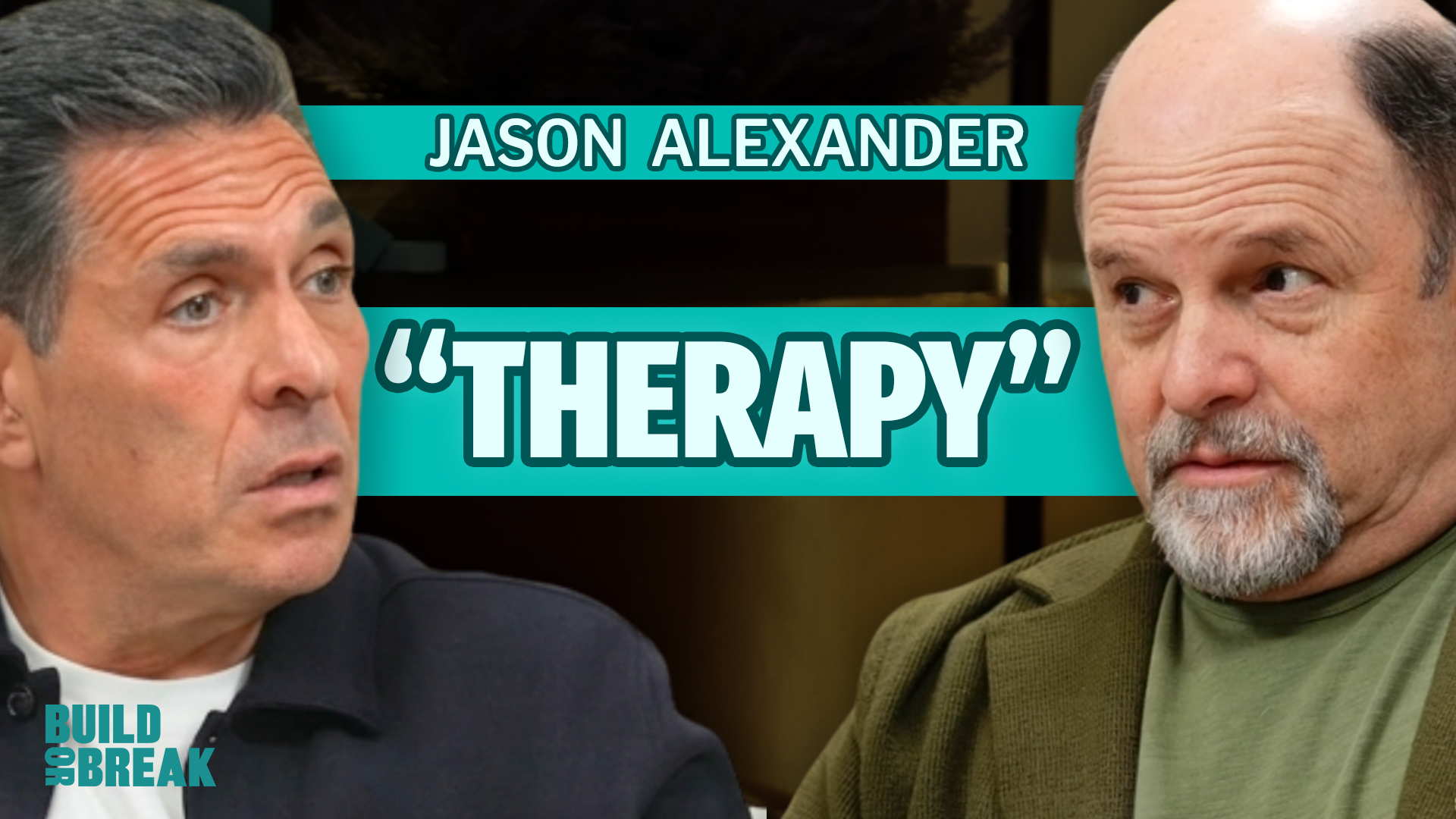
About nine episodes into Seinfeld, Jason Alexander walked up to Larry David after a table read and asked for help. The situation George was in seemed ridiculous, and George's reaction seemed even crazier. "This would never happen to anybody," he told David, "and if it did, no one would react like this." David looked at him and said, "I don't know what you're talking about. This happened to me, and this is exactly what I did." That was the day Alexander understood who George Costanza really was.
On the ninth episode of Build or Break, Daniel Lubetzky's weekly entrepreneurship podcast, Alexander sits down with his friend of 25 years to talk about the role that defined his career and everything around it. He explains how he built George out of Woody Allen's elevated diction, Jackie Gleason's habit of visibly swallowing every insult, and finally Larry David himself, down to a tongue-against-the-teeth tic David still does on Curb Your Enthusiasm. He tells the story of the early episode where he played a heart attack the way a hypochondriac really would, and David stopped him: "It's not funny. You have to have a funny heart attack."
The path there started with magic. Alexander says he was a bullied, lonely kid, and doing the seemingly impossible made him feel powerful. Theater did the same, and he was a working professional by 14, after a children's theater pilot aired on local New York television. In college, a professor named Jim Spruill told him that nobody would ever cast him as Hamlet and that he should get good at Falstaff instead. Alexander took it as "expand," not "stop," and built his own syllabus of comedians and comic actors. He was on Broadway at 21, and by 30 he had won a Tony Award.
Then Seinfeld made him an international celebrity, and he went to therapy. He explains why he expected the show to end his career, the way Carroll O'Connor never escaped Archie Bunker, why he says the five worst words in show business are "ladies and gentlemen, Jason Alexander," and how it took him the better part of 30 years to learn what to do with fame. He also describes the night on Broadway when Liza Minnelli missed a performance of The Rink and Chita Rivera taught him what leadership looks like: her colleagues first, the audience second, and herself last.
The conversation opens with how the two met: at Danny DeVito's house, where Daniel and his OneVoice co-founder Mohammed Darawshe were asking for help building a grassroots movement of moderate Israelis and Palestinians. Alexander describes his trips to Israel and Ramallah, a Palestinian street vendor shouting "George Costanza!" at him, and the man who kept mailing pallets of Kabbalah books to the Ayatollah. It ends with a rapid-fire round on the Seinfeld finale, Los Angeles delis, a residency at the Magic Castle, and why he hates playing himself on TV.
Key takeaways
- Feedback can mean "expand," not "stop." When a professor told him he would never be cast as Hamlet, Alexander built his own study of comedy instead of quitting, and it became his career.
- Great characters come from close observation. George Costanza combined Woody Allen's word choices, Jackie Gleason's reactions, and, once Alexander realized it, Larry David himself.
- Comedy needs a filter. Larry David's note about a "funny heart attack" taught him that playing something truthfully is not enough; it has to be run through what makes it funny.
- Nobody is ready for sudden fame. Alexander started therapy as Seinfeld took off, and he says it took the better part of 30 years to learn how to live with it.
- Leadership is who you put first. Chita Rivera chose to perform for 100 people so the cast would be paid, and asked them to give that audience the full show.
- Find your tribe, not your applause. Alexander says he became an actor because theater gave a bullied kid a community, not because he wanted people to clap.
- Good work can be a life of service. He came to see that the joy Seinfeld gave people in dark times was the service his mother always told him to pursue.
Chapters
00:00 — Intro
00:55 — 25 years of friendship
01:47 — Meeting at Danny DeVito's house, and OneVoice
07:06 — Trips to Israel and Ramallah
08:56 — The man who mailed Kabbalah books to the Ayatollah
12:56 — Is peace in the Middle East still possible?
18:26 — Talking with campus protesters
20:14 — The professor who said he'd never play Hamlet
21:33 — A bullied kid, magic, and theater
25:59 — His first professional job at 14
28:17 — Why comedians can do drama
29:48 — Larry David and the funny heart attack
31:29 — Jackie Gleason, Woody Allen, and the comedy toolkit
33:07 — The Seinfeld audition
34:26 — Realizing George was Larry David
37:37 — Peaking with Seinfeld, and therapy
43:34 — The five worst words in show business
47:34 — Stumbling into a life of service
50:18 — Chita Rivera's lesson in leadership
54:41 — What happens when you get what you want
56:49 — Build or Break rapid-fire
Common questions
What is Build or Break?
Build or Break is a weekly entrepreneurship podcast hosted by Daniel Lubetzky, the founder of KIND Snacks and a Shark Tank investor. He talks with builders, from founders to actors, athletes and public figures, about the setbacks that shaped them. New episodes come out every Tuesday on YouTube, Spotify and Apple Podcasts.
Is George Costanza based on Larry David?
Yes. Jason Alexander says he figured it out about nine episodes into Seinfeld, when he told Larry David that a storyline would never happen to anyone and David answered, "This happened to me, and this is exactly what I did." After that, Alexander started studying David, including a tongue-against-the-teeth reaction David does when he feels undercut, and used it to play George.
How did Jason Alexander get the role on Seinfeld?
He auditioned on tape in New York with only four pages of the pilot script. The dialogue read to him like a Woody Allen film, so he played it that way and even bought glasses for it. Larry David called, said they loved it, asked him to be less obviously Woody Allen, and flew him to Los Angeles to read for the network. He got the part.
Why did Jason Alexander go to therapy?
He says he started therapy as Seinfeld took off, because no one is prepared for going from being successful at a job to being an international celebrity. He went from about age 30 to almost 50, took a break, and went back at 60 to figure out which of the many versions of himself was the real one.
Did Jason Alexander win a Tony Award?
Yes. Alexander says his dream growing up in New Jersey was a life on Broadway. He became a professional actor at 14, was working on Broadway by 21, and had won a Tony Award by the time he was 30, before Pretty Woman and Seinfeld.
What is Jason Alexander's real name?
He was born Jay Greenspan. On the episode he says his wife, whom he has been with since he was 20, "knows Jay Greenspan. She doesn't know Jason Alexander," which he credits with keeping him grounded.
About Jason Alexander
Jason Alexander is a Tony Award-winning actor, director, and magician, best known for playing George Costanza on Seinfeld. Born Jay Greenspan in New Jersey, he started working professionally at 14, reached Broadway at 21, and also appeared in Pretty Woman. He now does more directing and teaching than acting, has performed a mentalism residency at the Magic Castle, and co-hosts the podcast Really? No, Really?
Jason: In the Middle East, peace initiatives are like Kleenex. Everybody has a box of them. If you want to have a commercially successful career, you're going to have to expand what you think you can do.
Daniel: How do you handle accepting that that was a pinnacle?
Jason: Therapy. That's where that George, that's Jackie Gleason going, oh. He was a no nonsense guy and he very lovingly said, "I know your heart and soul, this Hamlet, and no one's ever going to cast you as Hamlet. Look in the mirror. He's not faking it. He thinks he's having a heart attack. And I'm now arguing with Larry about how I'm right because this is what a heart attack would look like." And Larry goes, "It's not funny. You have to have a funny heart attack." Life has been good enough to me that I go, "Life, you don't have to give me anything else except the opportunity to do something that's interesting and engaging and maybe positive."
Daniel: Jason, you and I have known each other for 25 years or so.
Jason: Easily.
Daniel: A lot of people don't actually know. I know Larry David takes credit for that, but they don't know that the character for George Costanza was loosely based on me. Do you want to just complain with everybody and tell them the truth?
Jason: Yes, yes, absolutely he was. Absolutely. First of all, the hair alone.
Daniel: The hair alone. But the true story of how we met is it's a little heavier.
Jason: Yeah.
Daniel: I really do think that over the last 25 years, it's around 25 years that I've known you. By the way, it's so weird because one of my team members probably wasn't born when you and I met. It freaks me out when I think about
Jason: It. That's going to happen more and more, I'm afraid.
Daniel: I know. But the circles where we met were very intense. Do you want to share -
Jason: I was invited, you and your partner, Mohammed Darawshe. Were you both founders of OneVoice? Yeah. Yeah. I was invited by Danny DeVito to come to his home to hear you and Mohammed sort of make a presentation about what you were attempting to do with the OneVoice movement. And I had recently, I had done two trips to Israel, the first one very reluctantly. I really thought Israel would be a place that I would not feel at home in despite my Jewishness. But I had been very, very impressed by Israel and interested in its future and trying to understand the nature of this conflict. So I was interested in what you guys were going to talk about and came to the meeting and to put it in a nutshell, what you and Mohammed and OneVoice were doing were devising a systematic approach to appeal to the citizenry, the moderate citizens of both Israel and Palestine to sort of negotiate in their own terms for a two-state peace solution, having cited it as a failure of leadership on both sides to be able to get to that. And the methodology was pretty well in place and it sounded all very well thought out. But what got me in particular, I'm sorry to say Danny, was not you, you didn't have children at the time, but Mohammad was talking about his son Fadi and how Fadi, I think was 12 years old at the time and he had come to his father and said, "Hey Dad, remember when I said I was going to be the number one student in my class? I wasn't at the time and I worked really hard and I became the number one student." Mohammed said, yes, Fadi, yes, very proud of you. And he said, "Remember I said I was going to be the captain of the soccer team even though I was not the best soccer player and I worked really hard." And he said, "Yes. Yes, I remember. Yes." And then he said, "My son has now said to me, I'm going to be a martyr."
Daniel: Shy.
Jason: And Mohammed, father to father, turned to us and said, "I need your help to make my son give up this promise." And at that point, you guys more or less finished speaking and I came up to both of you and I said, "I don't know what I can do for you, but whatever you think it is, I'm willing to try." And that's when you and I became friends and we planned our first visit to the Middle
Daniel: East. I was just earlier today talking to my team at Builders, which is kind of like an evolution of the OneVoice work you and I did, which we're still doing in the Middle East. And I was telling them, when you're aiming for big dramatic change to change the course of history, you have to also accept the small wins. And by the way, it's not a small win for you to know that Mohamed's son is a very successful young man and he's moved in the right direction. And what we did through OneVoice and what we'll continue to do has impacted hundreds of thousands of people in ways that it's very hard to sometimes take account for. But I think that's something. I have to say that when we first met that day, it was a very weird period for me because I don't know if you remember, I had a full beard because I had lost my dad. And in some weird way, it was very grounding because I was there a week after my dad passed away and it was a difficult time to be there, but it made me for the most part not be easily fazed by celebrities because Danny had an incredible who's who there. And Mohammed and I were very grateful, but Brad Pitt was there. He was then dating Jennifer Aniston who was there and Edward Norton, Lucy Liu. There was dozens of incredible people. But I secretly had a man crush on you because I was obsessed with Seinfeld and with your character. Do you remember what happened when you finally said, "Hey, call me." Do you remember what happened or no? No. So you gave me your number and I practiced what I was going to do and hi, Mr. Alexander, how are you doing? And how to try to get you engaged because you said, "I'm willing to try to help, but I don't know how to help, call
Jason: Me."
Daniel: So I'm planning on Mohammad and I think about what I should be prepared to talk to you about and whatever. I'm like, "Yes, Mr. Alexander. Yes." I'm ready. And then when I call you, you say, "Hello." And I'm like, "George?" Because I don't know the way you said hello. And I was like, "I'm so sorry, Jason. I'm so sorry."
Jason: Do
Daniel: You remember that or no?
Jason: I don't because it happens all the time. I have people who I work with, they've met me as Jason, they know me as Jason. We're three weeks into something we're working on. And they'll go, "So George," and they're mortified. And I go, "That's how you met me. I mean, I get it. That's how you met me."
Daniel: Pretty Woman came before or -
Jason: Just before Seinfeld. Yeah. So
Daniel: I also enjoyed your character, but I think it just became such an iconic character. But normally when people get together and they develop a relationship and they decide to travel together, they go on a romantic vacation, the birds are chirping, it's like a sweet thing at the island, you went straight into
Jason: The Middle East. Went right to the Middle East. With us. There was no honeymoon period.
Daniel: That was one of the most fascinating trips I've ever done in my life. Do you remember some of it?
Jason: I do. I remember a lot of the first one. I think I've gone with you three times. The third time we went was the time we went into the Palestinian cities as well. But yeah, I remember many things about the first time I went with you. Actually, the
Daniel: First time you went, you went to Ramallah also. All three
Jason: Trips. Oh, I didn't remember that.
Daniel: Yeah, for sure.
Jason: Because I remember distinctly for the last trip, you and I believe Muhammad were on the phone and you said, "There's Palestinians on the board and they're complaining that you come, but you never go." And I said, "Well, how much of a risk would I be taking as an American Jew walking into Palestinian cities?" And Mohammed said, "The greatest dishonor that could happen to a religious Muslim is to allow harm to come to an invited guest." And he said, "Jason, if they had to, they'll take a bullet for you." And what was so interesting about that trip is, I don't know if you remember, we were having lunch in Ramallah with a bunch of actors and artists at a sort of outdoor restaurant. And the Israeli army was conducting a raid on a bank that they thought had terrorist ties a couple blocks away. And they must have, to announce themselves, just shot into the air. And I remember 10 of those guys at the table surrounding me. And I went, "Oh my God, he wasn't kidding. They're not going to let me get hurt." But the first time we went, there were things I remember. I certainly remember our great time with the gentleman from the Kabbalah Society.
Daniel: I want to talk about that one
Jason: Next. I
Daniel: Was going to end with
Jason: That. That was great.
Daniel: You remember that?
Jason: Oh, of course. I'll never forget that guy. I think that's what bonded us more than anything is we were trying to hold it together while this guy went on and on. Well,
Daniel: Let's just go out and go there and then we come back to this stuff. We were on a very long road trip actually to go visit Mohammed Darawshe in his village in Iksal where they've lived for many generations. And on the way there, it was a two, three hour drive because there was a lot of traffic and back then the roads weren't as good. And this gentleman started talking, do you remember his theory of change? Yeah.
Jason: Sending pallets of the Kabbalah to the Ayatollah.
Daniel: Yeah,
Jason: Literally.
Daniel: Yeah,
Jason: Pallets.
Daniel: He was literally sending this Jewish mystical book by the pallet loads, pallets and pallets. They would arrive in the Islamic Republic regime dedicated to the Ayatollah. And his theory was...
Jason: Well, he said the first time he sent a pallet and he heard nothing and he went, somehow it didn't work. So he sent another pallet and he got a letter back that basically said, "I think there's been some mistake. We don't need these. Please don't send anymore." And he went, "You and I would go, we should stop." He went, "I've made contact. I'm beginning to be effective." And he kept sending them until finally he was getting letters that he didn't understand how funny they were going, "Stop sending these fucking books. Stop." You and I were like, "These guys
Daniel: Either going out
Jason: Single-handed only." He's going to ignite
Daniel: World War
Jason: III, that's right. Or
Daniel: They
Jason: Might say,
Daniel: "Okay,
Jason: Fine. We'll
Daniel: Make peace with you." Just stop sending all those books to
Jason: Us. But he was so clueless.
Daniel: He was just trying to.
Jason: We were hysterical.
Daniel: We were literally laughing to the floor of the car as we did.
Jason: That's right.
Daniel: But sometimes I wonder if when people saw you and I pursuing peace in the Middle East, they're like, "Fine, we'll make a deal just to get rid of these
Jason: Guys." That's right. Exactly. Get them out. But we had great conversations. I remember you took me to... One of the reasons you said it would be helpful if I went is because at the time, one of either you or Mohammed said, "In the Middle East, peace initiatives are like Kleenex. Everybody has a box of them and nothing gets any attention. Nothing gets..." The Israeli press at the time was like, "Yeah, whatever, whatever." And so I was the carrot that you were going to dangle to sort of get them to come to. You being modest.
Daniel: You were certainly back then a phenomenal like I've never seen before because it was interesting, both the Israelis and the Palestinians were starved for positive constructive attention and for a celebrity of your caliber because it was coming right off of you. Seinfeld was playing at the time all over. There were thousands of people in line to try to get to every one of our events and the paparazzi where it was crazy.
Jason: There
Daniel: Were hundreds of paparazzi for you, nothing like I've seen in LA, but you have hundreds of people.
Jason: Every now and then. Yeah, absolutely. But what was so astonishing is when the time that I do remember going into the Palestinian cities was Ramallah, and I'm getting out of the car and I'm going, "I don't know how I feel about all this. It feels a little dangerous." I stepped out of the car and there was a Palestinian street vendor with a cart. And I got out of the car and he went, "George, George Costanza." And street vendor started and I went, "Oh my God, they're watching our show in Palestine." It was incredible.
Daniel: It
Jason: Was amazing.
Daniel: And you always were very humble to always say, "I'm here to put the spotlight on people like Mohammad on people." Because by the way, that was my role too. I'm a confused Mexican Jew. I'm neither an Israeli nor a Palestinian. What you and other people from the Entertainment Council did was to try to put a spotlight on the true depth of the grassroots infrastructure work where thousands of people were working for the movement and hundreds of thousands signed on.
Jason: And Danny, I haven't asked you, so given everything that's going on in the region now, is OneVoice impactful still in some way? Is it at least part of the ongoing dialogue?
Daniel: The truth is that a lot of things have changed. You may recall there were four pieces of OneVoice. There was OneVoice Israel, OneVoice Palestine, OneVoice Europe, OneVoice USA. Each of them have been transformed. We're now, I think, in 60 campuses and they're working, they're doing good work. But I thought you were going to ask a slightly different question, which is how do I compare today to then in terms of whether I'm hopeful or negative? How are you
Jason: Feeling? Well, I know, because in our couple of conversations, I know you're hopeful. What I saw in the multiple trips that we were taking, and I haven't been to the region easily since 2012, so it's been a good decade. When we first started going, the talk of two states was prominent. People may have been doubtful, but they were hopeful. Towards the end of when I started to go, I heard less talk of two state. I saw a little more entrenched unwillingness to try and experience the conflict through the eyes of the other. And I began to think, oh, this is going in the wrong direction. This is really going in the wrong direction. I can't imagine how this generation of Israelis and Palestinians get to the place where they can let go and forgive enough, as you always said, not to be best friends, but to be respectful neighbors that allow for dignity and self-determination. I don't see that kind of grace in the world right now in huge numbers. So it's harder for me to be hopeful that it's around the corner. I think working for it is still absolutely vital.
Daniel: I would not use the word hopeful, but that's just because I never think in those terms. You may recall because I've shared this with before. For me, whether being optimistic or pessimistic, it's never crossed my mind to think that way. I always think about what do I need to do about it? It's not about whether the glass is half full or half empty. Fill up the damn glass, be an action, do something about it. And so if I was forced to ask whether I'm hopeful, I would say I'm very sobered up. I mean, the amount of hate that I'm witnessing nowadays across all walks of life is much greater than when you and I started on this journey. It's terrifying. It's horrible. It's horrifying. The reason why I'm determined and I actually am convinced that we can actually make a difference is nobody likes this. No Muslim or Jew is happy with the demonization going on. No Christian is happy. No anything. Everybody recognizes that there's something wrong with our society, partly fueled by social media and these us versus them algorithms, partly fueled by all these toxic forces. And the reason why I'm convinced that we have a chance because of my daily experiences, forget about the geopolitical stuff which I've studied for decades. If you look at the daily experiences, this just happened to me this week. There was a person that was being very difficult with me and I was becoming very difficult with that person and it was escalating. And then this person just showed leadership and kindness and respect and humanity towards me and completely made me shift and made me... And then we ended up with a very, very good outcome. And the same thing happens in the Israeli-Palestinian conflict. Each side thinks there's no partner, and so they double down in defending themselves because they're nationalists. They believe in their rights and their children's future, but neither side's aspirations are going to be fulfilled if they're at each other's throats. But if you really start thinking about it, When you and I visited the region, the Arab-Israeli population, which is about 20% of Israel, 20% of Israelis are Arabs, mostly Muslims, people like Mohammed Darawshe, most of them called themselves Palestinian citizens of Israel. They acknowledged their Israeli passport, but they didn't have an identity as Israelis. Today, 40% of them identify as Israelis, proud Israelis from Nusaya Sin to Lucy Aharish. There's incredible group of leaders that are Arab, that are Muslim, and that are proud to be Israeli, and they're an important bridge. And similarly, when you and I were doing that work, Saudi Arabia was sponsoring hate. Now they are part of the solution. They're really working really hard to deconstitute and neutralize extremism and terrorism. The Emirates are probably one of the most remarkable countries in the region. There's a lot of momentum in the Arab world to recognize that's enough with this extremism and absolutism that we need to turn the page and build together, and now we need to do that here on our shores.
Jason: Yeah. I was doing a benefit somewhere and there was a protest and I always try, if it can be respectful, I try and go and spend five minutes, 10 minutes with them. The thing I said to them, because they all have absolute answers, boycott Israel, land to the sea. I go, "Okay, so which side do you think is stupid? Are the Palestinians stupid or are the Israelis stupid or are they both stupid? Because you clearly think one of them is stupid." They go, "What do you mean?" I go, "Well, this conflict has been going on longer than I've been alive and I'm alive 66 years. I've been to Israel and Palestine. By the way, have you?" No. I go, "Oh, okay." Well, my experience of the Israelis and Palestinians is they're really smart. They both value education and they both know what they're talking about and they can't resolve this conflict. But you standing here on the campus of UCLA, you've got the answer. So you have to believe one of these cultures is just stupid because you can figure it out,
Daniel: But
Jason: They can't.
Daniel: But you're being too generous. You're being too generous because it's not just that they think that they have the answer. They're actually causing a lot of harm because people that hold on to diluted absolutist perceptions about fully destroying and annihilating the other side, if a person says from the river to the sea and they want to destroy Israel, that makes Israeli say, okay, we need to defend ourselves. This is
Jason: Exhibit
Daniel: Number one that we need to not allow that to happen. And so these absolutist efforts to destroy the other side end up hurting the people they're purporting to support.
Jason: Absolutely. Absolutely.
Daniel: What we're doing with builders and part of what we're doing with Build or Break is to try to help everybody. It's not necessarily about the politics, but in our own lives, how do we become builders? And we're doing that also for our personal growth. We're interviewing some of the most extraordinary, amazing people that have accomplished so much and trying to get into the madness of how they became who they became. So I'm going to pivot a little bit and ask you a little bit about your craft. And this is not only for actors, comedians, magicians, this is for everybody, but I really am very curious about your craft and about your build or break moment. By the way, I've known you 25 years, but I also enjoy learning a lot. One of the things that I learned is that early in your journey, one of your professors told you, "Jason, I don't think you're meant to be Hamlet. I don't think that's going to work out." And he encouraged you to move to comedy. And for me, it was fascinating to think that you could have just given up, you could have just quit or ignored the advice, but you actually delved in and pivoted and then did something incredible. So can you walk us through what was going through your mind as a kid when you're being told advice that could be putting you down? I don't think he meant to put you down, but you took it constructively, you took that feedback and did something good with it. So tell us
Jason: About that. So when I was a little kid, my ambitions were in the world of magic. I just wrote a forward for a magic book that's coming out that the magician Ossy Wind is doing. And I talked about this a little bit about why do little kids sometimes get into magic? And in my case, it was because I felt isolated and scared. I was the target of the bullies. My siblings were out of the house. I was basically a latchkey kid, and I did not feel powerful in any way, shape or form. The idea of doing things that other people couldn't do, doing the seemingly impossible, meant to me, oh, you're going to be powerful and people will perceive you as powerful. That's what I was hungry for. Likewise, when I realized I wasn't going to be the magician I wanted to be, and I got pulled into the theater world with those kids, the initial things I was doing made me feel, oh, this is powerful. This is very powerful. So my aspirations were to the classics of the great theater, or I told Bill Shatner this, Bill Shatner's Captain Kirk was one of my heroes because why? Powerful, powerful guy. He's running a starship around the galaxy. All my aspirations when I went to college were as being a dramatic actor in these sort of powerful roles. The gentleman you're talking about was a professor named Jim Spruill. He was the only black professor in our program. He had come up from street theater in the 60s where you do theater to change the world kind of thing. He was a no nonsense guy and he very lovingly said, "I know your heart and soul is Hamlet and you would probably be a very profound Hamlet and no one's ever going to cast you as Hamlet. Just look in the mirror. I'm five foot five, 25 pounds overweight, already starting to lose my hair." He said, "No one's going to cast you as Hamlet. You might want to get good at Falstaff." And he was basically - Falstaff? Falstaff is one of the great comedic roles in the Shakespeare canon. And I went, "He's telling me to be funny." Now, I didn't think of myself as funny. I thought I was engaging. I could be that, but I didn't think of myself as funny and I never thought I could have a career in comedy, but I took him very seriously. He didn't say stop. He said, "Expand." It doesn't mean you can't do what you have your eye on, but if you want to have a commercially successful career, you're going to have to expand what you think you can do. And for some reason, instead of being defeated by that, I got inspired by that and I began to build my own syllabus of comedy performances, comedians, comic actors, looking at old films, looking at television shows, listening to comedy albums, and trying to understand why funny people were funny. What were they doing that was creating this comedic effect? Jackie Gleason had his bluster. Woody Allen was the little man who thought he was more than he was, a ladies man when he's a nebbish. Sometimes it's musicality. Why is Jackie Mason funny? He's funny because he looks like and the music of his voice is funny and his movements are funny. So all these things were ideas that I began to play with until I could begin to build what I call my bag of tricks that I can pull something out of and go, "If I put this idea on this piece of material, I'll probably get a funny result."
Daniel: Is there something that you think equipped you to, instead of being defeated, be inspired to turn feedback into something you could do something good with and be a protagonist to not just be a victim, but to actually do something good with that feedback? Where did that come from?
Jason: Part of it was purely circumstantial. I fell into a professional career when I was 14. So I was already a professional working actor when I went to college and this happened. So I knew there was a potentially successful career there for me. It wasn't like I was just a student going, "When I get out of here, I hope good things will happen." They had already started to happen. So I had that going for me. What
Daniel: Was your first job?
Jason: When I was 14, I had to join what was then AFTRA, a standalone union, because I was doing local children's theater in New Jersey, little original musicals for children. And there was a father who brought his kid who happened to be a television producer and thought these might be a good children's series. So he made a pilot and I had to join the union. And the reason my career started then was he never sold it as a series, but he got it on local New York television one Sunday morning. They just aired the pilot and a management company that only handled kids and teens saw it and hunted me down and went, "We would like to represent you." And so they started my career at age 14, mostly commercials.
Daniel: What was the pilot about?
Jason: What was the pilot? It was called Pushcart Players, which is still a children's theater organization in Jersey. Pushcart Players Feelings and Friends. And it was two little 15 minute music. I played multiple parts. They were a little tiny. It's almost
Daniel: Like it was like theater, theater on time. Isn't it fascinating that that moment where you tried something out, you took the risk to just try something out and all of a sudden you look back and that moment was -
Jason: I think for most of the successful people I've found, yes, they had the skills for it, but it's a bunch of happy accidents. It's literally being that right place at the right time. Yes. Happy
Daniel: Accidents, just a little fortune. But one of the things I'm finding, I'm enjoying this a lot. I don't know if I'm good at it, but I'm enjoying it a lot. And one of the connective tissues I see among all these successful people is they try shit out. They take risks. They just try things out. And every one of us has their founding story, but they all involve getting outside your comfort zone. But it's my impression that being a comedic actor is harder than a dramatic actor. And interestingly, I'm a great father, so I started watching Breaking Bad with my voice recently. But it's interesting, both Breaking Bad and Better Call Saul, almost the entire ensemble were comedic actors. It's fascinating to me. And I'm connecting the dots that people that can do comedy can do anything. Am I right or am I totally getting it wrong?
Jason: My general experience is that good comedians are more successful at doing dramatic roles than dramatic actors are doing comedic roles.
Daniel: Why? What does it take, because you've been both, what does it take to be a great actor, a great comic actor, a great dramatic actor, or is it not easy for you to distill
Jason: It? It's different things for different people. Why people are good at things, it's hard to put your finger on. There are some great actors who really have mastered the tools. That was the thing that was so eye-opening to me when I went to school and started studying this is that there are tools for an actor that you can use. Some people just use the tools brilliantly and they become brilliant actors. Some have an enormous natural empathy and ability to observe so they can empathize with the characters in the situations. It opens their heart and they can deliver the truth of that moment. It's one or the
Daniel: Other or somehow -
Jason: No, sometimes it's combinations.
Daniel: Which
Jason: Is you? For me, mine is mostly... Well, mine is, and I think that's true for all artists, but you keep developing as you go. But initially, my superpower was observation and imitation was how I was able to do most of my early work. With comedic actors, Larry David really opened my eyes to this in an interesting way. In an early Seinfeld episode, George thought he was having a heart attack. Now, Jason goes, "Okay, we know George is a hypochondriac. Hypochondriacs, if they have a pain, they Google everything and they know everything it can be and what the symptoms are. I figure George is that kind of hypochondriac. So if he thinks he's having a heart attack, he's going to have the pain in his chest, the pain in his arm, the shortness of breath. He's going to have a heart attack, right? I go to rehearsal and we do the scene and Larry goes, "You can't do it that way." I said, "What do you mean?" He goes, "It looks like you're having a heart attack." I said, "Well, he thinks he's having a heart attack. He's not faking it. He thinks he's having a heart attack." And I'm now arguing with Larry about how I'm right because this is what a heart attack would look like and George would know what a heart attack is look like. And Larry goes, "It's not funny. You have to have a funny heart attack." And he's right. I'm wrong. He's right. And then I had to go, "Okay, how do I take all this and run it through a filter that makes it funny?" Performers that don't have the answer to that question can't do comedy because they're going to have a real heart attack. I mean, that's the difference.
Daniel: Can you give us, including me, some of your toolkit for funny? Because I've found there's so many different types of intelligence and being witty and being funny, it's not something... I mean, I'm very good at being self-effacing or whatever, but give us a couple of your toolkit, just a couple of things that you -
Jason: Things that I learned about one of the great influences. I mean, you can see it in George. George borrows very heavily from Jackie Gleason. So what was funny about Jackie Gleason? He was actually a little man in an oversized body with an oversized ego, but he's a very little man. He's a bus driver. He's a simple guy, loves his wife, wants to believe that he wears the pants in the family. He does not. Wants to believe he's smarter than all his friends. He is not. He's a little man acting big. And part of what Gleason would do is his wife, Alice, would say something cutting and instead of glossing over it, you'd see him eat it.
Daniel: That's
Jason: Where that George, that's Jackie Gleason going, "Oh, you're all right, Alice." It's that same sound. So watching Gleason do those physicalities of being belittled, so much of that is George. Woody Allen, it's word choices. He doesn't go, "I'm the smartest guy here." He goes, "I'm the most profound." It's an elevated diction. And coupled with that New York accent of a guy who's stammering and spitting, but he might be the most articulate guy in the room. That's hysterical. So many
Daniel: Things. When you get
Jason: Hired
Daniel: To do George, do you then start studying who to be inspired and come up with Jackie Gleason or can be forward or somebody give it to you? How did that come?
Jason: So my audition for Seinfeld, nobody from the program was there. I was in New York. They were all in LA. They put a couple of guys on tape in New York and I only had four pages of the original pilot script. So I have no context. I know that they're looking for a Costello for Jerry Seinfeld's Abbott. That's all I know. So it's a second banana. It's a fall guy. When I read those four pages, it read to me like the dialogue of a Woody Allen film. So I went, Woody Allen, that's where the glasses came from. I didn't wear glasses at the time. I got a pair of glasses and I literally was doing Woody Allen. You don't understand Jerry. Jerry. And those were my choices, Woody Allen. When the call came in from Larry, he said, "We love everything you're doing. We want to fly you out to read for the network. Love it. Just don't be so obviously Woody Allen." So I took out the stemmering, the stammering, and I just did a lodge New York accent. Then I get the job. And now I'm going, "Well, how do you play George? Who is he? I don't know who he is." So I got Woody Allen in my head. I got a little bit of Jackie Gleason in my head trying to figure out what this guy is. And
Daniel: You haven't yet figured out that it's Larry.
Jason: So somewhere about nine episodes in when -
Daniel: Nine episodes in?
Jason: When we did the reading at the table, I wish I could remember the episode. I don't. Whatever it was, I thought the situation that George found himself in was ridiculous and the way he reacted to it was crazy. So I went up to Larry after the reading and I said, "Larry, please help me. Help me." I said, "Okay, we both know that this would never happen to anybody. And if it did, no one would react like this. So what are you going for? Tell me what you're going for and maybe I can understand that." And Larry said, "I don't know what you're talking about. This happened to me and this is exactly what I did." And I went, "Oh, that's the day that it hit me." Wait, let
Daniel: Me ask you a question. Were they trying to keep it from you for some reason or did
Jason: Larry
Daniel: Also not really know that it was him at that point?
Jason: Larry certainly knew that a lot of the storylines were being told. Larry has notebooks of things that happened to him. And he basically, to create Seinfeld scripts, he and Jerry would go, "Let's take that and that and that and put it together." So he knew he was drawing from his life. I don't think he thought he was writing his own avatar, but the minute I understood that, then I started watching Larry. And Larry, I've done this before for people. Larry has a thing that he does, like Jackie Gleason had... When Larry gets undercut or thinks he's been undercut, you've seen it. If you watch Curb, you've seen it. He puts his tongue at the base of his bottom teeth and he does this. And that's how I learned to do George.
Daniel: I've known you for 25 years. You're not George. You're like one of the brightest people I've ever met. No, for real. You're just the sweetest heart. You got the soul, the heart and the brain. You're not George. George is amazing. I love George, but you're not George. When I do Shark Tank, they ask if the sharks are who they are. And what I explain about Mr. Wonderful, have you watched Shark Tank? Yeah. Kevin is like the tough guy. He really is Kevin. He just amplifies it for the TV. And time again, find some of the people that play the biggest jerks. In real life, they're actually the salt of the
Jason: Sweetest people.
Daniel: And do you still encounter people that demand or assume that you are either the lawyer for Pretty Woman or the -
Jason: It's more the George thing. When I don't... I mean, I still have solid hints of a New York, New Jersey accent when I speak, but when I'm not doing the thick New York accent and I don't have the glasses and I'm not...
Daniel: And you're yourself.
Jason: Yeah. They don't know if I'm putting this on or they're expecting that guy because that's all they know.
Daniel: Well,
Jason: That's all they know. I mean, nothing else I've done. I mean, I've had a lovely career. I'm not complaining. But the biggest single impression of me that is repeated over and over and over today is George. So if you don't know me from anything other than Seinfeld, it's a big compliment. People go, "I didn't think you were acting."
Daniel: I had another reflection about this, and I've never asked this and I don't think I've ever talked to anybody about it. I don't think anybody's ever asked it. Every human being has a pinnacle. Sometimes they're not going to become the most famous actor, whatever, but you were the high school quarterback
Jason: And
Daniel: Then afterwards nothing ends up being as big as that. Or your wedding day or you achieve this or you achieve that. And you've very majestically managed your journey. George is one of the most extraordinary characters. If I have to think of 25 in my lifetime, it's just an incredible Seinfeld for people that didn't grow up when it was happening. It was a phenomenon. It was like nine years where it was a huge thing. It was like gigantic phenomena. And then it ends and you've gone to have a very elegant journey, but how do you handle accepting that that was a pinnacle?
Jason: Therapy.
Daniel: You literally went to therapy? You
Jason: Bet. I was in therapy while it was happening.
Daniel: Why? Because you knew it was coming or
Jason: Because you
Daniel: Just
Jason: Lacked therapy? The transition from successful at your job to international celebrity, let me just tell you, I don't care how well you've been raised or who you are, you're going to need some therapy. Keep you
Daniel: Grounded.
Jason: It is a mind fuck, but ongoing therapy for sure. But part of it was that if your dream is to be the quarterback of the, I'm terrible, of the Green Bay Packers, you want to be the quarterback and you don't get that, you never had it. That's your thing. It's never achieved it. You never got it. My fantasy of a successful life for myself as an actor growing up in New Jersey was getting across the river and working on those Broadway stages. That was the pinnacle for me. I didn't think about television. I didn't think about film. I dreamt about a life in the theater. God gave me that starting at age 21. By the time I was 30, I'd won a Tony Award. And now they throw in my path, Pretty Woman, some of the other films, Seinfeld. And I now live a life as an actor that I never dreamt of, never. I never thought I would have this kind of money, that I could keep my family the way I keep them, that I would have these opportunities, that I would work with the people I've met. So if you hit that and then that goes away, I would never go, "Why couldn't I keep that?" I go, "I can't believe I ever got that. That's not what I was thinking." So for me, life gave me more than I ever dreamed of. I didn't expect that to last. I objectively could sit back. And one of the reasons that we were so adamant at the end about making money on Seinfeld is because I grew up at a time when if you had a hit series on television, you never worked again. I mean, that was it. You were defined as that character, Carroll O'Connor, Archie Bunker. He stretched Archie Bunker out a whole long distance, but he never played anything other than Archie Bunker again. Alan Alda, M*A*S*H, he never got much beyond that. All these great, particularly television stars, they weren't given usually the kind of huge career after that. That was my anticipation. But to
Daniel: Your point about therapy and about staying grounded, my sense of life's a lot about expectations. And to your point, if you don't expect that, fine. But also once we've tried steak, we don't want to go back to the beans. That's a Mexican expression. I don't know if it exists in English. The person that's tried the steak, they don't want beans anymore. I don't know if you had this technique, but I throughout my life have deferred satisfaction. Once I was in New York and I could afford a one bedroom, I stayed in my studio apartment just a few more years. And then when I could do a two bedroom, I stayed in my bedroom. I paced myself. I didn't own any real estate till I was in my 40s. I didn't own a car. I didn't own anything. I do feel that once you get spoiled with something, it's easier said than done to be appreciative like you have. Let me extrapolate. With Kind, my dream was, well, it was PeaceWorks, my first company, but then with Kind, I wanted it to get to $10 million. That was my goal. I didn't think I was going to get past it. And then all of a sudden you get there and you realize you can go further and further and further, and it's exceeded my expectations before anything. And because I had 10 years of failures with my PeaceWorks company, financial failures, I do think it kept me grounded and not thinking that I am better than people because I messed up just as much, but I don't think it's the easiest thing. For me, my grounding tool is my wife and my kids, conversations with myself, taking risks and trying to do things that put me in a situation of vulnerability. I still hand out kind bars and sometimes people look at me like, "Who's this popper? Why is he soliciting me?" And it just humbles me enough. Do you have techniques like that or you're like, "No, just going to theater and having to be applauded every night, that's your technique?"
Jason: Danny, I was very lucky in a lot of ways. So you would think, knowing the little bit I've shared with you about myself as a kid, you would think finally being on stage and having people clap for me would be why I became an actor. It's not why I became an actor. The reason I loved it was I found my people. I had no tribe. I was not a sports kid. I was not a brainiac best student. I wasn't cool. I wasn't anything. And I went to a rehearsal for a play and these were my kids. This was my community. So I wanted to be an actor because I could be in that community. It had nothing to do with the applause, really. I loved the challenge of getting on stage. I loved the excitement of it, but it wasn't the hardest... I always say to people the five worst words in all of show business for me are ladies and gentlemen, Jason Alexander. I'm happy on stage because I'm hiding. I'm somebody else. I'm living someone else's life. I'm telling someone else's story. If I had to tell my story, I'd be much more... So part of my groundedness for whatever that is, is that I wasn't in it for the accolades. I wasn't in it for the compliments. I wasn't in it for the accoutrement of being a star or a celebrity. That's number one. Number two, just like you is my family. I've been with my wife since I'm 20 years old. She knows me. She knows me, and that's who I live with. That's who I go through the world with. She knows Jay Greenspan. She doesn't know Jason Alexander. The third thing was, and it may be our humble magic roots, I know the difference between an illusion and reality. I tell stories and I make illusions for a living. I'm not stupid enough to believe in them. I know I'm not powerful. The experience I offer you is powerful. The story I share with you is powerful. The illusion, the thing we share together, the Seinfeld show. Me playing George in these little stories has a very powerful effect for people's lives. I've met them. The greatest joy for me is when people come up and say, "You got me through really dark times. You made me laugh. You brought joy back to me." And I go, "The experience did that. I was part of that experience and I'm so proud to be part of that experience and grateful for it. It's not me. It's the thing we shared together, who you were in that moment, what I was part of in that moment." And when my son Noah sometimes said, "Dad, everybody loves you." I go, "Honey, they don't know me."
Daniel: So you said at one point that you knew that there was never going to be another Seinfeld. I also know there's never going to be another kind. I could potentially launch another company and succeed, but I don't take it for granted and it's very, very, very hard. I'm very unlikely for you to achieve that type of company. But what I tell myself is that I have yet to achieve the most that I can achieve. I don't want to be remembered for kind. I want to be remembered for builders. I want to build a movement of people that break the chains of hate and that mobilize citizens to regain agency and to hold their politicians accountable and not allow politicians and other forces to divide us. Am I living in an illusion and doing that because I'm just questing for meaning and purpose? And is it a little bit like the illusion that you acknowledge is an illusion by you entertaining people? I'm not really sure if I'm asking whether our search for meaning is an illusion or whether there actually is truth in the work we do in the how, because every time you entertain that audience, you actually created a beautiful moment for them.
Jason: It's all yes. It's all yes. Listen, for you and for me and for everybody else, the answer to that question will change day to day and moment to moment. There are times when I think we pursue what we pursue because there's a feeling of I can do or be or experience something more and therefore I should. Sometimes it comes from that. A lot of mine of late and why I am completely grateful and satisfied with how my path has gone is I finally understand what my mother was telling me all the time as a kid where she would say, "The greatest life you can live is a life of service." And I really felt for the longest time I had missed it. I would say to her, "Mom, I do this because I'm good at it. They pay me a lot of money. They treat me very well. I can make my way in the world. I don't think anybody's life is changed or improved because I got a gig. It's about me." And I meant it. And that thing that I shared with you about the effect that Seinfeld has had on so many people began to make me understand, I stumbled into a life of service. These stories, these things that I can be part of at any given moment can save someone. It can change their day, change their minute, change their life, maybe, who knows? And even in the work I do now, I do a lot of teaching. I do more directing than acting. Why? I'm more interested. If you and I go to work together, I'm more interested in what I can do for you than in what you can do for me. Life has been good enough to me that I go, "Life, you don't have to give me anything else except the opportunity to do something that's interesting and engaging and maybe positive." But if I show up to a gig now as an actor, as an actor, and I have... It's what I teach when I teach. If I have a two page monologue and you don't say a word, the most important person in my scene is you, not me. Why am I saying these two pages of things to you? What am I trying to get you to do? What am I offering you? What's the response I'm looking for? And how do I get you to know that when you have no lines on the page, you don't even know what your reaction is supposed to be. So I have to give you things in order to make you valuable. And that's my bedrock.
Daniel: Is there an unsung hero in your life that helped you become who you become and you haven't gotten a chance to acknowledge and that they really had a bigger impact than you than you realize or that they might realize?
Jason: My second Broadway show, I was 24 years old and I was cast in a show called The Rink. It's not one of the big musicals that has become Broadway legend, but the stars were Liza Minnelli and Chita Rivera, and I love them both, but my story's not about Liza. Chita Rivera, I remember consciously thinking, and I can give you the incident, but in general, my thinking was, if I'm ever lucky enough to be the guy, the star of the show or the person on the set or whatever it is, this woman is teaching me how to be that leader. So there was a policy if either of those ladies were to miss a show, the audience could get a refund. You didn't have to watch it. Chita would never miss a show. Liza missed a couple of shows. And on this one particular night, Liza was out and the stage management came to Chita. We're in a 1200 seat theater and they said, "Chita, it's totally up to you. There's about a hundred people out there. It's insulting. You don't have to do the show. You don't have to." First of all, it is insulting. Chita Rivera was a gigantic Broadway star, and the fact that Liza wasn't there, 1100 people walked out of the theater, it's insulting. But Chita hears this and she says to the stage manager... So the show was Chita and Liza and six actors, the boys. We were the boys. She said, "If we don't do the show, will the boys lose their salary for the night?" And they said, "Yeah, they would." So she said, "We'll get the boys." So we were summoned down to her dressing room and she said, "Here's the situation. Liza's out, there's a hundred people out there. We don't have to do the show." She said, "You know what? If we don't do the show, we'll go to my favorite restaurant. I'll buy dinner. We'll have a party. We'll have a great night on me, but you will lose your salary for the night." She said, "On the other hand, Liza's understudy is ready, but she's never had what we call a put-in rehearsal where all the elements are there. There's a hundred people. We could think of it as a put-in rehearsal for her. See how it goes. We'll do the show. And you know what? Then we'll go out and we'll have a celebration. We'll bring her with us. Either way, whatever you guys want to do, it's a hundred people, you don't have to do the show." And we went, "Let's do the second one. We'll do the show. We'll get paid. We'll still go out and have a great time." And we thought, "And we're going to screw around. We don't care what we do. We're going to have a blast out there. We're going to horse around. We're going to do stupid stuff." And Chita must have seen that look in our eye, that devilish look. And she said, "Boys, the hundred people that stayed, stayed. Give them our show." And that's when I went, at this moment, where she could have been so offended and so diminished in her own eyes, her first concern was her colleagues, her second concern was her audience, her last concern was herself, and that's what I clocked. And that's when I went, "She is here to teach me what success looks like in this business."
Daniel: I love that story, and it reminds me a lot. I had never appreciated... Now I connect the dots on what you're saying about how you care about what you're giving to that audience. And it's kind of like in consumer product goods, if you win, is if you're thinking about your consumer, not about yourself. You think about your team and you think about your consumer. Absolutely. And if you're just thinking about yourself, it's not going to work out. And that's like the parallel. Wow, that's so beautiful. Amazing. I have one last question before we go to our final segment, which is, is there a question I didn't ask you that I should have asked you or a question that you've never been asked that people should have asked you until now?
Jason: What people don't talk about, and it happens to everyone I know, is what happens when you do get what you want, when you get more than what you thought you want? I alluded to it before about I started therapy, really started therapy as Seinfeld began to be a thing. What happens to people when they go from living their lives to living their lives under a microscope on this huge scale, I don't know anybody that is prepared for it, particularly in our world now where that microscope is unending, you can't get away from it. It took me the better part of 30 years to understand how to deal with it, navigate it, what to make of it, how to be... It's so funny, Danny. I went to therapy from about 30 to almost 50, and then I took a break for about 10 years. And when I was 60, I'm 66 now, when I was 60, I went back, same therapist, and she said, "Why are you here?" And I said, "Well, I'm coming into, I think, my third act of my life. I have been so many avatars, both intentionally, I've played so many roles, but I've tried to be so many things in my childhood, in my adolescence, in my adulthood, in my marriage, as a father, in business, that I don't know which one is real. I don't know what's real. I don't really know who I am or what I really feel about anything, and I'd like to find out. I may not like the one that it is. I may not choose to live my life as that, but I'd like to at least know who that guy is.
Daniel: Well, we're going to move now to our last segment, which is a rapid fire segment called the Mexican Inquisition.
Jason: Oh, geez.
Daniel: You need to tell me build or break. Build or break.
Jason: Build is up, break is down. Okay.
Daniel: Ready?
Jason: I'm ready.
Daniel: The Seinfeld finale.
Jason: For me, it's a build, but I can tell you why. It's not because of the story. It's not whether it was a good episode or a bad episode. We were a very unsentimental show. Larry and Jerry found a way to bring back every actor that was important to our success, that was meaningful to our journey to share that finale with us, and I thought that was gorgeous. So build.
Daniel: Build or break sitcoms film with a live audience.
Jason: Generally build because it's a real reaction. The problem is it's not always a real reaction because you got somebody in the crowd going, "Come on, make it." So it's a little bit of false and inflated, but the idea of it, build.
Daniel: Build or break, bluffing a busted flush.
Jason: Personal history, break. I'm very bad at getting. Jason's like a
Daniel: Very big deal in the poker circles.
Jason: You
Daniel: Won some stuff.
Jason: I've won some stuff, not the big stuff. I win when I'm playing for somebody else. You remember you invited me
Daniel: Once. I almost went with you. Yeah. Build or break pro shot Broadway shows.
Jason: A qualified build. It is a great archival of something that theater is just the people who saw it, it lives in memory. So I like the idea of the preservation. I can tell you that with the possible exception of Hamilton, I've never seen a live performance captured on video that did what the live performance did. Yeah. They usually, they're not built for the camera.
Daniel: Build or break theater as an investment.
Jason: Oh. Well, if it's my show and I'm coming to you for money, build. But if I'm your friend and you're saying, "Hey, I'm putting money in," I'd go, "Break."
Daniel: Build for the right reasons.
Jason: Yeah. Yeah. Unfortunately, most of them lose money.
Daniel: Build or break Jewish Delis in Los Angeles.
Jason: Break. Break. We can't get a bagel worth it's... But
Daniel: You took me once, I think, to
Jason: Canter's or something. On Larchmont Street in Larchmont Village, there's a good bagel store. Canter's is an okay thing. Where did you take me? Do you happen
Daniel: To remember?
Jason: It was either Canter's or Factor's. Those are the two - Yeah, Factor's, you're right. Yeah. And you know what used to be good? Not quite a deli, but Steven Spielberg's mom had a restaurant, a kosher restaurant called the Milky Way.
Daniel: Oh, really?
Jason: And that was really good.
Daniel: It's
Jason: Not there anymore? She's passed away and I don't think the restaurant's there anymore.
Daniel: Build or break a residency at the Magic Castle.
Jason: It was one of the great successes of my life. I don't know that it was worth the years it took off my life. I've never been more fun in
Daniel: My life. By the way, when I perform Magic, I get so intimidated because it would take so much preparation. I love it, but it's a The
Jason: Scariest thing I've ever done.
Daniel: It's very intimate, you really have to... But you were voted parlor magician of the year.
Jason: Yeah. I was able to do something that my first... Mine was a mentalist act too. My first audience was a room full of mentalists. And I went, "Oh, Jesus, this is so stupid." But I was able to do something that they think about all the time and they were like, "You cracked it. You cracked it."
Daniel: Build or break, celebrity speaking out.
Jason: It is a build with some provisos. Of course, if you feel strongly and passionately about something, if you're informed about something, if your purpose in speaking out is for the benefit of others, of course it's a build. Most of the times those conditions are not met. We are not fully informed. We have not fully thought it through. Sometimes we're just grandstanding about something. My
Daniel: Grandfather from my mom's side used to have things like, "Can I say something and say, if you're going to say it in my favor, yes. If not, shut up. Celebrity speak out. If it's an issue I agree with, go for it. We need you." I will say this. Just quiet.
Jason: Just on a personal level, I'm not a big fan of award shows anyway. In general. But I don't think that that is generally the platform for that kind of stuff.
Daniel: Build or break theater house traditions.
Jason: Theater
Daniel: House traditions.
Jason: Give me an example.
Daniel: Break a leg, Merde. I saw when you had your last play, you're saying. I find it so cute.
Jason: So there's a friend of mine wrote a thing called The Actor's Handbook about how you comport yourself. And I did the forward for it. And I said, "There are many traditions and superstitions in the theater. I don't believe in any of them. And I respect every one of them because somebody else does. And I am not there to rain on their parade or to compromise what they need to do their work."
Daniel: Plus vitamin.
Jason: Yeah, right. Exactly.
Daniel: Vitams fate. Build or break, playing yourself on television.
Jason: Hate it, break.
Daniel: You didn't enjoy that?
Jason: I loved it because it was our Seinfeld reunion. But it makes me crazy when people go, "We have a cameo in this movie. We'd love you to do it." I go, "Uh-huh. You play yourself." And I go, "Uh-huh. What version of me are you talking about? You mean George? You mean George?
Daniel: Fuck you.
Jason: Yeah. It's not my favorite thing.
Daniel: Jason, I love you and I
Jason: Really
Daniel: Enjoy this. That was so stimulating. Thank
Jason: You so much. You know I've said this before. When people said you have heroes, you're one of my heroes. I think the work you do in this world is extraordinary and you changed my life in many ways and I now and forever adore you and I'm so grateful to have you in my life.
Daniel: We'll continue sending more Kabbalah books.
Jason: All right. Yeah, exactly. Pleasure, brother.
Daniel: We want you to become a builder with us. So subscribe to Build or Break now and leave us a comment or our review. We're trying to build a movement and you can be part of it by hitting the notification bell and telling us what you think about this episode and by telling all your friends to watch too. Thank you.
Watch Build or Break on YouTube
Listen on Spotify, Apple Podcasts, or Amazon Music
Follow Daniel Lubetzky on Instagram and TikTok
Become a Builder: buildersmovement.org
Follow Jason:
Instagram: https://www.instagram.com/jalexander1959/
YouTube (Really? No, Really? podcast): https://www.youtube.com/@reallynoreallypodcast
Instagram (Really? No, Really? podcast): https://www.instagram.com/reallynoreallypodcast/
Really? No, Really? on YouTube: https://www.youtube.com/@reallynoreallypodcast
Really? No, Really? on Instagram: https://www.instagram.com/reallynoreallypodcast/
Jason Alexander
Seinfeld
George Costanza
Larry David
Jerry Seinfeld
Curb Your Enthusiasm
Jackie Gleason
Woody Allen
Pretty Woman
Chita Rivera
Liza Minnelli
The Rink
Tony Award
Magic Castle
OneVoice
Mohammed Darawshe
Danny DeVito
Ramallah
Really? No, Really?
Builders Movement
Music: Amos Cochran https://www.editscoremusic.com/
Production: Straybird Studios https://www.straybird.studio/
Post Production: Jennell Lewis & Scott Convery
Social Media Production: https://www.edits-etc.com/
Build or Break Team:
- Executive Producer & Host: Daniel Lubetzky
- Executive Producer: Kristin Schneider
- Head of Programming & Production: Joel Rubin
- Marketing & Communications: Sarah Black
- Associate Producer & Social Media: Taylor Larned
- Booking & Scheduling: Kayla Rose
- Network Relations: Julianna Cohen


Become a Builder
Sign up for episodes, ideas and advice from Daniel