Andrew Yang
On Build or Break, Andrew Yang tells Daniel Lubetzky about the AI money he turned down, why Venture for America closed, and the year that almost broke him. They also get into Noble Mobile and paying people to use their phones less, the case for an independent primary, and what becoming a father built.
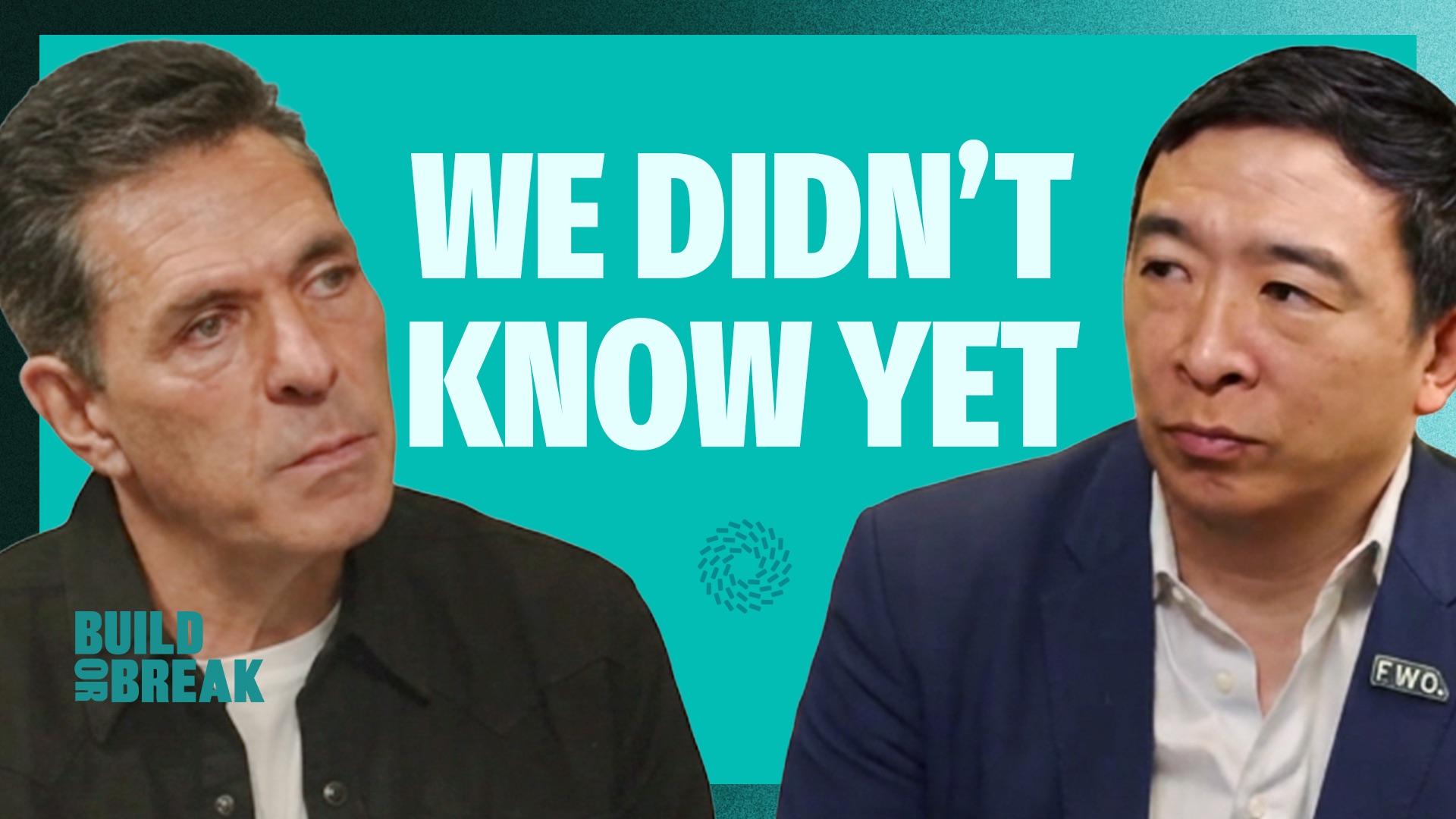
Andrew Yang has spent a decade being early. He was early on automation, early on universal basic income, early on the idea that the two-party system had stopped competing for anyone's vote. On the fourth episode of Build or Break, Daniel Lubetzky asks him about the parts of that record that hurt: the company that failed before anyone knew his name, the organization he founded and then watched close, and the year at home that he calls the hardest of his adult life.
Yang starts with the pitch he turned down. Raising for Noble Mobile, his wireless company, he took about $11 million. Along the way, multiple investors told him they would cut a check immediately if he started an AI company instead, and that it did not matter what the AI actually did. He said no, and says a founder without his name recognition would not have had that option. The company's promise is unglamorous by comparison: cut the average American's phone bill from $83 a month to $42, and pay people back when they use less data. The average Noble Mobile user, he says, spends 17% less time on their phone.
He is just as direct about what went wrong. Yang quit Davis Polk after five months, and he says his parents told their friends he was still practicing law rather than admit he had left. What he left for was Stargiving.com, a site where donations to a celebrity's charity entered you to meet them. He calls it a mini rise and a maximum fall, and an idea that was right a few years too early. Venture for America, the fellowship he built afterward and left in 2017 to run for president, closed in 2024. He blames COVID partly, since the model depended on placing people in specific cities, but says it comes down to leadership: the board brought in a new CEO who, in his words, could not run it effectively. His founding team has since restarted the idea as the Ember Fellowship.
The political middle of the conversation is a structural argument delivered with numbers. By his count, Congress sits at a 10% approval rating, down from 16% a few months earlier, while incumbents win reelection 94% of the time. Roughly 90% of congressional districts are decided before anyone votes in November. Yang's fix is an independent presidential primary that lets candidates make their case directly to voters rather than through a party gauntlet, and he floats himself, Mark Cuban and Matthew McConaughey as the kind of names that would draw attention to it. He has spoken to some of them. What stops them, he says, is the process of running, not the job.
He also explains why structural reform keeps losing. Unite America backed primary-reform ballot measures in six states in 2024, the subject of Yang's TED Talk that year. Yang puts the movement's spending at about $90 million, and says most lost by four or five points despite polling near even. His own history of ballot access is blunter. Yang says a predecessor organization spent seven figures clearing New York's signature threshold, and that Governor Cuomo then doubled it in real time so they could not meet it.
The most personal answer comes at the end, to Daniel's standard question about what broke him and then built him. Becoming a father, Yang says. His first son turned out to be on the autism spectrum, something they could not have known when he was two months old, and the mornings were brutal. He calls it his hardest year as an adult, and one of the main reasons he ran for president: if a family with two parents and unusual resources found it that hard, he could see how other families came apart.
Key takeaways
- Investors offered to fund an AI company on the spot, whatever the AI did. Yang says the same investors were not AI investors 18 months earlier, and that a 25-year-old founder pitching a non-AI company today would have been turned away.
- A wholesome mission is a harder raise than a fashionable one. Noble Mobile's pitch is halving phone bills and paying people to use their phones less, and Yang says investors wished him luck rather than writing checks.
- Leadership decides whether an organization survives its founder. Yang traces Venture for America's 2024 closure to the CEO the board hired after his successor left, not to the model itself.
- Being early is not the same as being right on time. Stargiving.com was a good idea that worked years later for other people, which is the difference between a mini rise and a maximum fall.
- The reelection numbers explain the dysfunction. As Yang lays it out, Congress polls at 10% approval and wins 94% of the time, because roughly 90% of districts are drawn so that the general election never matters.
- Ideas do not travel; people do. Yang wanted to call the campaign UBI 2020 until his team told him nobody would care, and he had to become the story to get the policy heard.
- The hardest year came from home, not from politics. His son's early autism diagnosis is what convinced Yang that families with fewer resources were being broken by the same pressures.
Chapters
00:00 — Cold open: the AI check he turned down
02:17 — Bullied as the only Asian kid in his grade
04:40 — Quitting Davis Polk after five months, and his parents' cover story
05:40 — Stargiving.com: a mini rise and a maximum fall
09:12 — Where his entrepreneurial streak came from
13:32 — Noble Mobile, $11M, and the investors who only wanted AI
26:26 — Why gerrymandering and closed primaries reward the extremes
30:04 — The reform push that lost, in Yang’s numbers
34:58 — His New York ballot-access fight
37:18 — "People follow other people": the case for an independent primary
44:57 — Two things he tells anyone thinking of running
46:44 — Going viral: grief, the Cupid Shuffle, and owning his nerdiness
51:01 — Why Venture for America closed, and the Ember Fellowship
54:38 — The $83-to-$42 phone bill and 17% less screen time
59:33 — Universal basic income
1:01:51 — What broke him and built him: becoming a father
1:04:01 — Rapid fire: first jobs and what drives him
1:07:57 — Build or Break
About Andrew Yang
Andrew Yang is an entrepreneur, author and former presidential candidate. He left the corporate law firm Davis Polk after five months to start Stargiving.com, then founded Venture for America, the fellowship that placed graduates with startups in cities outside the coastal hubs.
He ran for the Democratic presidential nomination in 2020 on a platform built around universal basic income and the automation of work, ran for Mayor of New York in 2021, and left the Democratic Party the same year to co-found the Forward Party. He is the author of The War on Normal People and Forward, and hosts the Andrew Yang Podcast.
His current company, Noble Mobile, is a wireless carrier built on cutting phone bills and paying customers to spend less time on their phones.
Andrew: Originally, I wanted to call the campaign UBI 2020, and then my team was like, "That sounds like a urinary tract infection." Donald Trump combined three communication modes, uh, politics, comedy, he's an insult comic, and pro wrestling. I think it's gotten categorically much, much harder for young people to do what you and I did. I had a chip on my shoulder for a number of years. They said, "Look, anything anyone else can do, you can do. Like, you are as talented as anybody else, and so you should not think that, uh, someone else can do it, but you're not capable of it." And so I applied that to entrepreneurship.
Daniel: Are they actually right to send all the money to AI, or are they making a mistake?
Andrew: The message in Washington was crystal clear. You lose your job if you do the right thing. Imagine if you walked into a restaurant and you didn't like 90%, uh, of the food, but then they just refused to change the menu, and, and that's American politics.
Daniel: Welcome to Build or Break, my fellow Americans. I'm pleased to say that the state of the podcast is strong, maybe a little too strong. Today, we're joined by someone who believes in the American dream so much, he left a prestigious law firm to build his own version of it. From Wall Street to Main Street, from Joe Rogan to Chapo Trap House, he'll speak to anyone, and I mean anyone. He ran for president as a Democrat in 2020 and then quit the party in 2021. He sings things well ahead of others for over a decade. He was right about AI and automation, he was right about math, he was right about the two-party system. He's been relentlessly, consistently, annoyingly right. And today, he's here to say, "I told you so." Ladies and gentlemen, Andrew Yang.
Andrew: Yes, thank you, Daniel. Yang Yang, Shark Tank, Lubesky Gang, all coming together. For
Daniel: This show, one of the things we wanna do is not just learn how we can make this a better world, but how we can learn tips from some of the most extraordinary people. For me, it was fascinating, all the things you've already accomplished. Like you've done so many different things. And so we're gonna ask for you to give us some tips on so many different areas. Um, but before we do, I just wanna start with something that I found interesting when I was reading about you because as a formative influence, I read that as a kid you were bullied a lot. Yeah. And
Andrew: Is
Daniel: That true and can you tell me about it because you and I have never had. We've known each other for - Years.
Andrew: For
Daniel: Awhile. Met
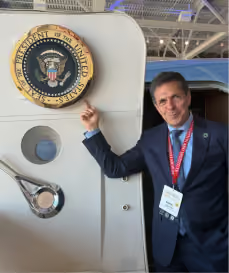
Andrew: In the White House, very fancy. Um, yeah, I was the, um, only Asian kid, uh, in my grade, one of the only Asian kids in school, and I'd also skipped a grade, so I was scrawnier and smaller, uh, than the other kids. So I got, um, pushed around and bullied a lot and called various, um, you know, ching chong sort of, uh, racial epithets, um, a lot of the time. And so I, at. Sometimes I would take it, sometimes I would, uh, decide to get in a fight. Um, and so that was, uh, a very consistent, um, experience in my childhood.
Daniel: How did that shape you into who you are?
Andrew: I had a chip on my shoulder for a number of years, and one of the questions I got all the time was, "Do you know karate?" Which I did not because that was like the, you know, 80s. Uh, you know, that anger manifested in various ways. Um, my dad, um, worked for IBM when I was a kid growing up, and he came home cursing one day, and I asked, uh, him what was wrong, and he said, "When you can't invent anything anymore at IBM, uh, they make you a manager, uh, so it's all white managers bossing around Asian engineers in the lab," and which was him. And so you hear this as a teenager, you're like, "Huh, like, is that true?" And, um, then you're like, "Don't know, maybe." Uh, and so, um, when I got older, it's one reason I wanted to try and become an entrepreneur because I wanted to succeed or fail based upon something I did, um, rather than whether someone, uh, liked me or not. Uh, like the, the prospect of working for years and years trying to climb a corporate ladder and then being denied a promotion at the end, um, was something I never wanted to experience.
Daniel: But is the. Was your dad's description accurate, or is it also just the fascinating reality that Steve Wozniak was less essential than Steve Jobs, that, you know, like the guy that's the techie is less important in practice than the storyteller that created the brand and the story?
Andrew: You know, my dad, objectively, as his son, love you, dad, um, would've been a terrible manager. He's just not wired like that at all. He -
Daniel: But he's a great inventor. Um,
Andrew: Yeah, he has 69 US patents for GE and IBM, but he grew up on a peanut farm with no floor in Taiwan, so he's very uncouth and blunt and brusque and, like, pisses people off a lot.
Daniel: I was reading, uh. I, I wonder, in, in a minute, we'll talk about how you and I met because it was fun, but I was reading also in your upbringing, you went to law school, you got a, an offer and started working at Davis and Polk, which I also. Davis Polk, Davis Polk. Yeah, yeah. I also interviewed, I, I though it was a good firm. I got an offer to. But, um, then you quit. Like, were you present? What the fuck are you doing, dude? Like -
Andrew: Yeah, yeah, that, that. Well, they didn't say, uh, and in those words, they, they were not. Uh, well, they just lied to their friends that I was still a lawyer, honestly. Like, that was the move. Um, so people would ask, "How is A- Andrew doing?" They'd be like, "Oh, great. He's, like, you know, still practicing." Uh, they just didn't wanna tell their friends that I'd quit Davis Polk, the, um, corporate law firm that they'd frankly bragged to their friends about while, you know, I was, um, there for that, those five months. Um, and so then when I left to try and start a business, it was much easier for them just to pretend that I was still there.
Daniel: You left Davis Polk for Venture for America or something? Oh no, for math.
Andrew: Oh no, I, I left to start, uh. Com that had a mini rise in maximum fall called stargiving.com. It was a bit ahead of its time. Um, so my parents were
Daniel: Probably right.
Andrew: Could
Daniel: Tell us briefly about that one.
Andrew: Oh, yeah. I mean, it's a good idea. Like, it ended up playing out years later. Uh, so stargiving.com was a website where you could click to donate to support a celebrity affiliated nonprofit, and then one person who clicked would meet the celebrity. So if you can think about the mechanics there - It's like
Daniel: Charity, whatever. It's
Andrew: Like, yeah, it becomes, it became later Charity Buzz or Omaze or these sites.
Daniel: No relationship to yours. No, no
Andrew: Relationship because -
Daniel: Yours failed.
Andrew: Oh, yeah, because I, I was starting this in 2000 before the
Daniel: Internet was doing charter. Like that failure did not teach you fuck. Let me not try these things. I'm sorry I keep saying fuck today.
Andrew: No, it's fine, man. I'm very profane. But,
Daniel: But that failure did not, uh, stop you from trying to be an entrepreneur, which you had told yourself earlier. Walk us through that because the vast majority of entrepreneurs, 90 plus percent of venture, uh, entrepreneurs in their first venture fail, but it starts going down. Then it's 80%, then 70%. So by third time venture, you, you have three times more likelihood of success, even though you still have 70% chance of failure. But the more you try getting back on the horse, the better you get at it. But a lot of people say, "Oh, this is not for me," and they give up. What happened that was start giving that you kept going, you still have an entrepreneurial mind in everything you do? Oh
Andrew: Yeah. So I, I, uh, met several entrepreneurs during that time and though I need to be like these guys and I need to learn from them, but I was 25, it just failed. Uh, and so I worked at another startup and followed a CEO around for several years trying to pick up what he was doing and then simultaneously - Who,
Daniel: Who was this? Uh,
Andrew: Hi name was Manu Kapoor. He's a, a physician. Um, he'd started a healthcare software company that I, I worked at.
Daniel: But call him how? This is amazing. I love that. How did you, how did he let you?
Andrew: Uh, so I became his, uh, legal guy, which, you know, I mean, I was the only person with a law degree on the team. Uh, and my, my -
Daniel: So you worked at his company? Yeah,
Andrew: Yeah. I was like hire number four or whatnot. And my thinking was I'm going to learn from him. And then his thinking was I can get talent, uh, cheap because I was willing to work for less than I was making at the law firm previously. Uh, and so at the same time, um, I started tutoring on the side because seeing my own company go bust, I had been burnt and so I though I need multiple income streams. Um, and then the third thing I did was I started, um, promoting nightclub parties, um, because I'd, I'd read this book about West Point, um, leadership where every year they have a cadet report to an upperclassman, but then also have someone in the year below them report to them. So they end up with leadership experiences both up and down every year. And so I though, okay, I'm gonna learn from Manu, so that's gonna be me absorbing, but then I need something to run simultaneously so that I can be the boss of something.
Daniel: It sounds like a restaurant decision for you to start parties.
Andrew: I also had a birthday party and a lot of people showed up and had a good time. So I was like, oh, you know, I mean, as an entrepreneur, it's like, shoot, I should, um, try and, uh, make this a thing.
Daniel: Were you entrepreneurial as a kid? Like where did that come from, that energy to start things? Because now you're. How old are you at this time?
Andrew: 26, 27. You
Daniel: Already starting parties and, and monetizing them. Um, you're done start giving and not giving up. You're learning from the guy. You have a very clear vision of that you wanna become entrepreneur. Anything in your childhood that, uh, is it just the conversation you had with your father? Any other formative thing that made you so entrepreneurial? No,
Andrew: It's a good question, Daniel, because I was not anyone's idea of an entrepreneur when I was that young. Uh, I was a little bit surly and brooding and angsty. Um, would never, for example, like run for student office, like that would not have been a thing for me at all. Uh, um, and so I, I think the entrepreneurial zeal came, um, from meeting other entrepreneurs, uh, and having heard from my parents, and I thank you mom and dad for this message. Um, but they said, "Look, anything anyone else can do, you can do. Like, you are as talented as anybody else, and so you should not think that, uh, someone else can do it, but you're not capable of it." Um, and so I applied that to entrepreneurship. I was like, "Okay." I met. Uh, it was an entrepreneur, and he knows this, uh, Mark Jacobstein, who's a little bit older, you might know him. He's, um, in the Bay Area now. He'd started an internet firm called, um, Small World. Uh, and, uh, you know, I just met him. I was, you know, 24, 25. He was maybe, like, 30. And he ran this little company and had this office of employees. And I was like, "I wanna be that guy. I wanna be, like, the captain of a ship like this." Uh, and so I though, "Well, shoot. Uh, you know, like, let me try and get there." Um, and I, I just, you know, decided to keep grinding. Um, partially too, Daniel, because I'd had five months at the law firm and though this work is for the birds. Uh, this work is documenting someone else's exploit. Like, I used to joke that it's not like when I was growing up, I dreamt about writing down someone else's adventures. I mean, like, I dreamt about - You have to write your own adventure. Yes, I dreamt about being an adventurer, not not, not, not like documenting someone else's achievement. I
Daniel: Also think that to be Dr. Freud, your earlier bullying or whatever else set of factors, you channeled that frustration to prove something positive. And a lot of us entrepreneurs and a lot of dreamers that wanna change the world also have something to prove. For me, it's predominantly just trying to build something that I like solving problems, but I've realized that I. And, and Shimon Perez once spoke to all of us at a group of hundreds of people, the former, uh, president and prime minister of Israel, and he said, "You know what we all have in common, we all deeply insecure." And he's talking to the 500, some of the most successful CEOs and founders in the world. And it was like, "What do you think? I'm just..." And he said, "But, but that, if you channel that towards something constructive, it can make something good." That is that, is that part of you or no? Oh,
Andrew: Yeah, 1000%. I mean, um, uh, I had this anger and desire to prove myself for years and years. And then even after I had a setback, I would say, okay, you know, like, I need to demonstrate I can do this to myself. And in my 20s, it was hard because my law school classmates were making more money than me, and they were having fancy birthday parties I felt like I couldn't afford to go to because I was this scrappy startup guy living with a roommate in order to save money. Where
Daniel: Were you? Um,
Andrew: I was here in New York. I was in Hell's Kitchen. But one thing I was reflecting on, Daniel, is that, um, my rent during this time was $1,080. But the places we lived now, if you go back and, uh, look at them, they're gonna be like three or four times more, and you're like, "Holy cow." Um, so now I'm, I'm grateful to have come up in this era where I, I think you could be a scrappy, wannabe, aspiring entrepreneur a little bit, um, more straightforwardly. So
Daniel: You think it's gotten harder to be a scrappy entrepreneur in this business?
Andrew: Unfortunately, I really do, and it breaks my heart. It's one reason I love what you're doing with builders so much, and obviously you and I connected on, um, Venture for America. Um, I love entrepreneurship. It's one reason why I, I love the message of builders and this podcast and you as a human being. Um, but I think it's gotten categorically much, much harder for young people to do what you and I did. And I think all the time about a n - younger version of me showing up. Let's say they did what I did, they went to law school, they're like, "Oh, I don't wanna do this," and they left to start a company. Um, I think right now, if you're not trying to start a company that has AI in the front or AI in the title or AI, then like it, it's, it's harder. Um -
Daniel: Don't you think that when people zig, you should zag, and I do think AI is gonna be revolutionary and we'll get to it. And, and you, you saw this ahead of most people, but sometimes there will be opportunities to do things that are different because everybody's running over there, then you'll do something different.
Andrew: Oh, I'm very much a contrarian, um, uh, Daniel, but I'll give you, give you the most direct experience I've had. So I started a company recently, Noble Mobile. We raised ab- about $11 million. Multiple investors said to me, "Hey, Andrew, love you. Wanna invest in whatever you're doing as, but if you start an AI company, like, we'll cut you a check right now and, and, uh, it doesn't matter, like, what the AI's doing." Uh, you know, I was like, "Well, that's not really what I'm about. I'm trying to save Americans money on their wireless bills because their, their wireless bills are, um, way too high and also pay people to use their phone less." It's a very wholesome message and mission that I know you enjoy. Uh, and these, uh, in- investors were like, "Yeah, you know, good luck with that." You know, and, and so there was. And because I'm me, like, we still raised, uh, money and, and, you know, are, are doing quite well, um, but- But
Daniel: Then it's very hard to go against that stream. Yes.
Andrew: And so if you were, like, some, again, 25, 26-year-old, uh, trying to start a non-AI company, the investors would've been like, "Look, like, we've got a new thesis." And these were investors that were not AI investors, you know, like, 18 months earlier. Side
Daniel: Question, from your vantage point, from what you know and notice, because I'm, I'm moved now into being an investor, and I'm still. I was always, as an entrepreneur, I'm the entrepreneur, and I looked at investors skeptically, I still question - That's
Andrew: Funny.
Daniel: Is the investor class, do they know what they're doing or they're just cheap? And are, are they actually right to send all the money to AI, or are they making a mistake? No,
Andrew: Daniel, one, another reason I like you, um, is that you're investing based upon your values and things you know and things you wanna see in the world. If you were. If, if you made me put on a venture capital hat and said you're gonna take other people's money, and your job is to try and return multiples of that in five years, the smart thing to do is to invest in AI companies because the valuations keep going like this. And if all you need is, like, one hit and it'll wash away - All the
Daniel: Failures.
Andrew: A- all the failures. Whereas if you invest in, like, a, a series of food companies and the rest of it, um, which again, the world needs and I love, but, you know, so it, it depends upon whether you're investing on your own account, on your own values, or whether your job is truly to try and return money to investors in, like, a certain time period. So it's rational, like, but it's, uh, you know, to me, it is now at this point. It's kind of the same
Daniel: Way that leverage buyouts are rational, but they destroy some jobs.
Andrew: Yeah, the, you know, I, I wish there were more investors that were, uh, able to break from the pack on this one, um, but I get it. Let's put it that way. Like, like, if, if you were just looking narrowly at their financial incentives, you can't necessarily say they're doing the wrong thing. But
Daniel: As now that someone that sold kind and have a lot of assets to invest, I find myself very often at odds with the way private equity people's incentives - Good. Is because they're - My goodness. Not just for the altruistic reasons, like, they make money regardless, right? Because they're taking your money, managing your money. Yeah, that's true. Yeah. And so, for entrepreneurs, if you have a family office invest in you, there's a much more direct alignment with your interest because they don't need to create liquidity for them to then put money in their pockets. If you're growing, you can continue growing. So
Andrew: When you were building kind and you were dubious of these investors, you got money from customers. I mean, you know, and you're just like grew, grew, grew, and then I'm sure people were trying to throw checks at you at certain times. Well,
Daniel: They were more dubious of me. Nobody wanted to invest in me. So I was lucky that I, by the, when I sold kind, had 80 plus percent of the company. I was very lucky. I even bought back an investor. But it was not because I was smart. It was because nobody wanted to invest in me when I first started PeaceWorks, which then became Kind. I, I don't know if you remember. No, I do remember. PeaceWorks was a piece of business too. So one thing that we have a lot in common, PeaceWorks is a company that use business to bring neighbors together - Yeah, yeah, of
Andrew: Course.
Daniel: Market forces to try to help people discover just humanity. And one thing that I keep noticing about you is, like me, you really love using market forces to solve problems. Yeah. Sometimes you have no alternative but to create a, a, a nonprofit business model. Yeah. But wherever you can use market-based mechanisms, uh - You choose it.
Andrew: You
Daniel: Always prefer that. Yeah, yeah. I've seen that time and again. Can you talk to that for a second? Oh,
Andrew: Yeah. So, um, so I, uh, ended up the CEO of an education company that grew to become number one in the US and was bought by a public company in 2009. Uh, and so I love the way businesses reinforce success in delivering where you do a good job for your customers, they tell their friends, you get more business. Um, and my joke is, having run a nonprofit that I started, um, it's like running a bakery where your funders aren't allowed to eat the cookies. You, and so all you can do is show them pictures of people enjoying the cookies, being like, "Look at the people eating them. Don't they look great? Give me more money so I can make more cookies." It's much better when your customers can just pay you with the cookies and tell their friends. So, um, businesses have much better, um, reinforcement mechanisms and incentives and growth mechanics. Like you can grow, grow, grow. Uh, I started a nonprofit venture for America that on its own terms was quite successful, but what that meant was that you had to go ask people for more money every year, every year, uh, and then that reaches a limit. The biggest nonprofits, you know, there are a handful of nonprofits in the United States that might, um, have revenues of over 100 million a year. And then you can find, you know, like thousands of companies that reach that level. Um, so business, if you can find a revenue mechanism, uh, and market rewards, you should definitely pursue them if you're trying to have a big impact.
Daniel: One thing I just noticed that you did beautifully is that you made something really accessible and you do the time again. Like for example, I've been talking about this for decades, about how PeaceWorks works better and other models work better because you are scalably, sustainably growing, right? Like you get paid for the products so you can sell more products. And, and I explain it in very theoretical terms. You explained the bakery analogy was so beautiful because it's so much easier to understand. How do you do that? Does that just come to you? What is your secret to do that well?
Andrew: You know, I, I think growing up as the child of immigrants in this country, I watched a lot of TV, a lot of movies, a lot of comedy, uh, pro wrestling. I, I was kind of a sponge. I used to watch WWE with my dad, um, who, you know, seemed to think it was real. It sounds sort of funny. Um, and, and so I, I think, uh, my natural frame of reference is, um, what a TV viewer might think or like someone who's showing up to a comedy club might think. Uh, and it is funny, Daniel, because, uh, some of the things I do, uh, naturally appeal to kind of wonkier, uh, or, um, like, uh, people who like math more or whatnot. Um, and I, I am always trying to translate it in a particular way, um, particularly as a result of having run for president, because there you have all of these cycles and iterations where you start with a PowerPoint deck going through AI and automation and no one gives a shit and then when you translate it to, you know, the opposite of Asian, uh, of Donald Trump is an Asian guy who likes math and then people enjoy that. And then math becomes an acronym for Make Americans Think Harder, people enjoy that. And that bubbled up from the grassroots.
Daniel: Organically that you were going to talks, this one would work and it's like comedians doing standup, stand up, stand up. You try, you try, and then you grab this one? Or you working at. The math one, for example, did you work on it on your own or you working on it with people? Did somebody give it to you? How did that one come about? So check
Andrew: It out. I'm running for president, and this is before the Yang Gang became a thing and we raised tens of millions and I made seven debate stages and, and all that good stuff. So I was with a friend of mine who, um, was a donor and trying to help. And then, um, he was a, a film major. Uh, and so he said, "Andrew, I think, uh, you're gonna do really well because the pendulum always swings the other direction. And the opposite of Donald Trump is an Asian guy who likes math." And I was like, "Oh, that's actually kind of funny. By the way, this friend is Asian. You might -
Daniel: But you were listening. Yeah.
Andrew: That
Daniel: You were listening. That was really important. So a friend says that in passing, and oftentimes some of the most genius things when people don't realize that they're saying something fascinating, and you capture that. Yeah.
Andrew: So then I started going to it as like an applause line. And then someone on my team, um, started making math banners and people would just grab them. And then he said," We should make a math baseball cap, "which we ended up selling $3 million worth. Uh, and so - And that was Make
Daniel: America Think Harder. Yes,
Andrew: Make America Think Harder, but it wasn't originally that. Um - Oh,
Daniel: That, that came later also. What
Andrew: Happened was someone in the Yang Gang online said, uh, you know, Math stands for Make America Think Harder, and then we just grabbed that. So
Daniel: You're crowdsourcing best ideas and, and - Yes.
Andrew: And then trying them out on live audiences because we'd have an event by multiple events a day. And by the way, this is one of Donald Trump's superpowers, and people know I, um, really, uh, detest Trump and his impact on the, the country. But he does, um, try things out on audiences. And then as soon as something clicks like Meatball Ron or Crooked Hillary or whatever, he's like, "Ooh, they like that." And then he just goes to it. And so one of the points I make in, um, my most recent book, Hey Yang, Where' My Thousand Bucks, which Daniel, um, appears in, is, uh, that Donald Trump combined three communication modes, uh, politics, comedy, he's an insult comic, and pro wrestling, um, because he's a WWE villain, Hall of Famer. And the problem for Democrats, they're stuck in lane one. Uh, and then meanwhile, Trump is toggling among all three, and two and three appeal to a very broad audience, including a lot of men. Um, and so when you ask me about, uh, what I'm doing, I'm not necessarily trying to emulate Trump, but I'm trying to communicate across these different wavelengths. John
Daniel: Mackey, the founder of Whole Foods, once told me there are progressives, there are conservatives, and they're integrationists. And you and I are an integrationist. We can actually grab from this one for granted - Yeah. But we are a minority. When I, um, did the research with builders, there's so much that actually we have in common. Americans agree that on economic freedom, that the people should be able to be free to pursue their potential. Americans that agree on a level playing field that rules matter, that things should be fair, whatever that means, but that, that, that should be a level playing field that nobody should be above the law. Americans agree on helping the most vulnerable. Can we create a language that unites us as builders to transcend this hyper-partisanship and puts nation and principle over power or party? Or realistically, that's not gonna happen, Daniel, because those other things are more primordial and we will only build that 5%.
Andrew: So, um, people who know me know, I've actually been, um, trying to crack this nut, um, for the last several years. Uh, and there is hope. The issue is, um, is you have a polarized two-party system, and the energy's heading to the wings in each party. And then you have media organizations that are actually getting paid based upon blue versus red. Uh, and then you have social media that's amplifying everything sensationalist and nasty and aggressive, uh, and the rest of it. So most reasonable Americans, uh, who are not fans of either of these, um, wings, um, some of them have checked out. Um, some of them, uh, are, like, trying to avoid politics. Um, some of them are trying to avoid the headlines, um, you know? So what you're doing, uh, is so important with builders and, and this podcast is that the plan has to be to try and build a middle constellation at every level. So this would be p - like, changing the primaries and political leadership, and then it's media organizations that actually can call it in a principled way, and then social media figures who are trying to appeal to kindness and reasonableness and pragmatism. But you don't need 51% to tune in to this movement. You probably only need five or 10% because the wings are so polarizing. And so that is what Forward is building, Forward Party, that is what Builders is building, haha. And you and I, I think, are friends with a lot of other folks who are trying to coalesce, um, this movement. First
Daniel: Of all, you need to have electoral reform because gerrymandering, the open primaries, the two-party system, really, really help the extremes win, right? Because - In fact, please explain to the audience why that ends up helping the extremes. Oh,
Andrew: Sure. Um, so as we're sitting together, the approval rating of Congress right now is literally 10%, uh, down from 16%, you know, uh, a few months ago. So that's ridiculously low. Meanwhile, the reelection rate for incumbent members of Congress is 94%. It's sky-high. So my joke is imagine if you walked into a restaurant and you didn't like 90%, uh, of the food, but then they just refused to change the menu and, and that's American politics for most Americans, um, because the two parties have sliced us into blue zones and red zones and said, "Look, if there's anything we can agree on, it's let's not compete for voters." Uh, and so you have a very, very small handful of genuinely competitive races. And
Daniel: It's literal. It's not, you're not speaking fi - categor - uh, uh, figuratively. They've carved out - Yeah, they carved the country out. Districts in such a way that almost all of them are not competitive. Just explain that a little bit more. Yes.
Andrew: Yeah. So, uh, 90% of our congressional districts are predetermined, uh, that it's gonna be a Democrat or Republican representing you. And
Daniel: Consequently, at the general election, there is no competition. It's whoever got the primary - Yes. Is gonna become the Democratic or the Republican candidate that's gonna win. You already in the primary know who's gonna win. Consequently, they're just trying to speak to their extremes. 11%
Andrew: Of Americans vote in the party primary, uh, which means that they're disproportionately ideologically extreme. And so the biggest threat that you can level against anyone in Washington is we're gonna primary you. Uh, it, and then you're like, oh my gosh, like, then I'm gonna lose my seat. My 94% job security is gonna plummet, uh, to 10%. Um, which - And
Daniel: So they're like trying to be more extreme than the extremes that challenge them. And
Andrew: Stay in, uh, the good graces of the party bosses at that time. So 90% of members of Congress are rubber stamps for party leadership. Uh, half the time, they don't even see the legislation they're co-signing on. And so what's the solution? So the, the solution is to change the primary system so that everyone's vote matters, everyone's voice is heard. And the best way to do that is via statewide ballot initiatives that make it so that everyone in the state can participate. Alaska's the most, um, long-standing example of this now where it has actually changed the electoral dynamics, um, so that someone like Lisa Murkowski could vote to impeach Donald Trump and then still come back because she didn't have to go through Republican primary. It essentially went to all Alaskans. And so she was able to come back and say, "Look, I'm my own person. You might not agree with me on everything, but, you know, uh, and then she got 53% of the vote. So
Daniel: You're talking about the ranked choice voting type of bucket to change the primary system. The other two interventions that I've heard of, but all of them are hard and I wanna get to it why in a second, is, um, increasing participation rates in the primaries and changing, reducing gerrymandering so that the Democrats and Republicans are not just dividing the spots, but actually encouraging competition. We like competition in business. We should like competition in politics - Definitely. Forced there to not build this gerrymandering, but to actually have districts that actually look more like America looks, which is a little more diverse, so the politicians have to actually compete for everybody's votes. But are those things just really, really hard to do because I'm struggling To increase primary rates, I'm struggling to see if you can get to gerrymandering reform.
Andrew: Yeah, so, um, there's an organization called Unite America that brought together philanthropists and don- donors to try and run these ballot initiatives in six states in 2024. They spent about $90 million. Uh, and this was the subject of my TED Talk that year, 2024, being like, "Hey guys, if we can change the primaries, we can turn off the extremes, and then you can have some, uh, principled leaders representing us." Uh, and those ballot initiatives did not do well because 2024 was like just a bad cycle. Um, Americans were pissed off, and if you said, "Hey, we'd like to change this so this works," but they're like, "Ah, I don't wanna hear it." So even though things were polling fifty fifty or 51 / 49, um, most of these measures lost by four or five. So this was heartbreaking for our movement because we had like 90 million. I mean, that's no joke to, to your point. Um, but there are still real opportunities, and I'm going to, to call a couple of them out. Um, so Montana, red state, people would think, okay, like that, that's, uh, you know, non-competitive. There's a guy named Seth Bodnar who's running for US Senate as an independent. Uh, he just raised more money than all the Republicans and Democrats combined. And, uh, Daniel, you would love this guy, first in his class from West Point, Green Beret, jumped out, like commanded an airborne squadron, comes back, uh, goes, uh, to GE and becomes a successful executive, then becomes president of the University of Montana. And now he's running for US Senate in Montana, uh, and he's been endorsed by John Tester, who was the Democratic Senator for a long time. And Jon Tester just came out and said the Democratic brand is poison in Montana. So Seth, you should run as an independent. So Seth's running as an independent. He's poised to compete at the highest level. Um, and he's just going to Montana and being like, look, like, I'm just gonna represent Montana and if I get to the Senate, I'm not gonna caucus without a party. I'm gonna be my own man. Now, is Seth going to win? He has a very, very good chance to win. Um, but that's the kind of approach that tens of millions of Americans are desperate for, because the proportion of us that say we're independents just goes up and up where it's now 50% of the country. It's even higher in a place like Montana. It's even higher in lots of states around the country. So the opportunities are still there because the two parties are degrading and deteriorating before our eyes. They both. Democrats have a 29% approval rating in this country, 50% disapprove. Republicans, 32% approve, 50% disapprove. So there's a, a massive opportunity for independent candidates and a new party movement. It's just not going to be reflected in some of the, like, the ways the districts are drawn and the rest of it. So we have a lot of work to do, but a ton of opportunity.
Daniel: And also, like, people need to understand that the quote unquote establishment, it's not democratic or republican, it's democratic republican, meaning they want the two party system to stay. And they really, the media, all these different forces are ray against third parties.
Andrew: They call, someone calls it the uni party.
Daniel: Yeah, it's crazy. It's crazy. And, and, and the way they behave for me is truly fascinatingly amoral. They don't care about principle. They care about power. So there are cycle after cycle after cycle. Like, for example, when some Republicans had the courage to stand up against Trump and impeach him, you know what the Democrats did, how they rewarded them? They funded their opponents in the primaries - Yeah, it was not, it was, it
Andrew: Was dark.
Daniel: 'Cause they wanted the more extreme because they wanted to just fight against the most extreme. So tactically might make sense, but it's immoral. And that's why you have dwindling moderates because the extremists, the, the people from the other side support those extremists. It just happened in the cycle again where the Republicans found the extremist Democrats, the Democrats always experienced Republicans. It's disgusting. And they, a lot of times, these parties, and I, you and I saw when we're trying to get voting rights passed and stuff, like the party didn't really care about actually voting rights reform. They wanted to score political points to rally their people and to use that as a wedge issue. It's
Andrew: Fascinating. It, it, it's very dark. I mean, if you look at the, let's call it 11 Republicans who voted to impeach Trump, nine didn't make it back to the primaries sometimes because Democrats were like happy to see them lose. And these were people like Anthony Gonzalez and Adam Kinzinger and Liz Cheney. Like these like principles. Yeah. Um, uh, Peter Meyer. And so, um, the message in Washington was crystal clear. You lose your job if you do the right thing. And, and so these, these, and like both, both parties have been party to that. Um, so I, I totally agree with you on the darkness and the incentives there.
Daniel: What's the difference between running as an independent versus running on the forward party?
Andrew: Well, sometimes they're the same thing, but in a place like Michigan, forward party doesn't have a ballot line, doesn't have ballot access. So -
Daniel: Because the political, the two party policies doesn't make it hard or
Andrew: What? Oh, yeah, yeah. In some, in some states it's very, very difficult.You know, I can tell you one story that's crazy. Um, so our predecessor organization, um, Sam, spent seven figures, uh, trying to get ballot access here in New York. Uh, and they did it. They, they cleared the threshold. And then, then Governor Cuomo doubled the threshold, like, in real time so that the, that they couldn't get it. Like he just raised the water level. So he's
Daniel: Literally the mafia of the political party system, which George Washington urged against, which Albert Einstein really, really is because of these are. They're basically just preserving their power. They're literally trying to prevent competition.
Andrew: A thousand percent.
Daniel: And - What did Cuomo do? He r- rub the threshold and then you had to start all over? Oh
Andrew: Yeah. No, it was even worse where like he's, he raised the threshold like in the middle of this process so that it was too late for them to actually do anything about it. And so that, that seven figures, uh, was squandered. Uh, you know, like let's, let's say the threshold was 15,000 signatures and then they got 25,000 and then he just like raised it to 30,000 with like zero time left.
Daniel: But I wanna ask a question. As a person that's very driven by a sense of fairness, like I really, one of the things that drives me is, is just, is fair. I really, it drives me nuts to see that this two party system is fucking with people so bad. And ultimately what, one of the things that I noticed already is that citizens who are all of us end up being owned by the special interests leading with the political parties, but also everything has its own special interests. Yeah. Every, the, whether it's a industry group like the, uh, agriculture or healthcare, whatever, and they wake up in the morning, go to sleep at night only thinking about their agenda. And then the vast major citizens that the 100% of us - Just living,
Andrew: Yeah.
Daniel: Are living our lives. Yeah, living our lives. And, and then we get screwed over again and again, again. But the problem that I see, it's so hard to get people to be passionate about this brother issue though makes so much sense. Yeah. So what can you use your yang magic to make it sexy? Because structural reform is not sexy. Yeah. It's not salient. People ultimately go and they vote for this party or that party because they find that most salient issue that they convince people to rather than thinking big as citizens and then creating solutions for better governance for other country. What, how do we communicate that better?
Andrew: Yes. So, so this is one of my great learnings over the last number of years, Daniel. People follow other people. I thought when I was running for president, "Hey, I've got this idea, the freedom dividend, uh, you know, universal basic income." People are like, "Yeah, yeah, yeah." Uh, and the only way I could get someone to pay attention is to make Andrew Yang a thing. And I, I wrote my book. Originally I wanted to call the campaign UBI 2020. And then my team was like, "That sounds like a urinary tract infection. Like no one's going to care. It has to be Yang 2020." And maybe it's partially my cultural background, but at first I was very self-conscious about calling something Yang 2020 because keep in mind, like, who the heck was I? Like, you know, like, you know, anonymous entrepreneur. And then I had to grow into Yang 2020 and Andrew Yang, the magnetic TV personality or whatever the heck. Um, so people respond to other people. Uh, here's what I think it's going to take, and this is a vision that, um, you, you and I, um, ha- have, uh, you know, bandied around. Um, let's imagine that there's a presidential primary in this independent lane, and it's me, Mark Cuban, Matthew McConaughey, America's gonna be all right, all right, all right. So we go to the American people and say, "Hey, you've been left out of this nomination process for your entire life. Um, you can vote in this nomination process on your smartphone. It gets verified via personalized QR code that gets sent to your mailing address, very hard to defraud, multiple rounds, uh, and see who emerges. We'll have forums and debates, we'll travel the country." Tens of millions of Americans could then participate in this, and the legacy parties would be left saying, "No, that's not real. What is real is waiting to hear what 6% of Iowans think in February, or like hear what the folks in New Hampshire think." The reason why the legacy parties have this anachronistic unrepresentative process is just so they can control it. Like ju- just so they can say it's like, okay, we're gonna filter these candidates through like, you know, like, uh, our process and then put our thumb on the scale. And by the way, like I lived that, like I saw that up close and personal. Um, so if you throw it actually American people, all of the fed up independents. And by the way, a lot of fed up Democrats and Republicans would say, "Okay, I see what this crew is doing. I'm on board and I will vote for Cuban. I will vote for whomever." Uh, and then you can actually achieve escape velocity by including the American people. And I've lived this. I think that's what it's gonna take, Daniel, because people want leadership. People want a
Daniel: Person. Yeah. I love the idea. I know every one of the people you mentioned. I admire them. I think they would be fantastic, better leaders for our country and they care about our country. But convince them to do this would be very, very hard. How do you get them to come on board?
Andrew: Uh, I think a lot of them, and I've spoken to some of them, um, some of them know that, uh, they would make great presidents. Uh, and the, the thing that's keeping them from running is the process of running. Uh, it's having to go through some weird partisan gauntlet. They saw what happened to Mike Bloomberg when, when, you know, in like the, the Democratic primary. You'd get, kind of get put through this like fun house mirror version of, of a campaign. Whereas here in the independent primary, you could make your case directly to the American people. Uh, you know, we're not gonna funhouse mirror you. Uh, it's, it's genuinely, um, like an effort to save the country. And I think that if some of these folks saw that they could actually make that case without the, like,
Daniel: You know - Party parties extreme
Andrew: Filters. Yes, the rest of it and like, and, and going through the, the artifice of like, you know, heading to the, like, uh, you know, South Carolina fish fry hosted by Jim Clyburn. Again, no offense, love you, South Carolina. What like, uh, then I, I think they'd actually, um, find it appealing.
Daniel: You know, you talked about Bloomberg. I, I saw this happen. Howard Schultz destroyed by the media because he, they are challenging the democratic establishment. Yeah. Bloomberg, many of these other people that are incredible public sermons that really wanna do good for the country and for the world, just destroyed by the political apparatus. Do you think that won't happen in your system where the media might still be manipulated by the establishment?
Andrew: Well, I think the media's weaker than it's ever been. I mean, some of these organizations, holy cow, uh, you know, like, uh, their, their ratings are down, their economics are bad, their audience is old and fading.
Daniel: Can we get people like Michael Bloomberg, would you bring in an Elon Musk or he's not too much associated with it, right? Who do you need for your vision to come alive? Uh,
Andrew: I think we've got most of what we need, to be honest with you,
Daniel: Daniel.
Andrew: Yeah. We, we need to activate the American people. Um, we need to show people that it's actually
Daniel: There. And how do you avoid becoming them? How do you avoid. Because politics is politics. I, I, I, I've had political leaders also here, and it's tricky, right? Because you need to also advance the ball, and sometimes you need that consensus. How do you make sure that you're always gonna be beholden to the people, not to politicians, not to political parties, not to special interests? What, what rules can you create in your system to make sure that you're here for the people and not for special interests?
Andrew: Oh, I, I think that's the appeal of an independent candidacy to a lot of Americans. Like, if you have a president, Mark Cuban, who the heck does Mark Cuban have to owe or answer to? We all know he's passionate about reforming the healthcare system. He's grinding away at it right now as a private citizen. And so he gets in there, and then the insurance companies are like, "Hey, Mark, we've got some money for you." He's like, "What are you talking about?" You know, I'm, I'm here to, um, I think in his terms, like, "Fuck you guys." So, so, uh, like, and, and that to me is, uh, one of the answers. Uh, and I'd work with just about anyone under the sun, um, who wants to help turn the tables, uh, on the political parties because that's what it's gonna take. But it's more doable than it's ever been in our lifetimes. I mean, the, the pieces are all in place that -
Daniel: Right. I'm gonna go back to what I'm most excited about, which is just learning from you and tips on how we can all grow. And I'm actually gonna start with you giving us advice on running for president because every one of us is thinking about it. And you should. No, just more because, like, it's crazy what you accomplished, and I'm gonna give you a confession. You're not become f - been friends for maybe one and a half decades - Yeah, yeah, it's
Andrew: Around there, yeah.
Daniel: Um, when you ran for president, I though you were fucking crazy. And I honestly told Michelle, "Oh my God, what is this guy doing? He's got no chance to have an impact. He's, it's gonna be embarrassing. I'll support him. I support you because you were a friend. I like your ideas." Yes,
Andrew: He is. You what kind of person Daniel is?
Daniel: But I had no idea. And then holy shit what you accomplished, right? Like, and the media was purposefully ignoring you as you were gaining more and more and more, more traction. You outlasted al- almost everybody. You were there in, like, seven out of eight democratic debates. You raised $16 million, of which most of was, like, donations of 17 to $30. You went on all sorts of shows from Joe Rogan to Ben Shapiro to -
Andrew: Chapo Chop House.
Daniel: Chopo Chop House. And, uh, y- you became a national figure on popular terms that holy shit, you saw things way before all of a sudden with your concepts of a BI and the terms of automation or whatever. So I just wanna delve in. Let's start with a little bit of, like, if anybody wants to run for office, what are some of the things you learned that work? Just give us a couple of tips.
Andrew: Yes. Um, and, and I talk to people who are looking at running for office all the time, and I'd say there are two main things I press on. Number one, you have to have a very, very clear why and reason you're doing it that is independent of how you do. And so I said to myself, if I end this campaign just walking around Iowa in the winter with a sandwich board saying the robots are coming and ringing a bell, I am fine with that. And then the second thing, and this was a learning that I kind of learned the hard way, I learned, uh, to be more human throughout the months of running, and that's how I ended up clicking with more people.
Daniel: 'Cause you're authentic. You were yourself.
Andrew: Well, I was at a gun violence event, um, and was talking to a mom who had lost their 10-year-old child in a shooting, just random, just like walking around their kids and kid got shot. Um, and I, I had young kids at the time, and I imagined me and Evelyn losing one of them in that fashion. So I, I teared up, um, and I was a little embarrassed by it because, like, I teared up, um, couldn't talk for, you know, like, uh, un - like, 10 seconds or something like that. Uh, and then that clip ended up being, like, circulated nationally, like, millions of views, and a lot of people ended up coming to the campaign. And my campaign manager said, "No one expects the Asian tech bro, uh, to cry."
Daniel: Emotions.
Andrew: Yeah, to have emotions. Um, now, was that deliberate? Of course not. Like, I was literally embarrassed coming off the stage. I was like, "Oh my God,
Daniel: Like, you know - You felt that you were, you, that. Because in my tradition, my dad taught us to be comfortable with your emotions, but i- in the Asian tradition, are you supposed to be stoic and not show that?
Andrew: Yeah. Uh, you know, I mean, I'm like a, a full-grown, uh, man on TV, like, uh, you know, crying over this. Uh, but I mean, even now you can tell, like, I get a little emotional thinking about the image because she was literally just walking down, down the, the street with her 10-year-old, and the 10-year-old just gets cut down and, and killed in front of her. Um, and, and so, uh, th- there were periods like that that, um. Now, I will say, because I have a team around me and they're trying to compete, so then they come to me and they're not like, "Hey, can we make you cry again?" But it's like, "Is, is there anything else that you can do?" So I was like, "I don't know." So then we, we visit South Carolina and we visit a senior center and they're doing this dance called the Cupid Shuffle, and then I do the Cupid Shuffle and then leave not really thinking much about it. And then that ends up going viral and getting seen by millions
Daniel: Of people. Why is it Cupid Shuffle?
Andrew: It's like a kind of Macarena type dance for our generation. It'd be like, you know, and then you stand in line and, like, d- do these moves. And, uh, and it was literally these old people were doing this, and it was either stand there like an idiot or, like, join in. And so that went viral and ended up, and then, you know, like, Chance the Rapper, like, saw it and - Just you started
Daniel: Having fun and stuff, but - Yes. For me, what I though was powerful, if I reflect about it, is that you owned your nerdiness, and you turned it into superpower, and, you know, a lot of us perceive some of these things that are weaknesses as our greatest strengths, and you made it cool to care about what you called Math Make America Think Again. You, you had the courage to treat your audience as adults and to, you know, have real conversations and to just say things that needed to be said. And I, I think it was very refreshing.
Andrew: Well, thank you. So this is my advice for candidates, is to try and dig into your own humanity and express yourself, whatever that means. And you seem like more of a human being.
Daniel: I love it. I'm gonna go because I have so much more to ask you, uh, to another area of your ex - because you built so many amazing things. So can you think of a failure, a setback, very frustrating thing that hurt you, that really hurt you, but then what you learned from it?
Andrew: I mean, the, the first thing, a- and you probably have the same, it's personnel. It's like you just screwed up on a hire, like, held onto someone too long. So for me, um, when I became CEO of Manhattan Prep, I inherited a marketing executive, um, and I wasn't sure if it was the right fit. And, uh, I worked with her for a year. And then I, um, decided to move on from her when I found out that she was kind of, um, oppressing, like, some of her junior hires shall we say. But then I realized, it's like, I should have made this move months earlier, you know, like, uh, this person, um, was spoiling the culture. I was creating the culture that, again, I, I really detest. Um, and I think in the service of being what I thought was, like, a good guy or whatnot, it's like, oh, give the person a chance. One of the biggest mistakes you make, I think, is, think, is conflating those two things. Like, the, the right thing to do is, like, get rid of the person because you'll be doing everyone a favor. You'll be doing your other workers a favor, you'll be doing that person a favor because they need to get to an organization that's a better fit for them. You know what I mean? Um, so, uh, you know, I, I've learned that the hard way, but unfortunately, as many times as you learn it, you kind of keep relearning that one.
Daniel: Venture for America. Uh, tell us w - something you learned about it for people that wanna have an impact through the, uh, NGO world.
Andrew: Ve- Venture for America, um, is a fellowship program to connect enterprising recent college graduates to startups and startup leaders in cities around the country. Uh, and it was awesome. Uh, it was the, the best thing I did, uh, to that point. It's one reason you and I know each other, Daniel, is that I was at the White House, um, with you as an ambassador of entrepreneurship. Uh, and it, it's awesome even now when I meet people who are Venture for America alums or, uh, leaders and entrepreneurs are everywhere. Uh, and, you know, it gives me hope. Um, you know, we said earlier in this conversation, I think it's much, much harder for a young person to start a business today than it was, which I, I believe, uh, to be true, but it's also possible. And, you know, I see people who are living that.
Daniel: The concept of Venture for America was genius, but it closed. Yeah,
Andrew: It - Why
Daniel: Did it not sustain? Like, uh, and would you start at 2.0 or it's time to move on? Like, what, why did it not?
Andrew: So there, there is a 2.0 that, um, my, uh, founding team actually is, uh, started a- aptly called the Ember Fellowship because it's, like, sort of the Embers from, um, you know, like, the, the fire. Um, so I left Venture for America to run for president in 2017, and then seven years later, it closed in 2024, which broke my heart. Um, they called me down the stretch and I was like, "What is going on?" Like, you know, it's like I, I wanted to be helpful because it was my pride and joy for so long. And now, looking at it, I think COVID really hurt it because, uh, it was location-based. It was, like, sending people to, to various cities. I think, um, the nature of entrepreneurship, uh, shifted a little bit during those years, but I think it comes down to fundamentally leadership, where I left it in the hands of my colleague who was the CEO when I left, and then it was fine for a period of years, and then she left, and the board brought in a new CEO who, uh, you know, just frankly, like, couldn't run it effectively. Um, and it, it made me think, it's like, wow, like, the person. I mean, shocker, everyone, leadership matters, but, like, the person at the top - No, but,
Daniel: But it, the leadership matters point is fascinating to me because the more and more I see it's hard to find a killer CEO, a killer champion, and it, it makes all the difference. In starting a venture, in investing a venture, you don't have the right leader, you don't have anything. More important than the product.
Andrew: I, I, I couldn't agree more. And the, one of the things, Dana, I'm trying to figure out, and I want you to help me, uh, where have the leaders gone? Where are they? You know, it's like I. So when I was coming up, I felt like I had the potential to be a leader, but, like, you know, I wanted to prove myself. I wasn't sure. And then eventually wound up with an opportunity and became CEO, and then, like, did a number of things. Um, but using, you know, our experience as an example, I look around and be like, okay, who are the leaders that are going to help organizations or political movements and whatnot succeed? I meet a lot of great people, but this country does not have as much leadership as it needs or as it should. I mean, it, it's one of the things that, like, uh, um. And it's one reason why I looked at the West Point model so closely, because West Point trains leaders. And so I thought it's like, well, shoot, like, how are they doing it? What are they doing? Um, the military is our most respected institution now. Um, like, because all the other institutions, people have really called into question.
Daniel: I, I mean, my theory to your, what you said is, I think we've failed our young people with our educational system, which trains people to think rigidly and teach us the wrong things, right? You know, what we're doing this show for is to help everybody to be a builder that has four Cs curiosity, creativity, compassion, and courage, and curiosity, be able to not assume that you have all the answers, try to learn from others, to try to have the humility to think that you don't have answers to everything, which social media makes you think that because they're just feeding you what you already believe rather than what you might need to know. Compassion to be able to put yourself in other people's shoes and negotiate from a better perspective because you understand the other side. Creativity, the most important thing to think outside the box. And not to mention, you know, not to be looking at your screen, but looking at people's eyes. Amen. So I, I do think that we as a society do a better job in our educational system to not. And also to be proud of the American enterprise system. I'm very worried that for the last 20, 30 decades, we've moved more and more and more and more away from understanding what makes this country so exceptional, so.
Andrew: Yeah. O- on the screen time point, I think the screens are, um, making our kids sad, uh, and insecure. Um, it's one reason why I love Noble Mobile so much, and I think you love it. So Noble Mobile will cut the average American's phone bill in half from $83 a month to 42, but we also pay you back if you don't use as much data in a given month. So every time you're doom scrolling and making yourself agitated, you're actually costing yourself money, and then you're like, "Oh, I'm a chump. Uh, like, I should stop doing this." So the average Noble Mobile user is using 17% less screen time, uh, and we think that's the double whammy you need. Um, if you're saving money and you're using less screen time, you're probably gonna be happier and, and, and healthier. And then maybe you'll get out there and meet someone, have a good time, build something, uh, and lead in the real world.
Daniel: It goes back to what we were just talking about earlier about how you use creative models to solve a problem with market-based systems. It's beautiful how you're actually creating the incentive to save on your bill by doing less doom scrolling. I love it. I'm gonna ask you one last question, then we're moving to our crazy segments. Um, how the hell have you written already five books? Like everything you've done, I've managed to write one book. It took so much for me. It took a lot of time. Do you have any advice for people that wanna write?
Andrew: I actually put it in, in my latest book, uh, like the secret to writing is to write. I wrote, started writing a blog a number of years ago, and at the time I started writing the blog, I said, "This is dumb. No one's gonna read my blog. No one cares." And I got prompted to do so by a young whippersnapper at Manhattan Prep who's like, "No, no. The search engine's gonna find stuff. It's gonna be good for our website results. It's gonna be, like, uh, good for the brand. Just, like, write a blog." And so I was like, "Okay, like, uh, you know, if you say so." So then I wrote a blog post and then another blog post, and then one blog post ended up becoming a book chapter. Um, I then I got approached by a book agent who's like, "Hey, you should write a book." And I, at first, I blew him off, but then later I was like, "You know, what does that actually mean?" Um, and, and so, uh, writing's a muscle, Daniel. Like, the reason why, for you, writing one book was, like, you know, a, a bit more work is because you're not writing regularly. Um, and for me now, writing is, like, a bit of therapy. Um, I have a couple hundred thousand subscribers in my Substack, so there's some utility to it, like, getting the word out. Uh, uh, it's a bit like this, this, um, podcast, like, it's a communication medium. Um, you're a brilliant man with very deep thougts and, like, people would, people would love to hear what, what you're thinking. Um, and so that, that's, to me, genuinely the secret, the secret to writing is to write.
Daniel: When you, now that you know that that works, you purposefully think, "All right, my next book should be Papalamda Drabamba, and it should have A, B, C, D, E, and F." And then you just write A as a blog book, blog blog blog
Andrew: Book, or no, it's not that - No, no, no, no. No, I mean, there, there are times, Daniel, I'm like, "Oh, snap. Like, I, I know I'm gonna be writing a book about, like, this topic, so one chapter's gonna be this, so I might as well write that blog post because then I'll be killing two birds." I totally do do that. The book I'm working on now is called The End of Normal: A Survival Guide to the AI Job Apocalypse. And so that's, like, practical guidance for people, like, are your kids gonna go to college? Like, you know, uh, what is AI going to change? And so for that, I'm totally writing blog posts that I know are gonna wind up in that book. Um, and it, it's good, Daniel. It's like, you know, we're, we're goal-oriented people, so as soon as you have, like, a gold and you're like, "All right, like, you know, what do I need to do for it?"
Daniel: So now we're moving into what my favorite thing, because, um, we can make. Maybe I'm a part of me saddest or - I never realized how weird my Mexican culture is till I started teaching Americans about the toques machine. In Mexico, in Plaza Garibaldi, you pay people to be shocked.
Andrew: You pay people for this?
Daniel: Yeah, you pay guys go around and you pay them, like, five pesos, 10 pesos. So you're gonna hold this -
Andrew: You pay them to demonstrate your masculinity.
Daniel: Exactly. Oh, wow. So I turn it on. It's at zero, but I'm gonna progressively increase the dial. I like
Andrew: Zero. And let's see if
Daniel: You're - You can, like -
Andrew: Andrew Yak, zero manhood.
Daniel: It's kind of our version of, uh, hot ones.
Andrew: It's shock ones.
Daniel: Shock ones, exactly.
Andrew: Shock ones, right?
Daniel: All right, you ready? Right now it's at zero.
Andrew: Okay, okay.
Daniel: But I'm gonna increase it steadily.
Andrew: Oh, my gosh.
Daniel: Uh, name an unsung hero who helped you get here.
Andrew: My mom. I think it's everyone's mom. If not for my mom, I literally would not talk to other people because my dad was a bit of a roughneck. Love you, dad, but not very social.
Daniel: What is a question I should have asked you?
Andrew: Andrew, when is Universal Basic Income gonna arrive? Do you still believe it's going to be necessary?
Daniel: Yeah, I forgot to talk about UBA. How the hell did you figure that shit out ahead of all of us?
Andrew: I, uh, read a book or two, and I nodded my head being like, "Oh, yeah, this is definitely gonna be necessary." Plus, I knew that AI was gonna be able to do my old job at Davis Polk, and so if it could do that job, then I could do a ton of other jobs because that was a job that required A lot of education and schooling.
Daniel: I interviewed Senator Ben Sasson. He stood very strongly at UBI because he thinks work gives you self-worth and meaning. What's your thoughts?
Andrew: He's right. The big, the big misconception is that UBI somehow would keep you from working. The reality is it would help you start businesses, it'd help you participate in the market economy. It would give you, uh, the means to go out there and maybe ask someone on a date. Um, and so it actually gets you out there.
Daniel: All right and I'm increasing the thing to one.
Andrew: All right.
Daniel: You feel it?
Andrew: I do.
Daniel: Yeah, what do you feel? I,
Andrew: I
Daniel: Feel,
Andrew: Yeah, like a
Daniel: Sensation. Um, who would you love to invite to a dinner party?
Andrew: My friend, Dean Phillips, who ran for president, um, in 2024. Uh, he stood up for actual democracy and the Democratic Party, um, maligned him for it. Uh, I'm, I'm friends with Dean, so I guess I could have dinner with him anytime I wanted.
Daniel: But he saw again what people didn't wanna see till it was too late, that Biden was a good human being, but he was already kinda not really ready
Andrew: To go. Yeah. The, the entire party. I, I said that they should make him the head of the party because he was the only person with the courage and principle to stand up.
Daniel: Okay. On behalf of the Democratic Party, I'm increasing the shocks.
Andrew: Oh my gosh.
Daniel: You're a two.
Andrew: Holy cow, man. There's a really big difference between two and one.
Daniel: Um, I was gonna get more. Um - I'm like
Andrew: Gripping it all hard. Look at this.
Daniel: A historical figure you wish you could have lunch with.
Andrew: Uh, historical figure. Abraham Lincoln. I hear he's actually very funny.
Daniel: Yeah?
Andrew: Yeah.
Daniel: Increase it?
Andrew: Oh, no, I don't. Please don't. Two is actually a little bit of an
Daniel: Experience. And a half.
Andrew: All right
Daniel: Uh, I, I stand to four. After four, you clench and you can't even let go of it, but you, if you go before, beyond four - Oh,
Andrew: Please do not go to four
Daniel: Then. You be a greater man, you can get to five. Some people have gotten to five.
Andrew: I, I'm very happy not
Daniel: To get to
Andrew: Five.
Daniel: Um, what's one thing that broke you and eventually helped build you?
Andrew: Um, becoming a father, uh, it was very, very stressful in my house. Uh, and I had a difficult first child. He turned out to be on the autism spectrum, which I think actually manifest itself in his behavior when he was very young. So -
Daniel: And you didn't know it at the time.
Andrew: Yeah, of course you don't know because he's like a two-month-old or whatever. But when he woke up in the morning, um, he would look around and then he'd start screaming his head off. And, uh, and so it was very, very stress-inducing. Um, and that was, uh, my hardest year as an adult. Um, but it was one of the, it was one of the main reasons I ran for president was because I, I saw how hard that was for our family. And my family, I thought it's like, you know, we have unusually high levels of resources. There are two parents. Like, you know, so if it was this much of a trial for us, like I could see how families broke apart during that time. Um, and then it, it made me think like I gotta do more to try and help families try and get, like, alleviate poverty.
Daniel: Sometimes I hate myself as a, as a father when I feel like when I lose my patience. And obviously people say, oh, this is the kind guy. I'm a human being. I, I screw up just as much as everybody else.
Andrew: I try and
Daniel: Take - I hate myself when I lose my temper with my kids. And, and then I think about people who have kids with autism or other ailments and I just admire the strength you have. Do you sometimes also, as a human being, lose your patience or you develop more patience?
Andrew: Um, you're a human being. You lose your patience for sure. And, uh, you know, I, I try and warn new fathers in particular, like before, you know, they're excited to become a dad, which they should be, obviously. It's great. But I try and take them aside and be like, "Hey, FYI, you're gonna go through some things that you probably don't expect and whenever you go through, it's normal." Um, and, uh, you know, we love our, our, um, children dearly, but, uh, we have a special spot in our hearts for kids, uh, for families with kids, uh, who have autism or some other, um, neurodivergence, uh, or, uh, disability.
Daniel: I should decrease it because I love this answer, but I'm gonna increase it just because I'm a motherfucker. Um, you're at over two right now.
Andrew: Ooh.
Daniel: Not quite at three.
Andrew: No, no, no. Oh my gosh. Ah.
Daniel: You feel it? I really do. Um, what's something you've changed your mind on over the last year?
Andrew: I thought the Mets were gonna be really good this year. Like, I was a believer. We went to opening day and the rest of it, and they have been terrible. And it has made me really upset, like, most every day because, uh, you know, they play most every day and then I tune, tune in and
Daniel: It's so bad. I, I did not like an answer, so I'm increasing it to a. You're at three. Woo. Um, what was your first job?
Andrew: I was a busboy at the Imperial Walk, uh, Chinese restaurant in my town. And the reason I was a busboy, not a waiter is that my Chinese was too weak to translate orders and writing to the, uh, kitchen.
Daniel: Did that
Andrew: Job - So they.
Daniel: To this day impact you or no?
Andrew: Oh, yeah. I mean, I tip people well in part as a result.
Daniel: What about what you learned, uh, besides tipping people well? Is there something that, did it develop a work catheter? Oh
Andrew: Yeah, no. It's like respect for hard work. So one thing I was, they gave me a hard time for, which they probably should, um, was when the, um, plates and cups come out of the warmer that's quite hot and like I couldn't handle it. Like my hands were like were too soft. Um, and so I would take those napkins to handle them and like the kitchen staff just like gave me so much shit for it. They were like. And then they would right in front of me just like do it barehanded.
Daniel: Yeah.
Andrew: Um, out of, out of the teamwork and
Daniel: People's jobs that we take for granted. I had read that, uh, you sold knives. I sold
Andrew: Knives door to door as
Daniel: Well. Was that Cutco? Yeah,
Andrew: It was Cutco.
Daniel: I did that too.
Andrew: Yeah. How did you do? Um,
Daniel: I think I sold one knife. I still remember, I still talked to the lady that was kind enough to buy - To
Andrew: Buy the one knife? The
Daniel: One knife. Ms. Kenningstein. Uh, last question. So I'm gonna amp you up. Can you handle four? Uh, you're three and a half.
Andrew: I, I,
Daniel: I, whatever we're at. Actually I'm gonna stay through five and four after, just so you know what it feels like. What drives you?
Andrew: I am so fortunate to actually be able to build things that might impact people's lives positively. And I look back when I was young and ticked off and like, you know, like just wondering what my place in the world was going to be. Um, so what drives me is try and max it out, Daniel. I mean, you and I have known each other a while. Uh, like not everyone gets to do what we do. Um, so we just gotta do as much as we can in the time we have. Uh, and I wanna be able to look back on my life and career and say like, you know, I left it out in the field. I did all I could. And, you know, it's like, you know, not everything I do is, you know, gonna be a home run. I mean, I'm not president. We're not doing this from the White House. But, um -
Daniel: We will though. We will. I wanted to give you talkers in the White House.
Andrew: Uh, sure, man. I'm in the White House. Uh, might might, it might look like I was under torture, like duress. Like, hell, save the president. No, um, so, uh, and, and I wanna be a good role model for my boys too, where they see it's like, okay, dad worked hard on behalf of other people. Like, e- even when, you know, it wasn't like a monetary thing. It
Daniel: Was like a - You want your kids to be proud of you? Show them that you can get to four. Ready?
Andrew: Okay.
Daniel: I'm gonna give you four. Now you're at four.
Andrew: Oh my gosh. That's not no joke.
Daniel: I would say -
Andrew: Can I physically open my hands? You
Daniel: Can, but it's hard, right? Or no?
Andrew: It's not easy.
Daniel: You wanna go more? No, no, no. No, I
Andrew: Don't. Oh my gosh. Go,
Daniel: Go now. No,
Andrew: No. Like I just shifted my grip and it actually got like significantly
Daniel: Worse. Do you wanna try four and a half and be a record breaker here?
Andrew: Would it be a record breaker?
Daniel: I think you might be. Oh yeah, sure.
Andrew: Then do it.
Daniel: Four and a half.
Andrew: Okay. I broke a record. All right. All right.
Daniel: Do you wanna go to five? No, I think - Keep the record longer.
Andrew: No, I'll, I'll make a record that, uh, someone else can, can break.
Daniel: Uh - You wann stay at four and a half or go to five? Yeah,
Andrew: I'll stay at four and a half. It's good though.
Daniel: All right. You sure?
Andrew: Yeah, yeah. All
Daniel: Right. Record four and a half.
Andrew: Record for now. Thank you. Build a break.
Daniel: Woo. Um, okay. Last segment, build or break. This is super rapid fire. Yep. I'm just gonna tell you something you're gonna say. Build or break.
Andrew: Okay. It's a thumbs up, thumbs
Daniel: Up. Ready? All
Andrew: Right. Sure.
Daniel: Build or break rank choice voiding.
Andrew: Oh yeah, build. Thank you.
Daniel: Build or break nerd camp.
Andrew: Build.
Daniel: That was like a thing you did where -
Andrew: And my kids are in it now.
Daniel: Oh, really?
Andrew: Yeah.
Daniel: Build or break data centers.
Andrew: Oh God. Um, like, uh, like build with many, many more, like, uh, approvals and concessions and hopefully s - uh, share the value with the community around it.
Daniel: Build or break having a five-month job on your resume. My team put this in because when I have people that interview for a job, I'm like very skeptical when people jump, but you did it too, uh, for a good reason, I guess.
Andrew: For the right reason, build. Sure.
Daniel: Uh, build or break Dungeon and Dragon podcast.
Andrew: Yes.
Daniel: Do you watch them?
Andrew: Um, I, I mean, I, I, uh, wish I watched more of them. Love them.
Daniel: But you used to be a big Dungeons & Dragon. A
Andrew: Gamer, yeah. You gotta go slay the dragon.
Daniel: Build or Break Ivy League.
Andrew: Oh, no. Um, so I went to two of them. Um, I, I think they should grow a lot. I think they should all be trying to, like, triple in size. So build with a lot of growth.
Daniel: But with some changes to how they're - I,
Andrew: I'm
Daniel: Not loving the. Flexible thinking, not just dogmatic thing.
Andrew: The indoctrination bad too.
Daniel: Crypto.
Andrew: Um, geez. Uh, it's like these other things where it's like I, I wish it was being used, um, differently for, uh, like humanizing the economy and localizing the economy. I wish it wasn't financial speculation, um, which right now is the primary use.
Daniel: If you think he should run for president again, please run, drop a comment. Andrew, thank you so much for being with us.
Andrew: Thank you, Daniel Lubetsky. Live to tell. Shock ones.
Daniel: We want you to become a builder with us. So subscribe to Build or Break now and leave us a comment to our review. We're trying to build a movement and you can be part of it by hitting the notification bell and telling us what you think about this episode and by telling all your friends to watch you. Thank you.
Watch Build or Break on YouTube
Listen on Spotify, Apple Podcasts, or Amazon Music
Follow Daniel Lubetzky on Instagram and TikTok
Become a Builder: buildersmovement.org
Follow Andrew:
YouTube: https://www.youtube.com/@AndrewYangPodcast
Instagram: https://www.instagram.com/andrewyang/
Music: Amos Cochran https://www.editscoremusic.com/
Production: Straybird Studios https://www.straybird.studio/
Post Production: Jennell Lewis & Scott Convery
Social Media Production: https://www.edits-etc.com/
Build or Break Team:
- Executive Producer & Host: Daniel Lubetzky
- Executive Producer: Kristin Schneider
- Head of Programming & Production: Joel Rubin
- Marketing & Communications: Sarah Black
- Associate Producer & Social Media: Taylor Larned
- Booking & Scheduling: Kayla Rose
- Network Relations: Julianna Cohen
Become a Builder
Sign up for episodes, ideas and advice from Daniel