Kendra Scott
On Build or Break, Kendra Scott tells Daniel Lubetzky the real story behind her billion-dollar jewelry brand: the hat company she built for her dying stepfather and had to close, the customer calls that pointed to jewelry instead, and the $500 spare-bedroom restart with a newborn on her hip.
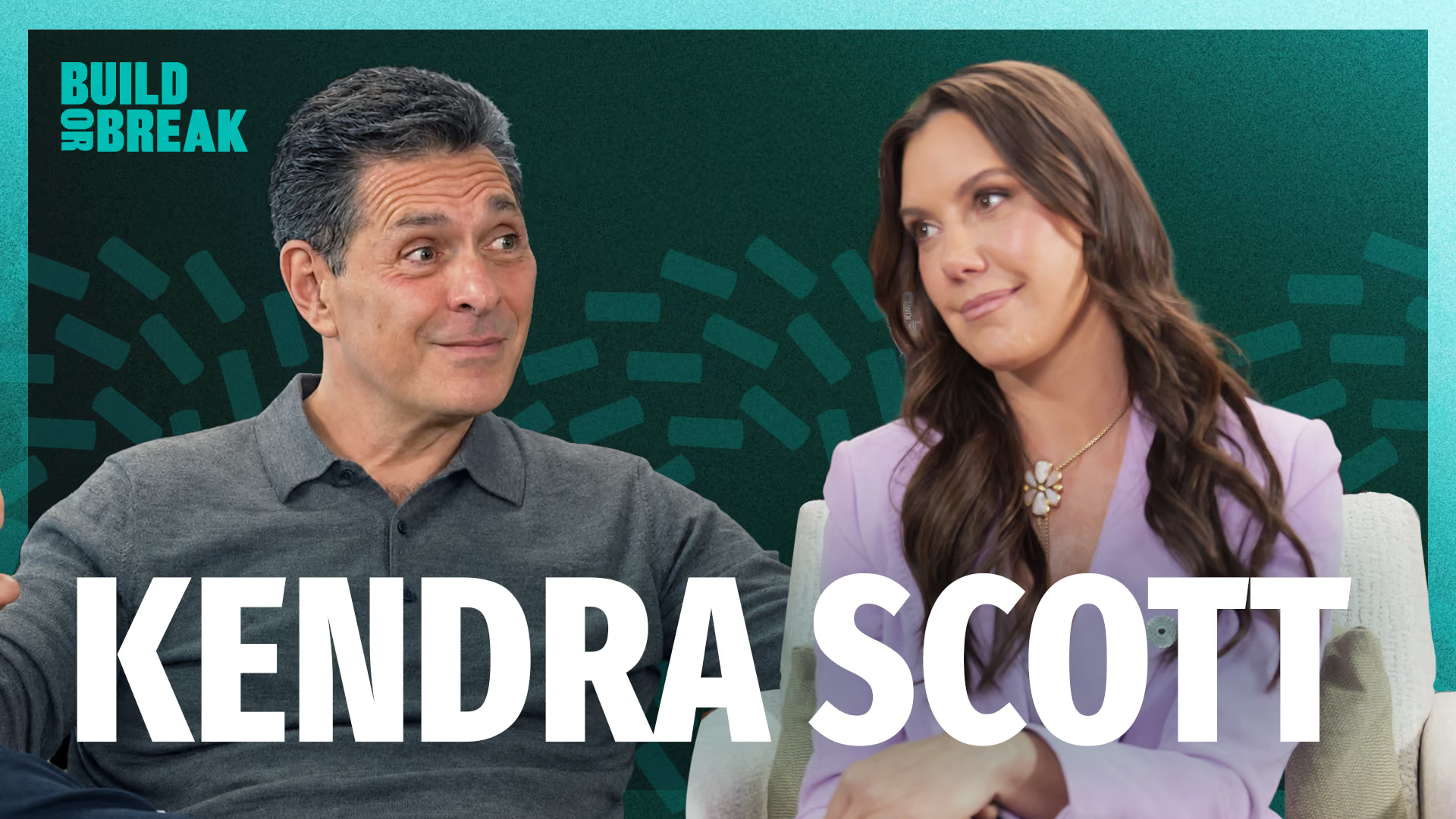
Before Kendra Scott was a billion-dollar jewelry brand with 165 stores, it was a failed hat shop. In the launch episode of Build or Break, Daniel Lubetzky sits down with his fellow Shark Tank shark and close friend to trace the whole arc — starting with the Hat Box, the company Kendra started at 19 after dropping out of college. Her stepfather was being treated for brain cancer at MD Anderson in Houston, and after watching patients struggle with itchy, uncomfortable headwear during chemotherapy, she bought soft cotton at the fabric store, sewed in linings, and gave the hats away — then opened a store in Austin to turn the idea into a business.
The Hat Box failed. Her stepfather died at 47, and Kendra closed the store feeling, in her words, like "a big fat failure" — a college dropout whose friends all had degrees. She took an ad-sales job at a friend's travel company, writing for Destination Weddings and Honeymoons Magazine while sketching jewelry designs alone at resort bars in Barbados. Then came the signal she had missed: former Hat Box customers kept calling — not about the hats, but about the jewelry she had sold on the side. "Sometimes the idea that you have, the main idea isn't the idea," she tells Daniel. "I wasn't paying attention to what was working until it closed."
So she started over from the spare bedroom of her Austin home — $500, a newborn, and a business card made in WordPerfect that read "Kendra Scott, Jewelry Designer." Her three-month-old son Cade rode along in a baby carrier on sales calls to local boutiques ("bring a baby or a puppy on a sales call and it's a pretty sure thing"). For the first ten years, no investor would fund her — a stretch she now credits for the scrappy cost discipline she still enforces at billion-dollar scale — until advisory board member Steve Hicks, the unsung hero of her story, became her first check.
Daniel and Kendra also dig into what makes a founder-CEO partnership work, why she will never franchise a Kendra Scott store, and why she hires on heart ("I can't teach that"). She breaks down the two-plus years of test-and-learn at rodeos and music festivals behind Yellow Rose — the Western lifestyle brand named for the yellow roses her stepfather brought to the Houston airport gate when she moved to Texas at 16 — which soft-launched in 2023 and opened its first store in 2025. Plus: becoming a full-time shark, Kevin O'Leary's promise to "chew me up and spit me out," quitting alcohol, and a rapid-fire Mexican Inquisition on breakfast tacos, lab-grown diamonds, private equity, and franchising.
Key takeaways
- The main idea often isn't the idea — the jewelry Kendra sold on the side at her failed hat store, not the hats, became the billion-dollar business.
- Ten years of investor rejections forced a scrappiness she still enforces at scale, asking her team "how many quotes have we gotten on this?"
- Before you can afford a board, build an advisory board — Kendra paid hers in earned equity, and one advisor, Steve Hicks, became her first investor.
- Hire on heart: the stones are trainable, warmth is not, so Kendra Scott stores hire for how a candidate makes you feel rather than retail experience.
- Test before you invest — Yellow Rose spent over two years of test-and-learn at rodeos and music festivals before opening its first store in 2025.
- The worst boss can be the best boss: her horrible magazine boss taught her everything she would never be as a leader.
- Kind and strong are not opposites — kindness does not mean you're weak, in the boardroom or in the tank.
Chapters
00:00 — Cold open
02:05 — The COVID pants prank that sealed a friendship
05:47 — The Hat Box: hats for cancer patients at MD Anderson
07:17 — Bullied in middle school, elected student council president
09:55 — Her stepfather's advice: on the other side of fear
12:10 — Closing the Hat Box: "I'm a big fat failure"
14:08 — The customer calls that pointed to jewelry, not hats
15:51 — A spare bedroom, a newborn, and a WordPerfect business card
25:13 — Ten years without funding: scrappy by necessity
27:54 — The Yellow Rose: her stepfather's flower becomes a ranch and a brand
30:18 — Why launch a second brand after 25 years
39:17 — Becoming a full-time shark on Shark Tank
45:49 — The builder behind the builder: first investor Steve Hicks
51:12 — The Mexican Inquisition: build or break rapid fire
Common questions
What is Kendra Scott's origin story?
Her first business was The Hat Box, a hat store she opened in Austin at about 19, and it failed. After it closed, former customers kept calling her, not about the hats but about the jewelry she had made in the store. She kept making and selling jewelry on the side while selling ads for a travel magazine, then left the magazine to do it full-time.
Where did the Kendra Scott business name come from?
She never set out to pick a brand name. When she started the jewelry business out of her extra bedroom, her business card, made in WordPerfect, just said her name and "Jewelry Designer." When she filed the business in Austin she named it Kendra Scott Design LLC, and over time it simply became Kendra Scott.
What does Kendra Scott look for in a job interview?
Kendra says the company hires on heart and does not require retail experience. She wants interviewers to notice how a candidate makes them feel, because product knowledge like the stones can be taught and warmth cannot.
What is Kendra Scott's business model?
Kendra says she won't franchise Kendra Scott. Owning every store is non-negotiable for her, so the company trains every team and keeps the customer experience consistent in stores and online. About 30% of sales are e-commerce, she says.
About Kendra Scott
Kendra Scott is the founder of Kendra Scott, the Austin-based jewelry and lifestyle brand she started in 2002 with $500 in a spare bedroom of her home and grew into a billion-dollar company with roughly 165 stores. A champion of women entrepreneurs through her women's entrepreneurial leadership program at the University of Texas, she is now a full-time shark on ABC's Shark Tank and the founder of the Western lifestyle brand Yellow Rose.
Kendra: I'm on the boat and I'm having a panic attack because he's down there fighting off sharks. Can
Daniel: I say you have the balls? Yeah. I
Kendra: Mean, sometimes the idea that you have isn't the idea. I wasn't thinking I was starting a brand. I have an opportunity to do something he didn't get to do. And so I've got to do it with everything I have. And you're going to get the most joy out of life by being able to do something good for others. I was a mom when I started this business with a baby and my baby came to work with me. Family became part of the business, even when it's scary. Push through those moments of fear because on the other side of fear, usually something great is waiting for you. I had a boss at the magazine who was a terribly horrible
Daniel: Boss. Name him.
Kendra: Bring a baby or a puppy on a sales call and it's a pretty sure thing.
Daniel: My guest today turned up project to provide hats to cancer patients into a business, but that business turned into her first failure. Then with only $500, a spare bedroom and a newborn baby, she turned her side gig into a billion dollar jewelry brand. She's as comfortable in the boardroom as in the barn. She is the CEO herself, the newest shark on Shark Tank, Kendra Scott. Kendra, I am so excited for you to be here.
Kendra: I am so excited to be here with you.
Daniel: Something about me. I feel like you're like my little sister. I don't know why I have that relationship with
Kendra: You. I've always felt that too. I felt like you were the big brother I've never had. And you're just wise and thoughtful and I can lean on you.
Daniel: And you're fun and irreverent and also wise and thoughtful.
Kendra: But I love it because I feel like we have this true friendship and we have each other's back. And it's been like that from the very first moment we met and that's -
Daniel: Did we meet through Shark Tank?
Kendra: Yes, through Shark Tank. Yeah.
Daniel: And we have a friend that connected us. And I was going to talk about this at the very end, but I like this story so much and I'm actually going to start with it.
Kendra: Okay.
Daniel: It was COVID times. Once upon a -
Kendra: Once upon a COVID time.
Daniel: Once
Kendra: Upon a pandemic.
Daniel: We spoke. I gave you some pointers. I had done it, I think one season before you or two seasons before you and you were coming to Shark Tank, but then COVID hit and so they had to redo everything. It was a time where everybody was wearing masks and we had to fly private. I tried to avoid flying private personally, but that was the only option. And you reached out to me a few days before and you're like, "Daniel, can you do me a favor?"
Kendra: Yes, because it was my first time on the show and I had a pair of, I wanted to wear this mint green pants outfit and there were no tailors that you could go to during COVID. Everything was closed. Tailors used to be able to come to your hotel room and they would do your tailoring there. They couldn't offer that during COVID. So
Daniel: You
Kendra: Had to take my pants.
Daniel: You asked me to bring them to you.
Kendra: Yes. And
Daniel: When I picked them up, there was a clear packaging. I could see them and they were not, this is called tappered and non-tappered is called what? Like a
Kendra: Boot cut, like a flare.
Daniel: They were flared pants. For us mortal men, flared is like real. And for me - Like a
Kendra: Vell bottom kind
Daniel: Of. Beautiful, but very powerful. You call it mint green. I call it you know you're present. Clearly a pant that a guy wouldn't wear. And somehow in my demented mind I'm like, I'm going to tease my team about it. So when we come on the plane and I'm with two team members, they're like, what is that?
Kendra: What are those
Daniel: Pants? And I'm like, oh, I forgot to tell you, Artem is the wardrobe consultant, told me that she thinks she wants to change things up and Make it come out to not be boring with all the men's colors. And so I'm going to wear these pants to really bring out my eyelight. And my team is like, I remember Ellie, she's like, I think mortified. No. The only thing that worked for me is that during COVID times we had this stupid mask. And so nobody could see that I was laughing through my teeth. And throughout the flight they were like, well, can we talk about it? It was like stop getting me nervous because we've already decided and please don't take me out of my room. So you
Kendra: Kept it going
Daniel: For a
Kendra: While. For
Daniel: Hours. Oh my goodness. For hours I kept it going. We finally land and I give you your pants and my team was like,
Kendra: Thank God. Yeah. Oh my God. I love it. No, we hadn't even met in person yet. We had only talked on the phone when you brought me my pants. So talk about a great friend that was just - It was so
Daniel: Weird that how sometimes in the COVID times and in all times with video conferences now you think you've met the person. We hadn't actually
Kendra: Met. No, we talked on the phone for hours. I mean, it was so fun because you obviously were so open about your experience on Shark Tank and so wanting to help me. And every question that I asked, you had such great answers for, but you were so helpful. You are that person who just wants to lift everybody else up around you. And the minute we met, I'm like, this is going to be one of my good friends forever.
Daniel: I think it was more that you were a lot of fun to hang out with, but let's start with, I have so much that I want to cover with you, but what's fascinating to me, because I remember having this conversation with you, you built a billion dollar brand, just an extraordinary iconic brand, Kendra Scott. And it started, I think with $500 out of your bedroom. But prior to that, it was a pivot from a very interesting story. Remember you were making beanies hats?
Kendra: Yes. Yes. Can
Daniel: You tell us that story? Because it's like a super cool story.
Kendra: Yeah. My first business was a hat company and I started it because my stepfather had brain cancer and we were spending a lot of time at MD Anderson in Houston when I was in high school actually. And when I graduated, I was still going where he'd have treatment and we would be there. And I met so many men and women that were losing their hair and experiencing hair loss through chemotherapy and some of the treatments they were receiving. And I had loved hats and I loved fashion since I was a little girl. And the headwear that was available, a lot of them were itchy or uncomfortable. So I remember going to Joanne's Fabrics and buying comfortable soft cotton.
Daniel: How old were
Kendra: You? I was like 18 years old. And I sewed in cotton linings and some of the hats that I had and then brought them to MD Anderson and shared them with some patients and gave them to them.
Daniel: First as a gift.
Kendra: Just as a gift. And I just saw how happy it made them. It gave them confidence. It made them feel good about themselves. And I just felt like, why aren't there more hats available in the world? Maybe this could be a thing. I'm going to start a hat company. So I dropped out of college to start my hat business. And at basically 19 years old, I opened a little store in Austin. I did every type of headwear. What was it called? The hat box. And I was making hats, custom making hats, but I also sold every hat you could ever want. I've always had this kind of entrepreneurial mindset. I've always been this, if I want something, I'm just going to go figure out how to do it. I think the first time I witnessed that happening was in middle school. I was bullied really badly. You? Yes. To a point where I'd eat my lunch in the - Why
Daniel: Were you bullied? Because I see you and I think she's like the coolest person in the world. How could anybody
Kendra: Believe? Well, I was almost legally blind in my right eye. So I wore these hideous glasses that were really thick and I had a really bad perm. They called me Stixter because I was really skinny and I had kind of a bobblehead for a head. I know that you don't look at this now, but it was the ugly duckling. Look at this now. Look at this now. Of course not. You know what? That's why I always tell people, you're feeling awkward in those stages of your life. Just wait. The awkward ones turn into the beautiful salons. But it was a very awkward time for me. But I had a big personality and I tried to make friends with everybody, but there was just some mean girls. And for whatever reason, I became a target and it was really hard. And I remember eating my lunch in the bathroom and they'd have hall monitors that would come in and I have to put my feet up on the toilet because you weren't supposed to be in the bathrooms during lunch. But if I'd go into the lunchroom, I'd sit down and all the girls would sit up and move. It was literally one of those 1980s movies.
Daniel: Why is that a thing? I don't understand. I don't either. There's worse with girls and boys that in middle school there's these cliques and that movie. It's so
Kendra: Awful. It's so awful.
Daniel: Where does it come from?
Kendra: I mean, I think we're going through a lot of hormonal changes. I'm not quite sure. I think we're definitely getting more awareness around bullying, but at the time it was so hard. And I remember my dad just always telling me, "Remember who you are, kill them with kindness. You walk in there with your head hell high and remember who you are." And it's not about the number of friends you have. It's about the people in your life that really see you and surround yourself with those people, even if it's one or two. And I had two couple good friends and that really helped me during that time, but I ran for student council president during this time of being bullied. And I believed that there were more people like me that felt like they were an outsider than the popular kids. And I was going up against some of these - We need to go movie about this. Yes. And I won. It was a pivotal moment of here's a girl who's eating her lunch in the bathroom, but she won student council. If I had listened to the bullies and believed the things that they were saying about me or making me feel, I would've been that. But I was like, "No, I know who I am and I'm going to show you who I am."
Daniel: And you're saying that you were entrepreneurial, not for starting a business, but entrepreneurial and taking initiative to run for student government posters and taking risks, which is entrepreneurship. It is. So then you fast forward and you have the, can I say you have the balls or not to start the hot box?
Kendra: Yeah. And my stepfather who had cancer was really special to me because he basically said, "Honey, you need to use the gifts that you were given in this life to do something impactful, to do something good. And you're going to get the most joy out of life by being able to do something good for others." And he's like, "Your time on this earth is so short, so you've got to give it everything you have. Play hard, even when it's scary. Push through those moments of fear because on the other side of fear, usually something great is waiting for you." And I think that sense of urgency, he died when he was 47 years old. Every birthday I have, Daniel, it's past 47, it's like I have an opportunity to do something he didn't get to do. And so I've got to do it with everything I have and be so grateful for all the things that I'm able to do and accomplish, but not be afraid, not let fear keep me from doing something new or trying something new. And even when I fail to know there's an amazing lesson in this and there's a reason this happened and it's my bridge to get me to the next place I'm going. And that mindset has really just helped me kind of get to where I am because I have had a lot of failures. Not everything has been successful. So many times in my life I've been like, "Oh my, why is this happening?" In the rear view mirror, I look back and I'll just go, "Oh, that's why that happened." I needed to experience that myself to be able to learn what I needed to learn, to take that to what I needed to do in the future.
Daniel: Something that I read recently is that the more times you try it out, the more likely you're to win. 90% of startups fail, but if you're a second time entrepreneur where you get back on the saddle, then you have a 20% chance of success. And if you're a third time entrepreneur, you're a 30% chance of success. And that sounds like just a little bit more. It doubled your chance from 10 to 20%. And so a lot of times you need to just dust it off and then get back on the horse and learn from the lessons. But it's easier said than done. When you have a failure, how do you teach yourself that it's an opportunity to learn from that setback, not an actual failure?
Kendra: I think in the moment, I remember when I closed the hat box feeling so defeated. At that point, my stepfather had passed away from brain cancer. So the business that I had founded for him really that inspired it, I had lost him. I was a college dropout. So now all my friends had college degrees and I didn't because I had just spent my college years running a business that failed. So it was really, really down. I remember just sitting here thinking so down on myself. I don't think there's ever been a point in my life that I felt as down on me and my ability and lost my confidence. And I just felt like, wow, I'm a failure. I am a big fat failure. I did. I really did. And now what? Now what am I going to do? And fortunately, one of my friends was running this travel company and travel magazine and he knew me well and he knew what a hustler I was. And so that I didn't have the college degree, he still gave me an opportunity to go in and ad sales and I can sell. So let me sell something. And so I was doing advertising sales and then he saw that I had this creative spirit. So he was putting me out. He started a new magazine called Destination Weddings and Honeymoons Magazine. So I would go out and write articles about these different places where people could get married and have their honeymoon while I was selling ad space to the potential hotels and resorts. And then while I was traveling, I was still so engaged in fashion and design. I mean, that was my passion and what I loved. So I'd be in Barbados and I'd be looking at the colors of the houses there and I'd be sketching ideas of jewelry.
Daniel: And the travel was paid by - Yes.
Kendra: Yes. You
Daniel: Were getting free travel.
Kendra: Yeah. And this is before we had our phones around with us. So you're going to resorts where there's honeymooners and I'm by myself. So I'd sit at the bar and I'd have a sketchbook and I didn't want to look stupid. So I'd order my dinner at the bar and then I would be sketching so I could keep myself busy of ideas of clothing and jewelry and different things. I'm sure we're not that
Daniel: Long. I'm sure all the people from the wedding were asking you to come dance with them.
Kendra: Oh no. But at that time, what was funny is I was getting calls from customers from my hat store still and they weren't calling me about the hats. They were calling me about the jewelry that I had made in my store. So
Daniel: The genesis started with hat box because you had a little jewelry line as a side gig.
Kendra: Exactly. And what was so funny, and I say this all the time to entrepreneurs that we work with, sometimes the idea that you have, the main idea isn't the idea. There's something in there that could be the big idea. It was jewelry, but I was so focused that the hats had to work. And you
Daniel: Didn't even notice it.
Kendra: I wasn't paying attention to what was working until it closed. So I was working at the magazine and then side hustle making jewelry and selling jewelry on the side.
Daniel: And the jewelry that you were making back then, if I saw it today, would I be able to connect the dots that is what today? Probably
Kendra: Not because I was buying what was available in the marketplace. So I was just using stones that I could buy from the beach shop or from wherever and then reworking them. Now I custom cut our own shapes, our own stones. So they're very identifiable to Kendra Scott. The one thing that's the same is that I loved color from day one. So I love semi-precious stones. I loved mixing color together. I was the color girl. The
Daniel: Parallel is that I also had Peaceworks, big setback, but out of it grew a product that became the predecessor to what became kind. So that's where we have commonality. Where we don't have commonality is I think when people see you and they're like, "Oh my God, this is the Kendra behind Kendra Scott." And then they say you and they're like, "Aha, that makes so much sense." And then when they see me it's like, "Wait, this is the guy behind Kendra." I was like,
Kendra: "What?" What are you talking about?
Daniel: Why did you choose to name the brand Kendra Scott? I
Kendra: Didn't actually, Daniel. It's a funny story. So when I started Kendra Scott, the jewelry company, I wasn't thinking I was starting a brand. I was starting a business out of my extra bedroom. I was hoping that it would produce enough money to help take care of my newborn baby, participate in our family. We needed money in our family. At that time
Daniel: You were married?
Kendra: Yep. Newly married. We were both working and trying to figure out how to provide for our family. And so I just had made a business card on WordPerfect and my name was Kendra Scott and it was Jewelry Designer. I didn't come up with a brand name. This wasn't a big business. That's how it started. And once I started getting sales and little boutiques in Austin, which is where it started, I had to go and file as a business. I had to go down and do the whole thing here in Austin. And they're like, "What's the business name?" So I just named it first Kendra Scott Design because I didn't have any idea. So we were first Kendra Scott Design LLC for years.
Daniel: When you were starting this, you were still working at Travel Magazine?
Kendra: Yes. When I first started, I was working at the Travel Magazine. And then when I really made it a business business, I left the Travel Magazine and said, "Okay, I'm going to do this full-time." And I was a new mom.
Daniel: And at that time it was Kendra Scott Design and mom. And
Kendra: Mom. And I was a brand new mom. So Cade was three months old and I was taking him on sales calls with me in a baby carrier. And
Daniel: That helped you close the deal?
Kendra: Oh, in Texas, for sure. It works really good. They love a baby. Bring a baby or a puppy on a sales call and it's a pretty sure thing. Cade, I tell him this, he's about to turn 25 this year. I can't believe it. And I tell him all the time, "You are the reason that we had this business start because of your cute baby and you're such a great, well-behaved baby. He'd go with anyone." So I was like, "You have no idea. You helped close a lot of sales."
Daniel: It was Kendra Scott Design and then eventually it became Kendra Scott.
Kendra: Yeah. And it just became. And part of it, as it started to grow, obviously at that point, you're not going to change the name. But then I really realized I'm proud of the fact that I can be a representative to this brand. And when I'm selling it, people know it's coming from me, and it really meant something. I think as the business now has become as big as it is, it's a big responsibility to hold the name of a brand. But the DNA of the brand are all the thousands of people that get to work with me. I'm just the lucky one that has the name. I mean, it is all of our fingerprints are all over this brand that have built it. But let's talk about that
Daniel: For a second because for me, as you may know, I finally sold my last take of Kind a couple years ago, and I still connect so much to the brand. It's still my baby. I love Kind and what I built. No,
Kendra: People said they saw you passing out Kind bars on their flight recently, and they were like, "I can't believe this guy. He's passing around Kind bars on our flight." I'm like, "That's Daniel."
Daniel: Kind is a big part of my identity and brand's not called Dubetsky, thank God. All the more so for you, and to your point, every action you take, you're even more associated with the brand. Do you sometimes feel constrained? I, for example, sometimes feel like when people say, oh, you're the kind guy, and setting up a very dangerous barometer book. I'm a normal person. I try to be kind, but I'm not the kind guy. I'm the guy that's very kind. Well, you are one of the
Kendra: Kindest humans I've ever met, and it's true.
Daniel: But I'm perfectly imperfect, right? I make mistakes too. So do you. I'm sure you've made mistakes. But with you, the stakes are very high. Yeah.
Kendra: I mean, I think I am who I am. I'm also very open and honest. I don't try to be anything I'm not. I'm pretty try to stay my authentic self. I'm not afraid to also talk about the things that are not perfect or flawed. You know what I mean? And I think some people -
Daniel: Well, you even wrote a book about. One of my favorite things that I read was about how that perfection's a myth and the messy parts of your life were critical to your success. And this goes back to who you are as a person. Reminds me a little bit of my father not to be too heavy, but my father, I think he went through the Holocaust. He survived some of the worst things in human history, and yet he was the kindest person. He found a way in his narrative of who he told himself that he was to bring out the best thing, to see himself as his role, to bring kindness together. And so I don't take for granted that from some difficult challenges you had in your upbringing, you made the best of it and you're always telling how -
Kendra: I think that does come from sometimes the people who are the kindest, the people who want to help others, the helpers are ones that have gone through struggle and that maybe have been hurt themselves by others. And you know what that feels like. And so you're more sensitive and you have more empathy, right? Do
Daniel: You think that seventh grader that got slightly bullied made you be more tender towards other human beings? Yes,
Kendra: I do, because I see people, I see when somebody's struggling, I see if somebody's hurting and I always wanted to reach out and try to help them. Does
Daniel: That help you as a leader at Kendra Scott?
Kendra: Absolutely. I lead with my heart and some people are like, "Well, you have to be..." You talk to some of our other sharks. It's like cutthroat and all these things. And look, you can be kind and strong at the same time. It doesn't mean you're weak. Kindness does not mean you're weak. So I'm a kind and strong leader. I had a boss at the magazine who was a terribly horrible boss. Name
Daniel: Him. And
Kendra: I say often he was the best boss I ever had because it taught me everything I won't ever be in a boss. I will never treat somebody the way that I was treated by this person, but I'm so thankful. And so as I even coach other people who are going through hard times, or I have students in University of Texas with our women's entrepreneur and leadership program that may be doing internships and they're having difficulty, and I'll go, "This is a gift. I know it doesn't feel like it right now, this experience that you're having, but I say it too. The worst boss was my best boss." The other
Daniel: Thing I want to just explore with you, which I don't think I have yet with others, is when you're the founder and then you're working with a CEO and you're the chief visionary officer, I've had relationships where that works really well and I've had relationships where it doesn't. What are the things that you've learned that make that work and what do you need in that partnership for it to work?
Kendra: It's a very tricky dance, as you mentioned. I think having a CEO that really brings to the table the elements that I don't have and identifying, "Hey, these are my strengths. These are your strengths. These are your weaknesses, which I happen to have strengths in those areas, or these are my weaknesses and this is what you're really great at." So I think finding when you can identify within yourself, "Hey, what are the things that I know that I excel at?" When it comes to understanding the customer, whether that's through marketing or the store design or the experience, I excel in that area. I don't need a CEO that's their expertise. I need somebody who can help us. All right where are we heading next? We're looking at international expansion. We're looking at category expansion. Have they done this in other businesses and brands? Can they bring that to what I need to do? What are the missing links that I don't have as a founder, visionary? Bring in the person that fits that and then together it's like a great, beautiful puzzle piece that allows you to focus on the things that you excel in and he or she can focus on things they excel in and then together it's this beautiful partnership and there's a level of respect for one another because you know I'm not very good at that and wow, he's great at that and vice versa.
Daniel: And your point also assumption of positive intent where you both. There has to be an element of trust,
Kendra: Open
Daniel: Communications and loyalty.
Kendra: I have that with my current CEO and it's just we're having so much fun together and every day I'm just amazed by him and he'll text me and he'd be amazed by something that I do. We're very complimentary of each other, but we also can have difficult conversations and be honest with each other. I told him when he came on board, I don't want a yes man. I'm not here for that. I want you to poke holes in things. I want you to tell me how we can do things better. I'm not going to be too sensitive here of like, oh, my idea is the best idea because it's not. This is why I'm bringing people in this organization that have walked the walk, that have done things before, that can bring their knowledge to the organization to take us to the next place. So I think as a founder, it's really important to be able to have that humility, but at the same time, not being afraid to come up with the crazy ideas and present those crazy ideas because that's inevitably what can bring your business forward. You
Daniel: And I have never had this conversation and you've never brought it up, but being a woman, only when I was preparing for this conversation, one of my team members talked about this thing called the girl boss persona. I didn't even understand what it means, but it brought to me an appreciation that there are challenges that you have that I take for granted that you don't have. I don't like identitarian ways of thinking. I transcend that, but I also don't want to dismiss the reality that things that I take for granted, you can take for granted because they're realities. How have you navigated that?
Kendra: As I've gotten further in my business and I think success that you have, you obviously are able to handle it and navigate it easier, right? But in the early days, I mean, I would walk into a boardroom asking for money. Nobody in there looks like me. It's a boardroom full of men. They're not funded. A lot of women are not getting funded in their businesses. So the first 10 years of my business, no one would give me money. No one. Me
Daniel: Neither, but that's just because I was a loser. Yeah.
Kendra: Well, I mean, I didn't have a great track record before that either, but I had a business that was doing well and we were growing, but it wasn't the business that these investors were interested in. So I think it was hard. I just kept having to go, okay, I've got to figure this out on my own. And it made me incredibly scrappy. It made me incredibly thoughtful about how we spend money, how we invest in things, which served me really well. I honestly look back on it and go, I'm actually really grateful in a way that I just didn't get a big check in the beginning because I think a lot of entrepreneurs that have that VC funding early, they just don't have perspective on how to really budget and have that scrappy small startup mentality that you need even in a big business. I go back to my team all the time. I'm like, how many quotes have we gotten on this? Is this really how much we have to spend? And that comes from that struggle that I remember so well. But I think being a woman, I was a mom when I started this business with a baby and my baby came to work with me. And then when they went to preschool, I would hustle while they were in preschool and then bring them back to my office after and they'd be crawling around on the floor in a bouncy seat and I had a pack and play in my office. I couldn't afford extra help. I couldn't afford a nanny, so they just had to be with me and family became part of the business. Why family is a core pillar is like I brought my kids to work, so somebody that worked for me had to be cool with that. They would have to pick up a kid occasionally and hold them. Then as they started having babies, they were bringing them to work. Do you
Daniel: Remember that you subleased me an office? Yes. When I moved to Austin six years ago whenever I needed an office and I almost never used it.
Kendra: But
Daniel: When I would go there, I really was fascinated by that feeling that everybody seemed happy, everybody had smiles. I don't know if it was kind of like Disney that you pushed the button for me to impress with you. There was a lot of good energy. Do I recall that pets are allowed in your room? Oh yeah.
Kendra: I
Daniel: Would bring my
Kendra: Dogs often. Yeah.
Daniel: There's pets, there's kids. There's kids.
Kendra: We have little scooters. Y'all see kids sometimes cruise around.
Daniel: There's a very joyous energy. Yeah.
Kendra: It's special. I mean, but that was the dream world. And so when you're an entrepreneur, that's what's so cool is you get to build your own dream. Tell me
Daniel: The origins of the real yellow rose.
Kendra: Yeah. So my stepfather, when I first moved to Texas at 16 with my mom and my stepdad, that was when you could actually go to the gate at the airport. And he greeted me in Houston. We moved to Houston first. Got there. I was moving in with them and he met me at the gate with a dozen yellow roses. He said, "Honey, this is the Yellow Rose of Texas. I want to welcome you. We're so happy you're here." It just became our thing. Every birthday, he would get me a dozen Yellow Roses. He'd get my mom Yellow Roses. They were his favorite. When he passed away, we - What a special guy. We covered his casket in Yellow Roses. And it's just always, anytime I'd see that flower, it just spoke his name to me.
Daniel: Why did he choose Yellow Roses? It was the
Kendra: Yellow Rose of Texas. He was such a Texan, such a Texan. Cowboy boots, creased pants. I mean, he just was such a sharp dresser, but he had always loved the idea of having a ranch and loved. We watched Walker Texas Ranger together always. And I always though, gosh, someday I would love to have a ranch. And if I do, I wanted to name it Yellow Rose after him. And so I bought a ranch, named it Yellow Rose, and that lifestyle, the horses, the wide open spaces, the beautiful Texas sunsets all inspired me to create a whole brand around that part of my life. It's
Daniel: Incredible to hear how everything in your life, you find the best in it. It's really a beautiful feature of you. Well,
Kendra: Thank you. I mean, again, I think that perspective of losing Rob at that young age and knowing how much he wanted to live. When you see somebody die who is so full of life and such a just walk in a room and a magnet and bright smile and just people just loved being around him and he had this energy and enthusiasm for life, to see that taken away from somebody who wanted to live so bad, you realize how special every single day is, and it just has made Me live my life so differently from that moment on. It's like I just go after it with a different approach. It's not endless. So every interaction I have, I want to make it count. Every time I get with my kids, I want to make it special because I think you look at life differently when something like that happens to you.
Daniel: I really love what you're saying. I'm going to now channel Mr. Wonderful to ask you a tough question on the business front because it sounds amazing and there's such depth in the Yellow Rose name and story, but having two brands is very tricky. One of the things I learned when I was doing Peaceworks, and this is my Hall of Shame, all the different brands that I did during the PeaceWorks years, I was trying too many different brands. I ended up trying too many things and diluting my power. Obviously Kendra Scott now has achieved so much that you have the right to have a second brand, but you still, it begs the question, why did you feel the need? And walk me through the decision. How should an entrepreneur decide because they are substantially different, but how do you decide where it actually makes sense to have a second brand as opposed to double down on the first brand?
Kendra: Well, I think for me, it's been 25 years of building a very strong foundation and a core business. So before you're just going to launch multiple brands or go into other categories, I look at my friend Ralph Lauren as a great example. He's built this house of Ralph Lauren. He has everything from Ralph Lauren collection, super high end to Chaps, which is sold in Walmart and everything in between. He's created many different sub-brands underneath a brand, but they all have a Ralph Lauren kind of thread that runs through each of those brands that make them relatable, brothers and sisters, so to speak. That's really what we've now, after 25 years, believe our customers want more from us. They love our products and we look at where can we fill white space? Where can we be disruptive? And where can we do it with a very authentic voice? Yellow Rose is a part of who I am. And so Western, it was taking this big surge in popularity. Even though Western's been around forever, the whole world is starting to know us with Yellowstone and all these other things happening. This is part of my life. This is authentically who I am. When I'm not in the boardroom, I'm in the barn. That's really who I am. So for me to be able to bring a lifestyle, my love of Texas, my love of this style into the world felt authentic and real. And I knew I could do it in a way that would be so unique and also do it from a woman's perspective. Most Western brands were cowboy first. It was the man, and then secondary, they'd make things for the women. I wanted to launch a brand that was female first. We have things for the guys. How long
Daniel: Did you have the idea for Yellow Rose before you launched it?
Kendra: So we tested it for over two years. So we had a small tiny home that we were bringing to rodeos and music festivals. We were testing product. We were just doing tons of test and learn, test and learn, test and learn. And once we saw what was working, then it was like, okay, we know we've got something. We can invest.
Daniel: When did you launch it officially?
Kendra: We started soft launching it in 2023 when we were starting to test it. And then 25 is when we really opened our first
Daniel: Store. How many stores do you have for Kendra Scott already?
Kendra: We're at 165, I think.
Daniel: Insane.
Kendra: Crazy.
Daniel: That's crazy. It is. I want to go to your second minute. You walk sometimes without being announced and people are freaking out or what?
Kendra: Oh, I love walking into a store. Usually somebody -
Daniel: They know you're coming.
Kendra: And they tell them I'm coming. I've gotten now more sneaky where I won't even tell my assistants or anything if I'm in certain cities and I just want to pop in. But I do like to give warning because I do like to meet as many of my team members as I can. And if they don't know, then they're like, "Oh my God, I missed meeting her." And I hate when that happens. So most of the time I let them know I'm coming so I can really say hello to everybody. How make sure that they're
Daniel: Comfortable telling you what they want to tell you. Because one of the things that the more you succeed, the more that the younger people might feel intimidated into just speaking up and you really value it, right? You want to know what I can do better. I
Kendra: Want to know the hard stuff. And
Daniel: I walk in -
Kendra: How
Daniel: Do you help them know that they have the permission?
Kendra: When I meet with a store team, I walk in, obviously I'm getting to know all of them and I say, "What can I do to help make your job better? What could I do to make the store better?" If you had a wishlist of things that needed to get done or that you wish you could have access to or that would help you do your job better, what are those things? So that I can just maybe take the Kendra Scott magic wand and make that happen for you. So I'm digging. I'm digging in for those questions. Not like, "Oh, so good to see you. How are you?" It's more like, "Tell me the stuff. Where are your blocks?" When you jump in,
Daniel: You go into the substance.
Kendra: I want to know what I can do to. And
Daniel: Then when they - When you're at a
Kendra: Party - They feel
Daniel: Like
Kendra: They can tell me that and I'm like, "Okay. Oh, this is good. Tell me more. What else?"
Daniel: When you're at a party, can you make small talk or you want to go into the substance?
Kendra: When I'm at a party, oh, I can make small talk, but -
Daniel: I have a lot of difficulty enjoying. I don't mind. I can connect with any human being as long as you let me do what I do, they call the Mexican Inquisition when I just jump into a lot of questions. You
Kendra: Do do that.
Daniel: And we're going to go into Mexican inquisition in a few minutes. Okay,
Kendra: Great.
Daniel: But not that this isn't there already, but if I can't go deep, it bores the fuck out of me. So if I have to just stay with it, I very quickly pivot. And I wonder if people find it like, "Oh, that's fun because I grew from this conversation. We both grew because we were curious about each other. We really get to learn or it's like this guy's intense. Joanie, don't invite him."
Kendra: No, I love that about you, Daniel. I think for me, I find myself not doing as much bigger social events that I used to do. I don't know.
Daniel: You could have fooled me. You throw some parties with me.
Kendra: I do. I throw some fun parties, but those are all people that I know and love. They're like my family. So I'm very comfortable. It's when I'm more going into events where it's like - In the galas. Yeah, where you're in a gala or something like that. I'm finding myself doing less of those things as I've gotten older. And I feel like getting just my people, being around my people, time is so precious, Daniel. And it's like every moment that I have that I can spend with my family, my kids, my dear friends, I just want to be able to do those because you don't get as many of those when
Daniel: You're
Kendra: Running businesses and you're doing the things that we do. So I value those times so much.
Daniel: It's funny how it's the little things in life that mean the most. And it's not like where you live or what you drive or -
Kendra: Is this a
Daniel: Song? The price tag on your clothes. There's no dollar sign on peace of mind that I think I've come to know this. So if you agree, have a drink with me, raise your glass of a toast and let's do a little bit of chicken fried.
Kendra: Yeah. I've done such a super familiar song. Yeah. I happen to know that one. The artist is really cute too, the lead
Daniel: Singer. I wanted to see how long it would take before Kendra. Oh, I knew right
Kendra: Away. I knew right away.
Daniel: That's Zach's. One of my favorite things about you was when you called me and like, "Would you be friends with my fiance?" And I really love Zach. I know. I think you hit it out of the park with this guy. He
Kendra: Was so excited to spend time with you too, and he's just such a special, loving. I mean, talk about kind. I mean, kind and generous
Daniel: Person. Super interesting.
Kendra: Super
Daniel: Smart. And really.
Kendra: And the two things, he uses his art, his creativity, his music. He's built a camp for kids and veterans. It's very similar in how we think about the world and wanting to utilize the gifts that we were given to do something bigger than ourselves. And to find that in a partner is really special.
Daniel: He's very special. You're not going to know what I love the most about getting to know
Kendra: Him. What?
Daniel: Spearfishing.
Kendra: Yes.
Daniel: Holy shit. My son and I just discovered it and we got a little fish like this. You
Kendra: Need to go out with Zach.
Daniel: He showed me the videos, the photos. It's insane what he's done.
Kendra: I know. And what's crazy, I mean, I'm on the boat and I'm having a panic attack because he's down there fighting off sharks. Literally sharks come around when you spearfish and you have to. He'll push them away. And I'm just like, he doesn't think it's a big deal. And I'm like, "Honey, there is no way I'm getting in the water with you with these sharks around." But it's really impressive. He's teaching my sons to do it. They're loving it. All three of them are loving it. You have to go with him. He's an incredible instructor too. He just has a very good way of teaching. He's so patient and he'll be right there with you in the water so you feel very secure and safe. He'll fight the sharks off for you so you don't have to worry about it, but it is something that, that's his happy place
Daniel: For
Kendra: Sure.
Daniel: And you, if I recall correctly, went to be with him at that -
Kendra: The Spear.
Daniel: The Sphere in Las Vegas. Is he going to do it again or not? In
Kendra: 27, yeah. So this year he has his tour, so he will be on tour going to
Daniel: Cities all over. I haven't done this Spear yet. I want to do
Kendra: It.
Daniel: It
Kendra: Is amazing. I mean, it was
Daniel: Such an incredible thing. Will you please invite me next time he does it?
Kendra: Yes.
Daniel: So something really exciting just happened.
Kendra: Yes.
Daniel: You were announced as a full-time shark.
Kendra: I mean, here we are together. We're going to be on the poster together, Daniel.
Daniel: I'm so excited about it.
Kendra: Oh my gosh. I mean, I'm so excited. I love it. I mean, from the first minute I stepped in the tank with my lucky shoes, I just felt at home. I felt like, oh, this is my place. And I love entrepreneurship. I love the entrepreneurial journey and the spirit. And just being part of that is just. I mean, we're on set for many hours.
Daniel: But you bring something really special to them. And you can tell from this conversation. Why do you do it?
Kendra: Because of the entrepreneurs. I just love being a small part of this American dream. And when they walk in, I just see myself in my journey so much in these entrepreneurs, and I know I can help them.
Daniel: You know why I do it?
Kendra: I just love it so much.
Daniel: I also do it for the entrepreneurs, but I have to convince, I also do it because for me, it's so intellectually stimulating. Same with this show, learning something new. Something that's been fascinating for me is learning the art of interviewing is actually harder than being on the receiving end. I've gone on so many interviews and it's just so comfortable. You come in, they're keeping. It's kind of like the context of me being the founder versus being the CEO. As the founder, I can misbehave, do whatever I want, be creative, but the person needs to keep the drinks
Kendra: Running.
Daniel: Got to keep the things going. This job for me is challenging. And when I go to Shark Tank, I have to put in my best work to keep up with the weight of the other sharks, to out negotiate them, you have to have pattern recognition. It's challenging for me. I enjoy it because it's intellectually stimulating.
Kendra: It is. I mean, definitely, you have to be ready to get in there and not be afraid to jump in, and it can be super intimidating. I remember when I met Kevin, he told me that he was going to chew me up and spit me out in a million pieces. He literally said that to me when he first met me, and I was like, "Ooh, I can't wait." That was my response. Great, let's go. I love Kevin, by the way, and we've had so much fun since then, but it is fun getting in there and it is such a challenge, but it's also like I get so excited, especially when I can beat out Kevin in a deal or partner. I mean, partner with another shark on a deal is always fun too.
Daniel: One of the things you said that is really interesting, I don't lack for the ability to have energy. When I showed up there after my first segment, I though, oh my God, I overstayed my welcome. I was too aggressive. I talked too much. And the producer's claim is like, "Daniel, you need to wake up." I'm like, "What?" "Yeah, we need more of you. "I'm like," What are you talking about? "Because the studio is so big that you need to project, and the sharks are fighting each other, and you don't want to interrupt because you're the new one in the thing, and they need you to assert yourself. It's the only place where I've ever been to
Kendra: Step it up and not shut up. That took me a lot because I was talking over. I didn't want to talk over another one of the sharks or be that. And they're like," No, you have to. Otherwise, you won't make it, basically. You have to get in there and be more aggressive than you would typically be in any other situation. "Because I wouldn't do that. I wouldn't talk on top of somebody else talking and be like," Hey, wait, wait, wait. "I wouldn't do that, but you have to do that when you're in the tank.
Daniel: And they turn off the mic of the guys that don't get the thing. So for the audience, it's not as difficult as experience as when we're recording, because we're recording, we're interrupting each other, but once it gets edited, you don't feel that fiction except when they tried it live and it was a disaster because the audience wasn't used to the reality of fighting to get your warming edge. Yeah,
Kendra: That was crazy.
Daniel: What are something that you would share with the audience that surprised you and was different from you would expect that having done Shark Tank already a few seasons is different for what people might expect?
Kendra: I mean, I think everyone always asks me, are the sharks nice or are they. And they are. I think everybody is so amazing, not just the sharks, it's the whole Shark Tank family that's incredible. The producers, the assistants, the wardrobe. I mean, everyone
Daniel: That's there. It is a family.
Kendra: It is such an incredible culture there that you feel of love and commitment. And I think that's what has attracted me most to it is
Daniel: That - And everybody's working towards the same thing. They
Kendra: Are. And we all want these entrepreneurs to succeed. It's like we want them. When they come into the tank, we don't want to tear them down and make them. We want
Daniel: Them
Kendra: To be successful. We want them to have a great pitch.
Daniel: But even Kevin, What people don't understand sometimes is that Kevin has the strength to sometimes say what needs to be said. And I have to say, at least for myself, sometimes I need to share something, but I don't want to hurt the feelings of the entrepreneur. Most times I managed to be both frank and nurturing, but once in a I was like, oh my God, I don't have the guts. And Kevin always has the guts. Now he delivers it. What I say about your question about whether the sharks are the way you see them to be, yes, except they just elevate - They amplify. They amplify the
Kendra: Persona. Yes.
Daniel: But the essence of Laurie is her essence. I know Barbara and Robert andthing is just
Kendra: Volume up a little bit from their typical day to day, I think.
Daniel: Yeah. Is there a particular, you said Kevin, but is that who you. Kevin wants to be the foil, but beyond that, is there a shark that you find naturally competing more with or not?
Kendra: No, I think. No, not at all. I mean, I feel like we're all. If we see something good, we all want it. So it doesn't matter if it's you, my dear friend or whatever. I'm going to be like, "Daniel, I want that." Well,
Daniel: I actually look forward to competing with you because - It's
Kendra: Fun.
Daniel: I don't think you and I have gone at each other's throats yet on the show,
Kendra: Have we? We haven't. We haven't. And just be. Okay. I'm ready. Yeah. But if there's something real. We did try to go in on some things together. So yeah, we've tried to work together, but you're just so sweet that I might. But if it's a good deal - Barbara said about
Daniel: Me is like, "Be careful with this guy because he seems sweet, but then he goes with it." That's
Kendra: What
Daniel: Rashaun
Kendra: Said. Rashaun's like, "I thought you were like this."
Daniel: About you?
Kendra: Yeah. He's like, "You're a tiger."
Daniel: So Kendra, I tried to ask every guest on the show two signature questions. One is, is there a builder behind the builder? Is there somebody that made a huge difference in your life that you want to honor an unsung hero that honestly, you would've not gotten here without that person?
Kendra: I mean, I think for me, I've been so blessed to have a lot of people that have been mentors or who have showed up in times that were really tough, who believed in me when I didn't believe in myself. And that has happened throughout my life. My first investor, I think, was one of those unsung heroes, Steve Hicks. He was an advisor. So I had formed an advisory board because I didn't have a typical board because nobody would invest in me, but I wanted the discipline of having quarterly board meetings. I wanted to have. Yeah. So I was like, "Let me get some advisors." I gave them a small earned in equity position because I was like, "I can't pay you, but I want to give you something."
Daniel: A board has the legal oversight responsibility. It comes with fiduciary duties. An advisory board doesn't have those fiduciary duties. They're not going to have liability if something goes wrong, but you still try to draw advice from them.
Kendra: And it's great if you're a founder in a business where you're not ready to bring in investment capital, but you want to have more people around you. It can be very lonely at the top as an entrepreneur. So I always tell my young entrepreneurs who are just like one or two people in their company, you need more than that. So find three people in the community that you really admire and respect and ask them to be part of your advisory board. Be very thoughtful of their time. I would meet quarterly and maybe every now and then I would ask for a phone call and I would have 10 minutes of here's what I need to accomplish or a question that I have that I need help with to be really thoughtful. But I also respected that this was their time. And so I gave them an earned and equity position. And one of those advisors at one point came to me and he's like, "Kendra, you're building something amazing. I'd love to invest." I remember nobody had
Daniel: Said yes.
Kendra: It was Steve Hicks.
Daniel: Steve
Kendra: Hicks. He was my first investor. I think his confidence, and then for once I had somebody that was a partner in a way. It was a small percentage of investment, but still -
Daniel: Is Steve Hicks? Steve Hicks still around. He recently
Kendra: Passed away. And so it's just been devastating. I miss him so much. He was like a second father to
Daniel: Me. You got to say thank you to him.
Kendra: Yes, many times. He's very special and his wife Shannon and I are very close and his family, his kids, I mean, they're like part of my family too. I love them all and I really just love him because he believed in me when no one else did, and I'll never forget that.
Daniel: You got me already two, three times. I know. Is there any hacks, very practical hacks that you use to manage yourself, your business, your daily life? Any managerial thing or how you time management or any tool that you use that you want to share with
Kendra: The audience? I think about health and wellness is really important to me. And as I've gotten older, I realize that I've got to prioritize my health. One thing I know you do, Daniel, because I happen to see you in the neighborhood, is you walk and talk. You're a walker and a talker. You're always taking your calls. I have now started walking and talking thanks to you to get my steps in. So there's things like little hacks like that, like how am I going to get all my steps in today, but I have all these calls. Okay. Well, some of these calls I can do while I'm walking the trail or walking in the neighborhood and really trying to prioritize my health in this. I stopped drinking last year. It's been over a year, alcohol. I was like, "Why am I putting poison in my body when I'm doing all these other things for longevity and health and wellness and supplements and all the things we're trying to do, creatine and weightlifting and the things that they're telling you to do as you age?" I cut that out of my life and it was been such a game changer for me. And so littlest things, I'm sleeping better. Well, better sleep means being a more productive person. My mind is clearer. I'm able to do more. And so it's little things like that that are hacks. I don't know if they're hacks or not, but they're lifestyle changes that have made a huge difference in my productivity, in my ability to be a better mother, a better leader, is that you have to take care of yourself
Daniel: Because
Kendra: If you're not, then you're not going to be able to take care of everybody else.
Daniel: The walking thing was inspired by Michelle. The woman, I never. Every time I was like, "Okay, Michelle, check a look. I got 13,000 steps." She's like, "I got 16,000." I'm like, "Mish, look at this. I got 19,000. I ha 24,000." She always beats me. But what's interesting is ever since we moved to Austin, it just became so. I cannot not walk now. If I go three, four hours of meetings, I cannot need it. And it's so pleasant. It's nice. It is. Take the colds while walking. It really helps digest. It helps process. It helps. I love that.
Kendra: No, you inspired me. You really did. I want you to know that.
Daniel: Hopefully not with the outfits. I know, you look great. All right. We have moved to the final segment of this very important time. I'm so
Kendra: Excited.
Daniel: It's called the Mexican Inquisition.
Kendra: Oh, goodness. Here we go.
Daniel: I'm going to ask you a question. You have to quickly react.
Kendra: Okay.
Daniel: If it's a build or a break, build or break. I'm answering build or
Kendra: Break.
Daniel: And you say, "Yeah, do you think it's..." And you can provide a parenthetical, but we'll keep it moving.
Kendra: Okay.
Daniel: Are you ready?
Kendra: I think so.
Daniel: It's very deep philosophical -
Kendra: Oh, goodness.
Daniel: Okay. Items. Build or Break breakfast tacos.
Kendra: Build. Love a breakfast taco. There's nothing about a breakfast
Daniel: Taco that you think break. I'm going to tell you, for me, it's a break.
Kendra: What?
Daniel: Because breakfast tacos are like these Texan gringo. For me, a real taco - Texas
Kendra: Gringo.
Daniel: Yeah. Let me explain it to you. Oh
Kendra: My gosh.
Daniel: Flour tortillas and corn. It
Kendra: Can be corn.
Daniel: It can be corn. For me, a real taco is made with corn. It's got meat. It's got cilantro, onions, parsley, cilantro. Okay.
Kendra: Well, that
Daniel: Sounds delicious. And this thing that is just like beans and. I mean, I'll eat it, but -
Kendra: It depends on the place. I'm with you. Not every
Daniel: Breakfast. I think I'm going to get a lot of hate now.
Kendra: I love a breakfast taco. Build, build, all the way.
Daniel: Okay. Build or Break, Instagram filters.
Kendra: Is there a mid ground? What's between build or break? Whatever people - I think there's moments when lighting isn't good and you need a little but I don't like it when people are doing them so over the top that they don't even look like themselves. And then you're just like, "That's not even you anymore and it's not real for other people." So I would say I'm leaning more towards break.
Daniel: I'm where you were.
Kendra: Okay.
Daniel: Build or Break synthetic diamonds.
Kendra: Build. And they're not synthetic. It's called lab grown.
Daniel: Lab grown.
Kendra: They're lab grown diamonds. They are formed the exact same way a natural diamond would be, except they're in a lab. And so they're cruelty free. You cannot tell the difference. You can put them under a loop. And as a jewelry designer, you can look at a mine diamond and a lab diamond of the same quality and they're going to look exactly the same. I think it's helping people be more affordable. I think it's more attainable for people. They're beautiful. They're radiant. Build.
Daniel: Build or Break the CMAs.
Kendra: Build. I love the CMAs.
Daniel: Well, me too, but not more than I fell in love with Zach.
Kendra: Yeah.
Daniel: Build or Break owning a ranch.
Kendra: Build. How long
Daniel: Have you had a ranch? I
Kendra: Love it. Since 2021.
Daniel: It's not a ton of work?
Kendra: No, it's work. I mean, we have land, we have animals. My
Daniel: Grandfather was a rancher. He had three ranchers.
Kendra: I'm not ranching ranching. I have a cute ranch. I have some longhorns. I have mini cows. I have horses. We have trail
Daniel: Rides. Many cows still in your house?
Kendra: No, it's at the ranch. We have four now.
Daniel: Those are cute. They're
Kendra: Precious. They're precious. Yeah. It's work, but it's also like we have a full garden, so we're getting fresh veggies and fruit trees. We're making our own jams. I have honey bees, so we'll be harvesting our own honey this summer. I love it. I mean, my mom's family were farmers, so I would go to the farm when I was a kid and being raised around that, for me to now get to do this with my own family, it's kind of a full circle
Daniel: Moment. Can I ask you a random question? My son Jonah saw in a video how people harvest honey and he asked me to get a kit. We got this big thing and then it crossed my mind to check whether there are certain conditions that are required. Can it be done in a foresty area? Yes. Does it have to be all open field? Does it not matter?
Kendra: There's a lot of things you need to learn. I have a beekeeper who is a specialist who -
Daniel: Will you connect me?
Kendra: Yes. And I'm learning. I go out with him in my little bee suit.
Daniel: Would connect me? Yes,
Kendra: I will connect you. And he knows everything. There's a lot of complexities, so many more than I'd have any idea about beekeeping to keep your bees healthy and happy and all the things that happen.
Daniel: And you harvest your own honey.
Kendra: We'll
Daniel: Harvest
Kendra: Our own honey, yes.
Daniel: But you've never once let me try your honey.
Kendra: No, because last season we didn't harvest because we were just learning. We were just getting going.But I brought in this new beekeeper who's amazing. So this year I will hand deliver you Yellow Rose Ranch Honey. Awesome. I like to call it, guess what I'm calling it? Liquid gold.
Daniel: I like it. You market that.
Kendra: I know.
Daniel: Once we scale it.
Kendra: Okay.
Daniel: Build or Break private equity.
Kendra: Build.
Daniel: It's tricky. Because
Kendra: I have private equity in my company.
Daniel: I know, but it's tricky. It's tricky. What I want to communicate through this is you have to choose your partners wisely. Yes,
Kendra: You do.
Daniel: You have to set your terms to protect yourself. And it really matters who your partners are because sometimes - A
Kendra: Thousand percent.
Daniel: No,
Kendra: It's great. I wouldn't have the business I have today if it hadn't been for private equity coming in and helping us scale. So I absolutely would say build. But like you said, I've had a lot of founders who didn't have the right private equity partners and maybe were forced out of their business or they were making decisions based on their business because maybe they had more of a majority control rights and things like that. So it's very important on -
Daniel: And also don't assume that you know for sure where you want to be five years from now because you set some terms and then you change your mind and you want to continue running the company, but the private equity firm requires you to sell it, which was in my situation, something that caused me a lot of grief that they were pushing me to sell and I was able to overcome it, but it was a very big challenge.
Kendra: I think, look, like with anything, it's like the partnership, right? You really need to do your due diligence. You need to ask a lot of questions and you need to ask people who have worked with them, other businesses, what are they like on a bad day
Daniel: When
Kendra: The business isn't doing well or didn't have a good year? Great
Daniel: Question.
Kendra: What are they like then? Because they're going to show their shiny, happy, amazing self when they're pitching you to come in. That's their best day. What do they look like on their worst day and what kind of partner were they? Were they collaborative? Were they helpful? Were they there to all hold hands and get through that rough spot? Or did they become very dominating and aggressive? What were they like? I think getting those questions answered helped me find the right private equity partners because I did a lot of due diligence in just finding out what they were like working with other businesses.
Daniel: Love it. Build or Break, side hustles.
Kendra: Build. I mean, my business started as a side hustle. So I think for a lot of us, until you have the ability to let go of that other job before I could let go of the advertising job that I had, I had this as a side hustle. And that meant I was working a lot of hours and I was making jewelry when I was coming home from that business at night and on the weekends making deliveries or whatever
Daniel: It might be. The reason I like this question for you - But I loved
Kendra: It. I mean, I loved it.
Daniel: The reason I like this question for you, sorry that I interrupted you a thousand times. No, it's
Kendra: Okay.
Daniel: The reason I like this question for you is that it worked out in your case, but the danger with side hustles is that if you get distracted doing too many things and you don't sometimes. In my case, before kind, I was trying hundreds of things at a time and I always ask myself, had I not tried so many things, if I'd been more focused, would I have been more likely to succeed in one of those? Or just how it became that it was what it meant to be when kind became the focus? But you would have not built the hustle. I think
Kendra: For me it was like the timing. And I had to see that the jewelry had enough legs to support me dedicating my time to it and get to a place where I felt like I could do that, that I could let this other job go to be able to do that. But you have to at some point, if you're like, "Okay, it can't always be a side hustle or it'll never scale." So at some point you're going to be like, "I either am in or I'm not." And there's going to be that day where it's like the line in the sand will be drawn and you're going to have to make that leap of faith. And it is a leap of faith. The way I looked at it is like, "Okay, I'm going to put both feet into this. I'm going to go for it. And God forbid if it doesn't work out, guess what? I'll go get another job, but I'm going to give it everything I have and I'm going to throw it all in there and go for it and see what works, if it works out." And fortunately it did.
Daniel: Fortunately it did. A little bit.
Kendra: Yeah. It took a while.
Daniel: Build or Break, franchising your business.
Kendra: Break. Look, for my business, now there are very successful franchise businesses out there. For my business, I felt like there's no way that I could give away that ability to make sure that the customer. Experience wasn't at the level that I knew it needed to be. And with franchising, you can sometimes lose that ability. You can give them a toolbox and say, "This is how we run things," but they're running their own business that you're just allowing them to use the name or the products that they're selling. For me, that was a non-negotiable. I wanted to own every store. I wanted to make sure I was training everyone, that it was our people, that we were really giving that customer the experience that I wanted to make sure that was consistent. Every touch point, whether that was e-commerce or our stores. Now, there are other businesses that maybe franchise works for, right? It's a little simpler model. There's not such a high touch point of customer care and connection that you have with us within the jewelry business that it may work. But for me, there was never a question that I would never franchise Kendra Scott.
Daniel: Yeah, it's interesting. I also like this question because it's almost sacrilegious to think of a Kendra Scott store as a franchise. It doesn't work. You can expect the same identical quality experience. And the franchise business, you're aiming for the same quality, but it varies depending on the franchisee. It does. Barbara's done such a good job with franchises on Shark Tank. It's been interesting for me to behold. I've never successfully invested in a franchise business. Of course - No, and there
Kendra: Are so many that work that I think whether it's maybe car washes or laundromats or maybe there's different ones that can work. But I think when you're in high touch, high customer connection, we have color bar where customers are customizing pieces and all of these different elements happening and we're such experiential retail. To have that experiential retail, to me, you need to own that and that you never can be complacent. So for me, I wake up and I'm like, okay, we're going to be better than we were yesterday. And we may be implementing something company wide that is elevating the customer experience. If I had a franchisee, that's their own business. I'm not able to implement all of this, how we were going to do business today versus how we did it yesterday. It's like they've already got the plan. So I think it's just for us that ownership of owning the customer experience is so important.
Daniel: If I go to one of your stores in Kalamazoo and another one in Shamalamo -
Kendra: I love those stores. Kalamazoo and
Daniel: Shamalo Balough. They're my
Kendra: Favorite. Yes.
Daniel: Are they people working there taught to manage the. Will I feel, oh, same culture, same experience? I will feel that.
Kendra: Oh, before you get on the floor at Kendra Scott, the training that our team goes into is really extensive. And it's all about connection versus transaction at Kendra
Daniel: Scott. Warmth. Will I feel your warmth when I go into score?
Kendra: Yes. And we hire people on heart. So I don't care if you've had any retail experience. When I interview you, I'm looking at how you make me feel.
Daniel: You have people with high emotional intelligence.
Kendra: Yes. So I'm like, when you're interviewing somebody, I want you to be like, is this the person you don't want to stop talking to? Is this the person that just make you feel their warmth in their presence? It's how they make you feel. I love that. And if they make you feel great and you want to keep the conversation
Daniel: Going - And your HR person knows to look for that. And
Kendra: We can train them on what are the stones? That's trainable, but I can't teach that.
Daniel: I can't teach that love. A lot of times people are looking for skills rather than energy, values, integrity. They need to first and foremost be the culture.
Kendra: Yes. Anything retail customer facing. Don't just hire on experience. So many times, a lot of times they've come from retail. And quite honestly, how we do retail is so different at Kendra Scott. I have to unteach them all the things they learned at some of these other corporations. So it's not about that for me. It's about somebody that has this warmth and energy and love and passion and kindness. Those are the people I want working for me. That's the front line that I want. And then I can teach them everything else, but I cannot teach that. So that's what we look for and you're going to feel it everywhere you go. We hire on heart.
Daniel: Build or Break, Texas TV.
Kendra: Texas TV?
Daniel: Like Landman, the whole thing works.
Kendra: Oh, build. I am obsessed with anything Taylor Sheridan does. I love them all. I love that we have all this happening here in
Daniel: Texas. We're Texas Business Hall of Fame.
Kendra: Yes.
Daniel: And he became a fellow
Kendra: Ordinance. Do
Daniel: You know him or no?
Kendra: I've met him a few times, but yes, they're amazing. I love all their shows. I love that all this is coming out of Texas. It's so exciting.
Daniel: Build or Break online shopping.
Kendra: Build.
Daniel: What percentage of your sales are in the store versus online?
Kendra: About 30% is e-commerce. And then for me, I mean, I do probably 95% of my shopping online. I don't have time to go into stores anymore. I am an online girl. I know
Daniel: My brands - When you're walking in the airport or in a store, people recognize you and they stop you? Yeah.
Kendra: I mean, it depends on where I am more in certain places than others, but yeah, they do. And sometimes -
Daniel: And do you like it or it drives you nuts?
Kendra: No, I love it. I love meeting people and I love seeing people wear my jewelry. Many times I, like you, I go up to people and if I see them wearing my jewelry, I'd be like, "Thank you. I see you're wearing my necklace or you're wearing Kendra Scott." And then they'll sometimes be like, "Wait, you're Kendra." And they have this moment, but I
Daniel: Always - I go to them and I see them meeting at Karma. It's like, "Oh, I love that you're eating Kendra." And they're like, "Weirdo, police, please go."
Kendra: I know. No, but I do. I go up to people all the time. I thank people. I love meeting people. I love seeing how our business. So many times I have people come up to me and be like, "You've donated product for our charity or my son was in a hospital and your team came up for Kendra Cares." So a lot of times they're sharing how our business and our brand has touched them in a meaningful way. And I love to hear those stories. And they have no idea how much that gives me is to know that, okay, we are making a difference and the things that we are doing are making a positive impact. So I love it and I'm
Daniel: Always excited. M daughter was like, "Dad, I know it's too fancy, but I would love if you can please, for my birthday, get me a Kendra Scott piece of jewelry." And I thought it was adorable. I meant to tell you.
Kendra: Yeah, I love that. What a sweetheart.
Daniel: I love - And it's very aspirational. It's achievable and aspirational. You've done a very good job in building a brand. That's attainable. It's a lifestyle brand that people want to relate to, but it's not prohibitive. And also you're not a jerk. You're not obnoxious. Thank you. What I like about your brand is it's you. It's a person that's very fashionable, but not an arrogant brand. It's a very well done job.
Kendra: Yeah, very relatable and authentic. And I think that customers can smell a fake. So when they see a brand that continuously shows up, whether that's in their community or how they're treated when they walk in the store, all of those things, every single thing matters. And when you can do that authentically, every time that customers interact with the brand, that gains their trust.
Daniel: And
Kendra: That's ultimately what you're hoping to get as a brand is that you're getting their trust and that they become brand fans, not just customers, right? That they become a fan of the brand and -
Daniel: An ambassador.
Kendra: An ambassador. Exactly.
Daniel: We're going to end with a somewhat serious, a little bit philosophical question. Build or Break Asless Chaps on me.
Kendra: Wow. Let's just not do it. Okay. Let's just not do it. Let's not go there. But it's a capital B break. Okay. Don't do it, Daniel.
Daniel: Kendra, this has been so much fun. Thank you for doing this. Thank
Kendra: You for having me. This was fun. You're the best.
Daniel: We want you to become a builder with us. So subscribe to Build or Break now and leave us a comment or our review. We're trying to build a movement and you can be part of it by hitting the notification bell and telling us what you think about this episode and by telling all your friends to watch you. Thank you.
Watch Build or Break on YouTube
Listen on Spotify, Apple Podcasts, or Amazon Music
Follow Daniel Lubetzky on Instagram and TikTok
Become a Builder: buildersmovement.org
Kendra Scott
The Hat Box
Yellow Rose
Shark Tank
MD Anderson
Destination Weddings and Honeymoons Magazine
Steve Hicks
Zac Brown
Kendra Cares
University of Texas
Ralph Lauren
Kevin O'Leary
All images from Kendra's Instagram
https://www.instagram.com/officialkendrascott/
https://www.instagram.com/kendrascott/
https://www.tiktok.com/@officialkendrascott
https://x.com/kendrascott
https://www.linkedin.com/company/kendra-scott
Music: Amos Cochran https://www.editscoremusic.com/
Production: Straybird Studios https://www.straybird.studio/
Post Production: Jennell Lewis & Scott Convery
Social Media Production: https://www.edits-etc.com/
Build or Break Team:
Executive Producer & Host: Daniel Lubetzky
Executive Producer: Kristin Schneider
Head of Programming & Production: Joel Rubin
Marketing & Communications: Sarah Black
Associate Producer & Social Media: Taylor Larned
Booking & Scheduling: Kayla Rose
Network Relations: Julianna Cohen

Become a Builder
Sign up for episodes, ideas and advice from Daniel